


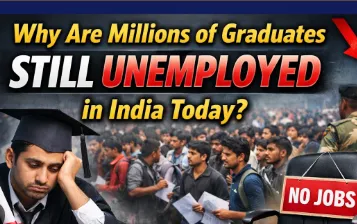


What Happens When a Nation Mass-Producing Degrees Runs Out of Jobs

The CSR Journal Magazine

India is in the middle of a peculiar celebration.

In November 2023, the University Grants Commission (UGC) finalised regulations allowing foreign universities ranked in the global top 500 to set up fully operational branch campuses on Indian soil — the most significant liberalisation of higher education since Independence.

By late 2025, seventeen globally ranked institutions had received formal UGC or IFSCA approval.

Three were already operational: Deakin University and the University of Wollongong in GIFT City, and the University of Southampton. Names like Queen’s University Belfast, Coventry University, the University of Liverpool, and Illinois Tech are scheduled to open between 2026 and 2027.

The national mood, at least in official circles, is triumphant. India is becoming a “global education hub.”

And yet, outside the press conferences, an entirely different India is waiting — 45 million graduate-level workers who cannot find adequate employment, an ILO report calling India’s educated unemployment “a problem that intensified over time,” and a NITI Aayog report that, even as it celebrated internationalisation, quietly noted that for every one international student who comes to India, approximately 28 Indian students leave for education abroad.

The degree factory is running at full capacity. The jobs are not there to match.

India’s higher education system is, by almost any quantitative measure, enormous. There are approximately 45,000 higher educational institutions in the country — more than any other nation on earth. The 18–23 age cohort stands at roughly 155 million people, the largest such demographic in the world. Enrolment has expanded dramatically over the past two decades.

But enrolment and employment are not the same thing, and the gap between them has become a defining crisis of our time.

According to the India Employment Report 2024 published by the International Labour Organisation and the Institute for Human Development, young people (aged 15–29) account for nearly 83% of India’s total unemployed workforce. More troubling still, the proportion of educated youth among those unemployed has nearly doubled in twenty years — from 35.2% in 2000 to 65.7% in 2022. The graduate unemployment rate stood at 29.1%, according to ILO figures — almost nine times higher than the 3.4% unemployment rate among those who cannot read or write.

A Bloomberg analysis of the same data put it bluntly: in India, higher education makes you more likely to be jobless, not less.

Within the graduate category, women fare far worse. They constitute 76.7% of the educated unemployed youth, against 62.2% for men, against the backdrop of one of the lowest female labour force participation rates in the world — approximately 25%. In states like Bihar and Jharkhand, educated unemployment reportedly exceeds 35%.

The IT sector, long the backbone of urban graduate employment, offers no comfort either. India’s leading IT firms cut an estimated 64,000 jobs in FY2024 alone, and average graduate starting salaries remain stagnant at ₹3–4 lakh per annum — a figure that has barely moved in a decade, even as inflation has not. The services sector contributes 54% to India’s GDP but generates fewer than 30% of its jobs. This is the statistical definition of jobless growth: an economy whose headline numbers improve, while its people wait.

In this landscape, the arrival of three foreign universities and a pipeline of fifteen more is, at best, a boutique intervention in a structural crisis.

Before we ask why graduates have no jobs, we must ask what kind of education system produces them — and what kind of regulatory architecture governs it.

India’s higher education is administered through one of the most complex regulatory structures in the democratic world. The University Grants Commission, the All India Council for Technical Education (AICTE), the National Medical Commission (NMC), the Bar Council of India, and the National Assessment and Accreditation Council (NAAC) each exercise jurisdiction over overlapping domains.

A new institution wishing to offer interdisciplinary courses that touch engineering, management, and law may find itself negotiating with three or four of these bodies simultaneously, each with its own timelines, fee structures, committee reviews, and documentation requirements.

NAAC is particularly instructive as a case study in regulatory theatre. Established in 1994 to address deteriorating quality standards, it has accredited roughly 9,000 of India’s 45,000 higher educational institutions — meaning that over 80% of Indian colleges and universities operate without NAAC accreditation. The institutions that do pursue accreditation must navigate a multi-cycle assessment process based on seven parameters, produce Annual Quality Assurance Reports, and demonstrate compliance with dozens of sub-criteria.

Despite all this, the system’s integrity collapsed publicly in February 2025, when the Central Bureau of Investigation arrested the NAAC chairman and six committee members for accepting bribes — cash, gold, laptops, and mobile phones — in exchange for favourable A++ ratings for Andhra Pradesh’s Koneru Lakshmaiah Education Foundation. Raids across 20 locations yielded seizures of ₹37 lakhs in cash and electronic devices. NAAC was forced to suspend KLEF’s accreditation eligibility for five years and initiate reviews of hundreds of recent assessments.

When access to government grants, student enrolment, and institutional prestige is channelled through a single accreditation body whose assessors are paid modest government salaries but hold enormous institutional power, the conditions for rent-seeking are structurally guaranteed. As economist James Buchanan would have recognised immediately, the incentives for regulatory capture and corruption are not aberrations — they are the predictable output of a monopoly bureaucracy insulated from market accountability. The institution mandated to improve quality becomes, instead, a tollbooth on the road to credibility.

For foreign universities entering this environment, the dual regulatory regime — IFSCA rules for GIFT City, UGC rules for mainland campuses — adds another layer. Universities must seek UGC prior approval before admitting a single student or starting any new programme. The Standing Committee has 60 days to respond, and institutions must establish campuses within two years of approval. Yet the compliance burden — FEMA audits, FCRA compliance, documentation on faculty qualifications, fee structures, and infrastructure — remains substantial. The University of Southampton’s achievement of launching its Indian campus in August 2025, just 13 months after its Letter of Intent in July 2024, has been described by analysts as “exceptional rather than typical.”

The irony is profound.

The government imposes such regulatory weight on its own domestic institutions that over 80% cannot meet accreditation standards. It then introduces foreign universities with “special dispensation” and relative autonomy — essentially admitting that the regulatory framework it built is itself the problem.

India sends its best minds abroad and then struggles to attract them back. The numbers from NITI Aayog’s 2025 report on the Internationalisation of Higher Education are striking. India hosted 46,878 inbound international students in 2021–22 while sending 11.59 lakh students abroad — a ratio that widened to approximately 28 outbound for every 1 inbound by 2024. The report states plainly that this “has contributed significantly to brain drain.”

Even as outbound numbers fell in 2024 — from 8.94 lakh in 2023 to 7.60 lakh, a 15% decline driven primarily by tightening visa restrictions in Canada (down 41%), the UK (down 27%), the US (down 13%), and Australia (down 12%) — the decline represents visa restrictions abroad, not a recovery of faith in Indian higher education. Canadian caps on international students, the UK’s near-total ban on dependant visas, and the political turbulence of Trump-era immigration policy in the US have all combined to strand a generation of aspiring students in mid-decision. They are not returning to India out of conviction. Many are simply recalculating which exit remains viable.

Germany and France are picking up this displaced demand. Germany saw a 68% increase in Indian enrolments from 2022 to 2024; France saw a 33% increase. These are destinations with low or no tuition fees, post-study work rights, and Schengen mobility — structural advantages that no amount of GIFT City branding can replicate.

Those who do go abroad and acquire high-quality skills and credentials frequently find that return is economically irrational. A software engineer with a Master’s from a German technical university, offered €60,000 in Frankfurt versus ₹8 lakhs in Bengaluru, faces a decision whose arithmetic is not subtle.

India’s failure to create high-quality, well-compensated formal employment is not merely a labour market failure — it is an active driver of human capital flight that compounds annually.

If the regulatory architecture represents the external failure of Indian higher education, the internal failure lives in the faculty room.

A recurring theme across institutional studies, government reports, and educators’ testimonies is the chronic underpayment of academic faculty in India. The UGC pay scale for an Assistant Professor begins at roughly ₹57,700 per month at a central university — a figure that sounds adequate until it is compared with entry-level corporate salaries for similarly qualified professionals, or with the incomes that the same faculty members could earn tutoring private students or consulting.

At private institutions outside the elite tier, faculty salaries are often far lower, sometimes in the range of ₹20,000–35,000 per month, with no job security and no research support. The NAAC-accreditation barrier that correlates with UGC funding eligibility thus creates a two-tier system: a small number of reasonably funded public universities competing with thousands of private institutions that survive on razor-thin margins by keeping faculty costs minimal and fees high.

Meanwhile, the metrics by which faculty are evaluated increasingly emphasise research publication — specifically, publication in journals recognised by UGC-approved lists, or indexed in SCOPUS and Web of Science. This sounds reasonable in principle. In practice, it has spawned an entire ecosystem of predatory journals, pay-to-publish conferences, and citation-exchange networks that produce enormous volumes of technically published research that contributes little to knowledge and nothing to pedagogy.

A faculty member at a tier-2 institution juggling four courses, 120 students, administrative duties, and the demand to publish two or three peer-reviewed papers a year is not in a position to innovate in the classroom. They are in a position to survive — and survival, in this system, means gaming metrics rather than teaching.

There is also an uncomfortable structural truth here about the governance of many private institutions: management profits while academic quality stagnates. Private universities and deemed universities have proliferated across India under a model in which management trusts extract surplus through high student fees while depressing input costs — including faculty salaries. The regulatory framework, ostensibly designed to prevent exploitation, has in practice been captured by the very managements it is meant to regulate, through a combination of political influence, accreditation lobbying, and, as the NAAC scandal demonstrated, outright bribery.

The sociologist Randall Collins, writing about credential inflation, described educational systems that expand their formal requirements without expanding their substantive content as “credential mills.” India has taken this phenomenon to a structural extreme. A country where it is “a growing trend for many young Indians to attain two or three degrees in the hope of attaining a job” — as Statista’s analysis of Indian labour data noted — is a country where education has been decoupled from employability and recoupled with desperation.

Dronacharya, the supreme teacher of the Mahabharata, is invoked so often in Indian academic discourse that his name adorns a national sports coaching award. But Drona taught through direct, individualised transmission of skill — Arjuna did not sit in a 200-seat lecture hall memorising theory about archery. He held a bow. He practised. He was assessed on what he could actually do. By any honest pedagogical reckoning, a system that produces 29.1% unemployment among its graduates, that relies on rote examination and publication metrics, and that cannot retain its own best teachers, would not qualify Drona — or any other skilled educator — for entry.

India’s higher education crisis is not a puzzle. It is the predictable outcome of a system structured to serve producer interests — regulators, management trusts, accreditation committees — rather than consumer interests, namely students and employers.

The UGC, AICTE, NAAC, and affiliated bodies employ thousands of officials whose institutional incentives are oriented toward expanding their own jurisdictional reach and preserving the complexity that justifies their existence. Simplification — fewer approvals, lighter compliance, genuine autonomy for institutions that meet outcome standards — would reduce the administrative apparatus and with it the power and rent-extraction opportunities of those who run it.

Private management trusts, which now own a majority of India’s higher education institutions, have similarly rational incentives to resist genuine market competition. They operate in a quasi-monopoly environment protected by regulatory barriers to entry and geographic segmentation.

The arrival of 3 foreign universities with fee structures in the range of ₹12–25 lakh per year — comparable to many private Indian universities in major cities — does not fundamentally disrupt this environment. It introduces a small premium segment while leaving the mass market of lower-tier colleges untouched and unreformed.

The students at the bottom of this system — those attending unaccredited colleges in smaller towns, paying ₹50,000–₹1.5 lakh a year for degrees with limited market recognition, graduating into an informal labour market where over half of all graduate workers are employed — have no lobby. They have no seat at the UGC table. They are not the target demographic of GIFT City campuses. They are the collateral damage of a system designed around credential supply

It would be unfair to dismiss the arrival of foreign universities entirely.

For a subset of Indian students — those who can afford fees of ₹12–25 lakh per year, who live near GIFT City or the urban centres where campuses will be located, who seek internationally recognised credentials without the visa uncertainty of studying abroad — the new campuses represent a genuine opportunity. Deakin’s first placement cycle in May 2025 was encouraging: 87.5% of MBA Analytics graduates secured paid internships or job offers within twelve months of enrolment.

But this is a boutique outcome for a boutique programme in a financial services enclave. It speaks to the value of a specific kind of education — industry-aligned, skills-based, internationally credentialled — that India’s domestic system has systematically failed to provide at scale.

The tragedy is that the solution being imported from abroad is precisely what Indian institutions have been structurally prevented from developing at home: flexible curricula, faculty hired on merit rather than bureaucratic qualification lists, programmes designed in consultation with industry, and institutional governance insulated from political interference.

The NEP 2020 articulates many of these principles. It speaks of multidisciplinary education, skill integration, reduced examination rigidity, and faculty autonomy. But a policy document is not a reformed system.

The UGC regulations that govern both domestic institutions and incoming foreign ones remain built around the same input-compliance logic — approvals for new courses, prescribed faculty qualifications, mandated infrastructure — rather than outcome accountability.

What India needs is not more institutions. It has 45,000. It needs a labour market capable of absorbing educated workers into productive, adequately compensated employment — and an education system whose outputs map onto that market rather than onto bureaucratic compliance metrics.

The foreign universities, if they succeed, may demonstrate a proof of concept. They may show that teaching-led, industry-aligned, skill-based education produces employable graduates. They may shame domestic institutions into change by competitive contrast.

But this is a long game, and it depends on political will to allow genuine market pressure to operate — to allow institutions that fail students to lose enrolment and close, rather than survive indefinitely on accreditation certificates obtained through cash and gold.

There is a bitter irony at the centre of this story.

In the country that gave the world the gurukul — a system of education built entirely around apprenticeship, practical skill, and direct transmission of living knowledge — the formal modern university has become an instrument not of emancipation but of disappointed expectation.

66% of India’s unemployed are graduates or postgraduates. Youth unemployment among the educated runs at nearly nine times the rate among the illiterate. Average starting salaries have not moved in a decade. The bodies that certify educational quality have been caught selling their grades. The faculty who are supposed to inspire the next generation are underpaid, publication-pressured, and teaching to examination rubrics rather than to competence. And the students who can escape — to Germany, to France, to wherever the visa will allow — are leaving, and many are not coming back.

Foreign universities are welcome. Their arrival is a net positive, a signal of confidence in India’s demographic potential and market scale. But let us be honest about what they are: a pressure valve, not a solution.

The solution requires asking a harder question than “how do we attract global universities to India?”

It requires asking: “Why does a country with 45,000 colleges and universities produce a generation of educated young people with nowhere to go?”

And then it requires the kind of structural reform — of regulatory architecture, of labour markets, of faculty compensation, of curriculum design — that threatens too many entrenched interests to be politically comfortable.

Views of the author are personal and do not necessarily represent the website’s views.

Dr. Jaimine Vaishnav is a faculty of geopolitics and world economy and other liberal arts subjects, a researcher with publications in SCI and ABDC journals, and an author of 6 books specializing in informal economies, mass media, and street entrepreneurship. With over a decade of experience as an academic and options trader, he is keen on bridging the grassroots business practices with global economic thought. His work emphasizes resilience, innovation, and human action in everyday human life. He can be contacted on jaiminism@hotmail.co.in for further communication.

Long or Short, get news the way you like. No ads. No redirections. Download Newspin and Stay Alert, The CSR Journal Mobile app, for fast, crisp, clean updates!

App Store – https://apps.apple.com/in/app/newspin/id6746449540

Google Play Store – https://play.google.com/store/apps/details?id=com.inventifweb.newspin&pcampaignid=web_share

Latest News

Popular Videos