


Quick Commerce Expands to 477 Cities, Targets Smaller Markets
The CSR Journal Magazine

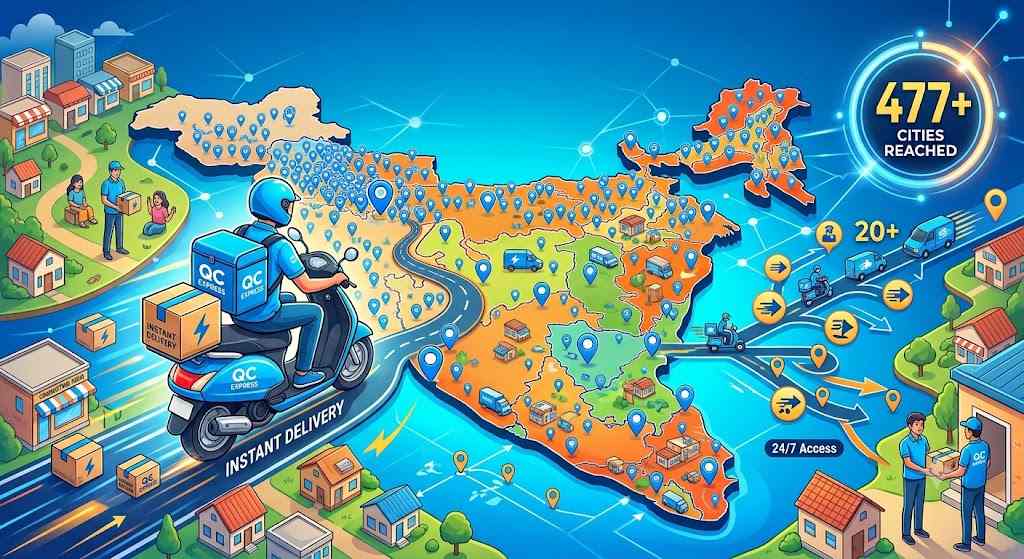
Quick commerce in India is broadening its reach beyond major metropolitan areas, with dark stores now present in 477 cities. This expansion includes both new entrants targeting untapped regions and established companies enhancing their networks in key markets, according to a report from CLSA.

The report emphasizes that the expansion strategy is cautious, especially in newer markets, with smaller networks of dark stores being used to assess local demand and economic viability before scaling operations. Emerging players are focusing on regions currently underpenetrated by existing companies, which may provide them with a potential “first-mover advantage” as quick commerce gains traction outside Tier-1 cities.

CLSA also indicated that established players could benefit from increased consumer awareness developed in these areas, potentially lowering costs associated with category development.

The report outlined notable differences in the networks of major players. In the top 10 cities, there are 3,536 dark stores, not including Amazon and JioMart. Among these, Blinkit has the largest network with 969 stores, followed by Zepto with 828, Flipkart Minutes with 627, Swiggy Instamart with 615, and BigBasket with 497. Blinkit holds approximately 30 percent of dark stores in the top 10 cities and over 34 percent nationally, maintaining the highest store count in six of these markets. Furthermore, Blinkit boasts a strong presence outside the largest cities, operating exclusively in more than 180 locations where other significant quick commerce players do not operate.

In major markets, competition dynamics are changing. CLSA noted that Flipkart Minutes has surpassed Swiggy Instamart in both dark store numbers and pincode coverage within the top 10 cities. Swiggy has been focusing on increasing its network density, recently adding the highest number of dark stores among the top three players.

The report suggests that higher density can enhance delivery speed, broaden product variety, and optimize logistics networks. However, while the top three players have been adding pincodes, overall growth in this area has slowed, indicating that smaller players are increasingly entering underserved locations.

As markets develop, CLSA posits that established companies may scale operations more effectively by leveraging existing consumer awareness and demand, reducing the need for significant investments in category-building. The next phase of competition is expected to depend on not just network size but also the operational efficiency of players in expanding into new markets.

Long or Short, get news the way you like. No ads. No redirections. Download Newspin and Stay Alert, The CSR Journal Mobile app, for fast, crisp, clean updates!

App Store –  https://apps.apple.com/in/app/newspin/id6746449540 

Google Play Store – https://play.google.com/store/apps/details?id=com.inventifweb.newspin&pcampaignid=web_share

Latest News

Popular Videos
