


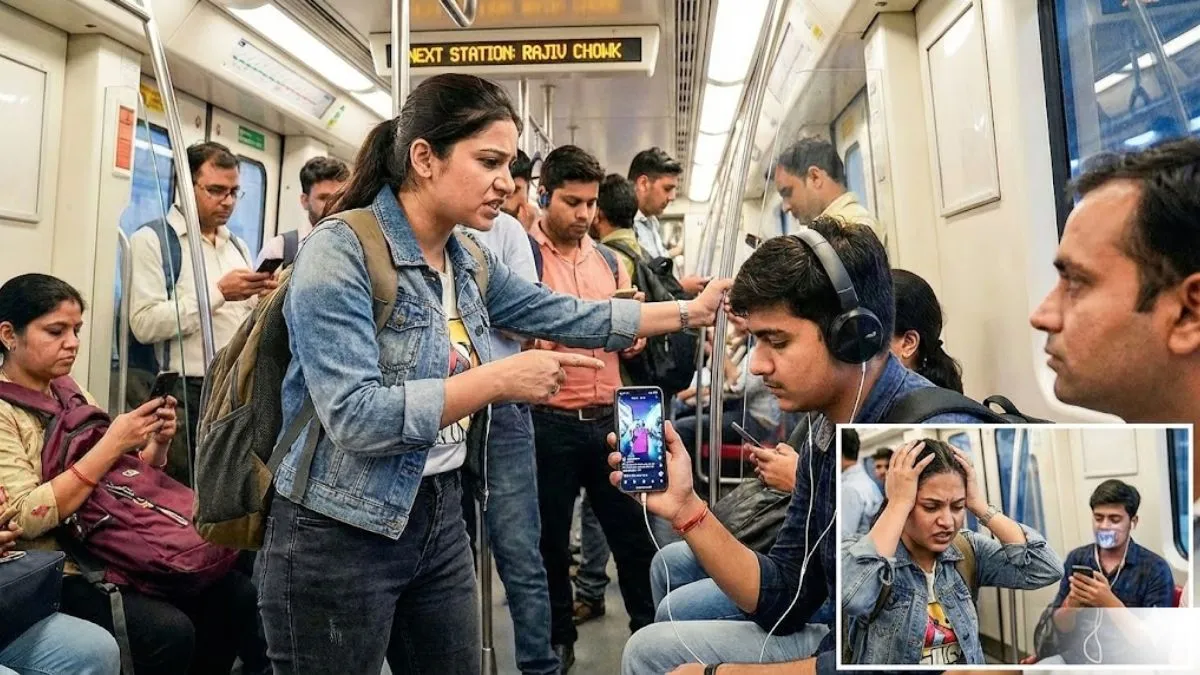


Ask an Indian to Lower the Volume and See the Angry Face

The CSR Journal Magazine

Every morning I step into a Mumbai local with a book in my bag and hope in my heart. The hope usually dies by the second station. Somebody in my compartment unlocks a phone, a reel begins at full volume, and there are no headphones and no embarrassment. The person seems unaware that a hundred and fifty other human beings exist within earshot. I have spent my life reading and teaching for a living, and I now find it nearly impossible to finish one page while travelling in the city I live in.

Let me say clearly that I write this without contempt. Most people who do this are not wicked. They are tired, hardworking, often warm and generous. That is exactly what makes it so frustrating. Kind people are doing an unkind thing and do not even notice.

It is not only the train?

The local is simply the most crowded stage of this play. In my residential locality, the sound arrives before the person does. A man walks down the lane with a video blaring from a phone held flat like a plate. In the garden near my home, a place whose entire purpose is to hear a bird or to hear nothing, a group sits on a bench watching reels on speaker, and the birds lose. I have seen families sit in one living room, 3 people with 3 phones playing 3 different reels aloud at the same time, and nobody minds. I have seen it on flights, where a passenger plays a video aloud inside a sealed metal tube at 35,000 feet, and the crew must walk down the aisle to request earphones.

The same happens in the other Indian cities I have travelled to. Buses, metros, waiting halls, hospital corridors, hotel lobbies. Sound has become something many of us spray in public like perfume, assuming everyone will enjoy the fragrance.

The angry face

Here is what puzzles me most.

When I say, very politely, “Could you please use earphones?”, the reaction is rarely embarrassment. It is a hardened, grim face. Sometimes it is a sneer, sometimes a stare that says, “Your problem, not mine.”

The reply I hear most often is a version of “Then take a taxi.”

Look at what has happened here. The person making the noise is not ashamed of the noise. He is offended by the request. The wrong has been flipped, so the one who imposes is the victim and the one who asks for peace is the aggressor. Since the loud one has company in the compartment and the polite one does not, I have learned to swallow my request more often than I make it. That silence is also part of the problem, and I will come back to it.

What psychology says, in plain words

I have tried to understand this rather than merely complain, and psychology offers several useful ideas.

First, attention and empathy are linked. To feel for others, you must notice them. A person inside a reel is inside a tiny private cinema. His eyes, ears and mind are all occupied, so the crowd around him fades from his awareness. He is not choosing to ignore me. He genuinely has no room left in his head for me.

Second, the reels are built to hook you. The psychologist B. F. Skinner showed decades ago that rewards which arrive unpredictably are the hardest to stop chasing. This is why people pull the lever on a gambling machine repeatedly. Every swipe might bring something funny or shocking or beautiful, and so the thumb keeps moving. A hooked mind loses track of its surroundings, including the volume.

Third, anonymity switches off shame. Psychologists studying crowds, such as Philip Zimbardo, described deindividuation: when we feel like faceless members of a mass, our self-monitoring weakens. In a Mumbai local nobody knows you, so nobody can tell your mother. Shame, which needs an audience that matters to you, does not switch on.

Fourth, there is the ‘bystander effect’ described by Darley and Latané. When many people witness a problem, each one assumes somebody else will act. 90 irritated commuters each wait for another commuter to speak. The silence of the many is then read by the noisy one as approval.

Fifth, the angry face is a defence. Nobody enjoys being told they are wrong in front of strangers. The mind protects a person’s self-image by attacking the messenger, a pattern psychologists call ‘cognitive dissonance’. The request for earphones lands as an insult, not as information.

Sixth, children learn by watching. Albert Bandura showed that behaviour spreads through ‘imitation’. A child who grows up seeing parents play loud videos in waiting rooms and restaurants concludes that this is simply how adults behave.

What sociology says, in plain words

Sociology zooms out from the individual to the society, and here the picture becomes even clearer.

Emile Durkheim wrote about ‘anomie’, a state where old rules have weakened and new rules have not yet formed. India has urbanised at astonishing speed. Millions have moved from villages and small towns to cities like Mumbai within one or two generations. In a village, sound is communal. The temple loudspeaker, the wedding band and the neighbour’s radio belong to everybody, and nobody expects a private acoustic bubble. Those habits travel to the city in the same bag as the clothes. But a crowded local train is not a village square. It needs a different rule, that my noise ends where your ear begins, and that rule has not yet been taught to us.

Erving Goffman described what big-city life quietly depends on, which he called ‘civil inattention’. In a large city, strangers give each other a brief acknowledgement and then politely leave each other alone. We act as if each person carries an invisible bubble of privacy. Playing a reel aloud pops that bubble for everyone nearby.

Pierre Bourdieu spoke of ‘habitus’, the manners we absorb so early that they feel like nature. A family that has lived in one room learns that sound, space and even privacy are shared property. If your childhood home had no closed door, then the idea that a sound can trespass will feel strange to you.

There is also a class angle that I must state honestly. India’s middle- and lower-income groups live in dense chawls, tight flats and crowded lanes. Privacy is scarce, and the phone is often the first private luxury they own. Data in India became among the cheapest in the world after 2016, and a smartphone is in nearly every hand. But manners did not get the same upgrade. A basic pair of wired earphones costs about as much as a modest meal, so money cannot be the reason. It is a habit, and habits must be taught.

Then there is a subtler point, which I offer gently. A person whom the economy, the city and the crowd ignore all day may find in loudness a small proof of his own existence. Sound says, “I am here.” I understand that. But an explanation is not an excuse, and my need for silence is also real.

The sociologist Norbert Elias argued that societies do not become polite by accident. Self-restraint is built slowly, through families, schools and institutions that reward consideration and punish rudeness. We have built phones faster than we have built that machinery.

Festivals, where the volume knob is a sacred right

If reels in trains are a small nuisance, festivals are the grand opera. Ganeshotsav, Navratri, Dahi Handi, weddings, Azan prayers, processions, jagrans: speakers are stacked like walls, DJs compete, and the music continues after midnight. India’s Noise Pollution Rules set limits of 55 decibels by day and 45 decibels at night for residential areas. Courts have repeatedly reminded organisers of this. Yet compliance is treated as optional, and a complaint is treated as an insult to faith.

I say this as someone who respects religion and celebration. Durkheim described ‘collective effervescence’, the joyful energy that groups feel when they gather and move together in ritual. It is real and it is beautiful. But it becomes selfish when the circle of joy ignores everyone outside it: the newborn, the old man with a heart condition, the student preparing for board exams, the patient in the hospital next door. I have never come across a scripture that says the divine can be heard only above 100 decibels.

The tragedy of the commons, Indian edition

In 1968 the ecologist Garrett Hardin described a shared pasture. Every herder gains fully from adding one more cow, but the cost of overgrazing is shared by all. So, every herder adds another cow, and the pasture dies.

A quiet train compartment is exactly such a pasture. Lets’ say, when I play a reel aloud, I get 101% of the pleasure and pay none of the cost. The cost is divided among a hundred and fifty strangers. Economists call this an externality; a cost pushed onto people who never agreed to pay it. A healthy society works by ‘internalising the externality’, which means making the person who creates the cost feel it, through conscience, shame, or a fine. India has become extraordinarily skilled at the opposite. We externalise noise, horn, garbage thrown from car windows, spit on the wall, dust from construction. The benefit stays private and the bill goes public.

Behind this I see 3 missing things. One is civic sense, the awareness that we live inside a public and not only inside a family. Another is empathy, the ability to feel another person’s discomfort as real. The third, and the one that hurts most, is common sense. In a compartment where five people play reels together, nobody hears anything clearly, including the five players. Everyone loses. It is a bad bargain even by selfish logic.

What Japan quietly teaches?

We are proud, and I am proud too, that India’s economy has passed Japan in size and is now the fourth largest by nominal GDP by most estimates. It also grows several times faster, around six to seven percent a year against Japan’s one or so. But look at income per person. Japan is still roughly ten times richer per head. And my larger point is that GDP is not civilisation. A country can win the race of growth and still lose the race of manners.

In Japan, trains carry announcements asking passengers to keep phones on silent mode and to keep earphone volume low, so others are not disturbed. Phone calls in trains are discouraged, and the compartments are so quiet that many people simply read books. School children clean their own classrooms and corridors, so they grow up respecting a space because they have cleaned it themselves. Public dustbins are few, and yet the streets are clean because people carry their rubbish home. During the 2022 football World Cup, Japanese fans were praised worldwide for cleaning the stands after matches.

Behind this stands an idea, ‘meiwaku’, roughly translated as the trouble you cause to others. A Japanese child learns very early that causing inconvenience to strangers is a moral failing and not a private matter. In other words, Japan has taught its people to internalise the externality. It has made the cost visible to the one who creates it.

What we can do, and what I am tired of

First, teach civic behaviour in schools through practice: cleaning, queueing, silence in shared spaces. It should not remain a forgotten chapter in a textbook.

Second, enforce the rules that already exist on paper, on noise, on public transport and on festivals, evenly and without fear of any group.

Third, transport authorities and airlines should announce the earphone rule and back it up.

Fourth, we who are disturbed must stop suffering silently. A polite, firm sentence, repeated by many people, changes what a compartment considers normal.

And to those who glare back when asked, I say this with respect: the request is not an attack on you. It is an invitation to be part of a society. Your reel will still be there, just a little quieter.

I would like to open my book tomorrow morning and reach the end of a page. That is a small dream for a country that wants to be a superpower. But a nation is measured not only by the size of its economy. It is also measured by how it behaves in a crowded room.

Views of the author are personal and do not necessarily represent the website’s views.

Dr. Jaimine Vaishnav is a faculty of geopolitics and world economy and other liberal arts subjects, a researcher with publications in SCI and ABDC journals, and an author of 6 books specializing in informal economies, mass media, and street entrepreneurship. With over a decade of experience as an academic and options trader, he is keen on bridging the grassroots business practices with global economic thought. His work emphasizes resilience, innovation, and human action in everyday human life. He can be contacted on jaiminism@hotmail.co.in for further communication.

Long or Short, get news the way you like. No ads. No redirections. Download Newspin and Stay Alert, The CSR Journal Mobile app, for fast, crisp, clean updates!

App Store –  https://apps.apple.com/in/app/newspin/id6746449540 

Google Play Store – https://play.google.com/store/apps/details?id=com.inventifweb.newspin&pcampaignid=web_share

Latest News

Popular Videos