


NASA’s Supersonic X-59 Achieves Key Speed and Altitude Target to Reduce Sonic Boom
The CSR Journal Magazine

NASA’s recent milestone with the X-59 aircraft marks a potential shift in aviation regulations that have restricted supersonic flight over land for decades. The central issue behind the ban, which was implemented globally by 1973, is the intense noise generated by sonic booms. When an aircraft exceeds the speed of sound, the immense shockwave produced can create noise levels that rattle windows, disturb entire neighbourhoods, and prompt significant public complaints.

The sonic boom occurs when an aircraft travels faster than the sound waves it generates. This results in a rapid build-up of pressure waves that combine into a singular, forceful shockwave. When this shockwave reaches the ground, it produces sound levels exceeding 100 perceived noise decibels, comparable to that of a pneumatic drill, thus making it an alarming experience for those on the ground.

With its innovative approach, NASA aims to resolve the issues surrounding sonic booms while paving the way for future supersonic travel over land. The recent achievements of the X-59 provide hope that these restrictions may soon be lifted.

Understanding the Mechanisms of Sonic Booms

The physics behind sonic booms involves the behaviour of sound waves in relation to an aircraft’s speed. When a plane travels slower than sound, it sends pressure waves outwards which have time to dissipate without causing disturbance. However, as speeds increase beyond the sound barrier, the aircraft outruns these waves, which results in an accumulation of air pressure ahead of it.

This pressure builds up, forming a shockwave that eventually manifests as the audible sonic boom when it reaches the ground. The loudness of this phenomenon is a significant factor that has led to numerous restrictions on supersonic flights, particularly over populated areas.

NASA’s X-59 intends to diminish this issue through design innovations that separate these pressure waves, potentially allowing for quieter supersonic travel. This may change the landscape of aviation and enable faster flights across land without the disruptive noise associated with traditional supersonic jets.

X-59’s Design Innovations and Testing Milestones

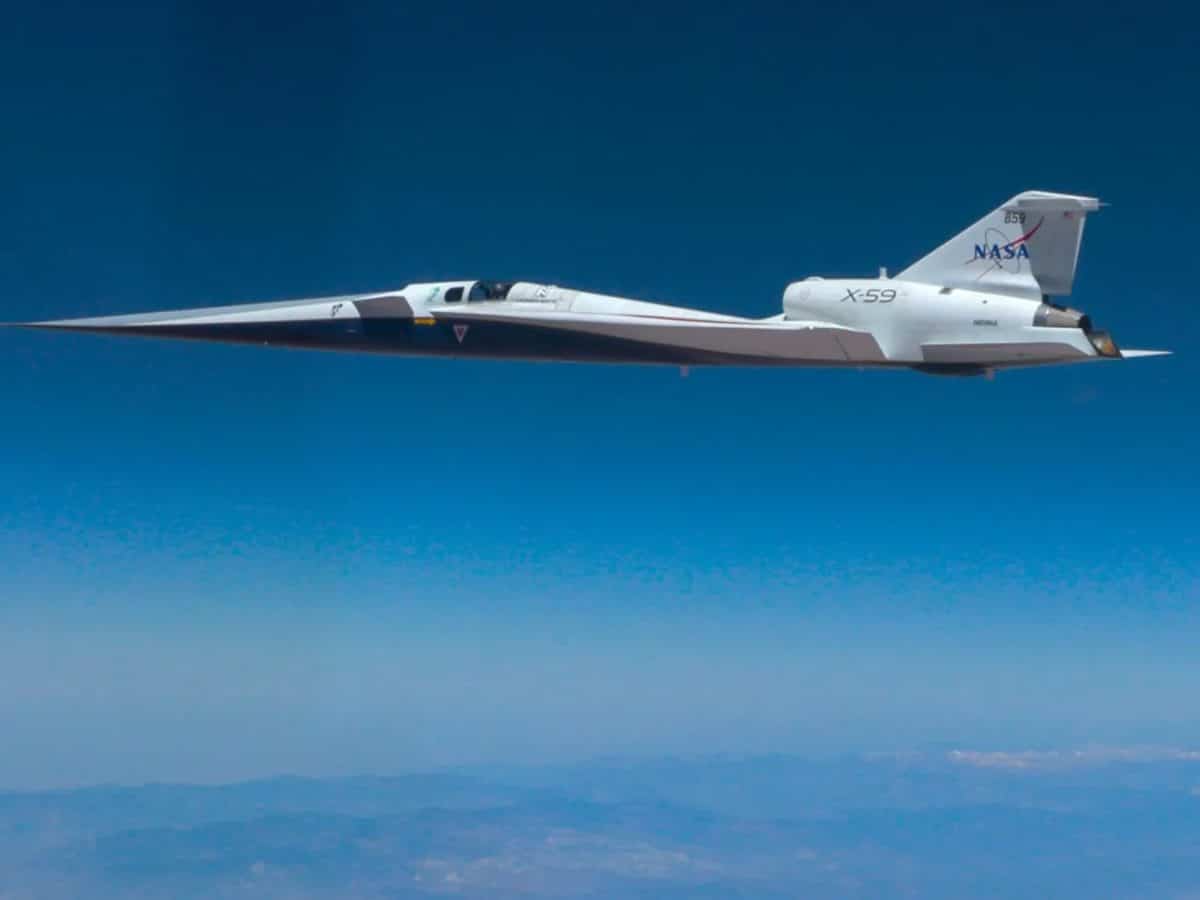
The X-59, manufactured by Lockheed Martin, features a distinctive design characterised by its long, slender fuselage and an elongated nose. At 99.7 feet in length and 29.5 feet in width, its design results in a significant physical separation of pressure waves. This allows the aircraft to travel at supersonic speeds while preventing the merging of these waves into a loud sonic boom.

On June 5, 2026, the X-59 successfully surpassed the sound barrier for the first time, achieving a speed of Mach 1.1 at an altitude of 43,400 feet. A week later, on June 12, it reached its designated mission conditions, flying at Mach 1.4 at 55,000 feet. This altitude and speed represent the operational parameters it will utilise during flights over populated areas.

Following completion of performance testing, NASA plans to conduct flights of the X-59 over selected communities across the United States. This phase will involve acoustic measurements using ground microphone arrays and surveys to gather feedback from residents regarding their perception of the noise generated by the aircraft.

The information gathered from these tests will be crucial for aviation regulators as they consider the possibility of amending or lifting the longstanding ban on commercial supersonic flight over land, potentially ushering in a new era of aviation.

Long or Short, get news the way you like. No ads. No redirections. Download Newspin and Stay Alert, The CSR Journal Mobile app, for fast, crisp, clean updates!

App Store –  https://apps.apple.com/in/app/newspin/id6746449540 

Google Play Store – https://play.google.com/store/apps/details?id=com.inventifweb.newspin&pcampaignid=web_share

Latest News

Popular Videos
