


J&K Assembly Disrupted as National Conference Protests Erupt Over Ali Khamenei’s Death
The CSR Journal Magazine

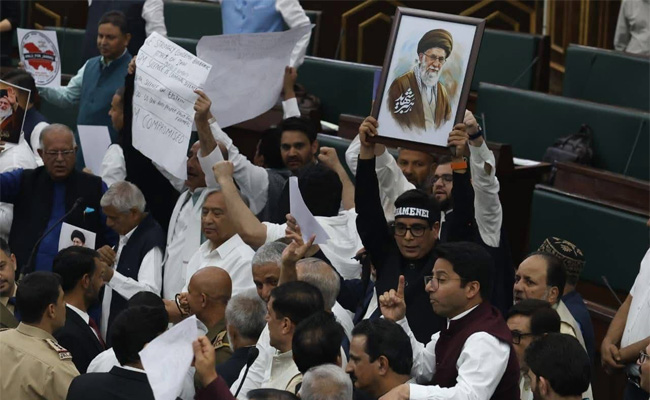
Jammu and Kashmir Assembly witnessed significant disruption as members of the National Conference (NC) protested the recent killing of Iran’s former Supreme Leader, Ayatollah Ali Khamenei. The demonstration was in conjunction with the ongoing military actions by the United States and Israel in Iran. Video footage from inside the Assembly depicted NC legislators engaged in uproarious activities, including chanting slogans and displaying posters and images of Khamenei, which incited a strong backlash from Bharatiya Janata Party (BJP) members.

The situation deteriorated rapidly, leading to a physical altercation between Congress MLA Irfan Hafiz Lone and BJP MLA Yudvir Sethi. Other political parties, such as the Congress, the Communist Party of India (Marxist), Independents, and the opposition People’s Democratic Party (PDP), also joined the National Conference in vociferously protesting against Israel. This collective action led to a disruption of proceedings during the Question Hour, despite multiple requests from Speaker Abdul Rahim Rather to maintain decorum.

As tensions escalated within the Assembly, police personnel were deployed to calm the situation. Following these events, the House was adjourned for a brief period of thirty minutes shortly after the budget session continued, having resumed following a five-week recess. The current session, which began in Jammu on March 27 after its first phase from February 2 to 20, is slated to conclude on April 4.

Statements from National Conference Leadership

In a statement to journalists, NC MLA Tanvir Sadiq emphasized the party’s solidarity with Iran. He remarked, “We stand in solidarity with Iran. The entire National Conference and the J&K government are with them. Just as Chief Minister Omar Abdullah had earlier condemned the killing of Ayatollah Ali Khamenei in civil society, we are reiterating that stand today.” Sadiq further stated that the manner in which Khamenei was killed is intolerable, asserting that no country has the right to launch an attack on another.

Furthermore, Chief Minister Omar Abdullah condemned what he termed an “unjust and illegal war imposed on Iran.” Abdullah expressed his condolences for the lives lost in the conflict, including that of Khamenei, and called upon Prime Minister Narendra Modi to utilize diplomatic means to help bring an end to the war, suggesting that it would be in the interest of humanity. He stated, “On behalf of myself and my colleagues, I strongly condemn this unjust and illegal war imposed on Iran. I express my deepest condolences over the loss of Ayatollah Ali Khamenei and others who have died in this conflict.”

Context of the Ongoing Conflict

The protests in the Jammu and Kashmir Assembly unfolded against the backdrop of an escalating conflict involving Iran, the United States, and Israel, which began on February 28. Recent US-Israeli strikes have resulted in the death of Khamenei and other prominent military and clerical figures. In retaliation, Tehran has targeted US bases in the Gulf, leading to increased instability in the region and interruptions in flight operations.

Despite efforts from US President Donald Trump advocating for a ceasefire, there are rising concerns about a possible US ground invasion amidst a significant military buildup. Iran has categorically rejected ceasefire proposals from the United States, insisting hostilities will continue until US and Israeli strikes cease. The ongoing conflict has also impacted global trade, notably through the Strait of Hormuz, a crucial oil transit route, with Iran tightening controls and targeting vessels linked to the US or Israel. However, select nations, including India, have been granted limited passage for oil shipments in this tense climate.

In the face of growing tensions, the United States has proposed a 15-point ceasefire framework while concurrently sending thousands of additional troops to the area, signaling potential preparations for military action aimed at securing the strategic waterway. Iran has dismissed the proposal and outlined its own five-point plan, which includes demands for reparations and recognition of its sovereignty over the Strait of Hormuz.

Long or Short, get news the way you like. No ads. No redirections. Download Newspin and Stay Alert, The CSR Journal Mobile app, for fast, crisp, clean updates!

App Store –  https://apps.apple.com/in/app/newspin/id6746449540 

Google Play Store – https://play.google.com/store/apps/details?id=com.inventifweb.newspin&pcampaignid=web_share

Latest News

Popular Videos
