




The Audit We Promise After Every Building Falls Down

The CSR Journal Magazine

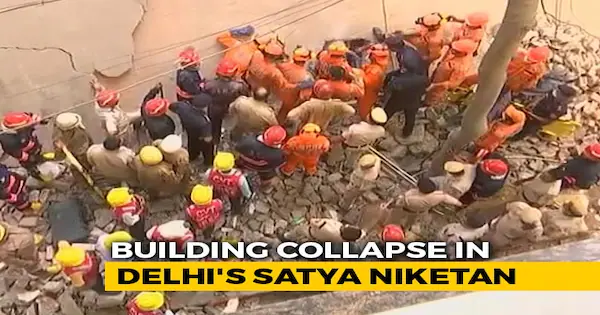
A five-storey building in Satya Niketan fell on a Sunday afternoon. It had been under renovation for months, reopened to tenants in August 2026 with the work still unfinished, and stood on a basement reportedly weakened by water accumulation. As of this writing, 7 people are confirmed dead and more were pulled out of the debris. The owner has been arrested. A magisterial inquiry has been ordered. A minister has promised a new policy requiring periodic structural audits for buildings used by the public.

I have read this paragraph before. I will read it again.

For the next 72 hours, this will be the only story that matters. Primetime anchors will stand in front of the rubble with grave faces. Opposition leaders will demand the Prime Minister answer for “educational infrastructure.” Twitter, or whatever we are calling it this year, will fill with outrage, hashtags, and demands for accountability. Then the news cycle will move on, as it always does, to the next controversy, the next celebrity scandal, the next election rally. The rubble will be cleared. The audit promise will quietly join the queue of audit promises made after the last collapse, and the one before that, and the one before that.

This is not cynicism for its own sake. It is a pattern, and patterns deserve to be named.

The Numbers We Have Already Forgotten

Structural collapses killed roughly 8,756 people in India between 2018 and 2022, an average of about 5 deaths every single day, year after year, without pause. Uttar Pradesh recorded around 1,696 such deaths in that period and Maharashtra around 1,491. Delhi alone lost 133 lives to building collapses in those five years, well before Satya Niketan added its own count.

None of this is new to Delhi specifically. In 2010, a five-storey building in Lalita Park collapsed and killed 65 people, mostly migrant families crammed into one room flats, in a structure that had reportedly added an unauthorised sixth floor shortly before it came down.

In July 2025, a four-storey building fell in Seelampur and killed the owner, his wife, both sons, and two others. Just weeks before that, another old structure came down in northeast Delhi. In Mumbai, a fifty-year-old building in Kurla collapsed in 2022 and took nineteen lives, a building that residents say had been visibly unsafe for years.

Each of these events produced the same headlines, the same visits by ministers, the same promises of audits and accountability, and the same quiet forgetting once the television crews packed up. If patterns this consistent do not qualify as policy, I am not sure what does.

Why We Keep Choosing This?

It would be comforting to blame this entirely on corrupt builders or negligent municipal engineers, and they certainly deserve their share of blame. But comfort is not the same as accuracy, and the deeper explanation lies in something more structural: the incentives that shape how democracies like our function, day to day, between elections.

Public choice theory, in economics, offers an unflattering but honest lens here. It treats politicians, bureaucrats, and voters not as saints performing civic duty but as ordinary people responding rationally to the incentives placed in front of them. A structural audit regime is a diffuse good. Its benefits are spread thinly across millions of tenants and building occupants who will never know a disaster was prevented, because prevented disasters do not make headlines. Its costs, on the other hand, are concentrated and immediate: inspection fees, compliance delays, and the discomfort of confronting powerful landlords, many of whom are themselves connected to local political networks.

When benefits are diffuse and costs are concentrated, the concentrated interest almost always wins the lobbying contest, quietly, in municipal offices where no camera is present.

Add to this what economists call rational ignorance. The average citizen has finite time and attention and correctly judging that their individual vote or individual complaint to the municipal corporation is unlikely to change outcomes, they rationally choose not to invest deeply in monitoring building safety codes or fire NOCs or basement construction permits. We reserve our attention instead for the news cycle’s chosen outrage of the week, because that costs us nothing and feels like participation. This is not a moral failing of the individual citizen so much as a predictable response to a system that punishes sustained civic effort with fatigue and no visible reward.

Then there is the political time horizon problem. Elected officials operate on cycles of roughly five years, sometimes less if state elections intervene. A structural audit mandate that prevents a collapse a decade from now offers no ribbon to cut, no photograph to release, no credit claim before the next ballot. A flyover, a stadium, a free scheme with cash transferred directly before polling day, these produce visible, creditable, immediate returns. Public choice theory, in economics, calls this the problem of concentrated political payoff versus dispersed and delayed public benefit, and it explains with uncomfortable precision why India keeps building flashy metro stations while decades old buildings, sitting one monsoon away from collapse, receive no attention until they fall.

Regulatory capture compounds all of this. The very inspectors and municipal bodies tasked with auditing buildings often depend on the goodwill, and sometimes the informal payments, of the property owners they are meant to police. This is not unique to India, but our scale and our density of unregulated construction make the consequences unusually lethal.

The Taxes We Pay for This

We are not a low tax nation pretending to demand high income services. Indians pay income tax, GST on nearly everything they purchase, property tax, and a long list of cesses labelled for education, health, and infrastructure. In return, a hostel that had been reopened with renovation work still incomplete was allowed to house students in August, and it collapsed in September.

The social contract implicit in taxation, that citizens fund the state and the state protects them in turn, keeps being tested and keeps failing the test quietly enough that no one is forced to answer for it.

What Would Actually Change Things?

Public choice theory is not merely a diagnosis of despair. It also tells us that incentives can be redesigned. Independent, third-party structural audit bodies with public liability insurance, rather than municipal inspectors embedded in the very patronage networks they are meant to regulate, would help. Mandatory public disclosure of a building’s audit history, visible to every prospective tenant before they sign a lease, would create market pressure where regulatory pressure has failed. Class action liability for landlords and municipal officials alike, with penalties large enough to change the cost benefit calculation of skipping an audit, would matter more than another ministerial visit to a rubble pile.

None of this is exotic. Versions of it already exist in other democracies that also once struggled with unsafe construction. What is missing in India is not the knowledge of what works. It is the sustained public demand that outlasts a single news cycle, and the political incentive structure that would make responding to that demand rational for those in power.

Until those changes, I expect to write some version of this piece again. Perhaps not this year. Perhaps not from Delhi. But somewhere, another old building, another basement weakened by water, another set of tenants who paid their taxes and trusted their government, and another few days of outrage before the news moves on.

Another day. Another collapse. Same country, same choices, same result.

Views of the author are personal and do not necessarily represent the website’s views.

Dr. Jaimine Vaishnav is a faculty of geopolitics and world economy and other liberal arts subjects, a researcher with publications in SCI and ABDC journals, and an author of 6 books specializing in informal economies, mass media, and street entrepreneurship. With over a decade of experience as an academic and options trader, he is keen on bridging the grassroots business practices with global economic thought. His work emphasizes resilience, innovation, and human action in everyday human life. He can be contacted on jaiminism@hotmail.co.in for further communication.

Long or Short, get news the way you like. No ads. No redirections. Download Newspin and Stay Alert, The CSR Journal Mobile app, for fast, crisp, clean updates!

App Store –  https://apps.apple.com/in/app/newspin/id6746449540 

Google Play Store – https://play.google.com/store/apps/details?id=com.inventifweb.newspin&pcampaignid=web_share

Latest News

Popular Videos