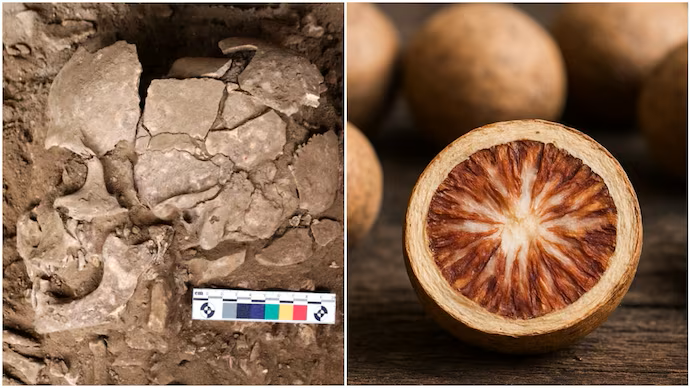
Recent findings suggest that humanity may have engaged with psychoactive substances far earlier than previously acknowledged. Researchers from Griffith University, in collaboration with Indonesian archaeologists, discovered that hunter-gatherers in Sulawesi were using betel nuts to achieve a mild “high” as long as 25,000 years ago, predating the advent of agriculture by millennia. This research, published in the journal Science Advances, may represent the earliest documented instance of habitual drug use.
The study analysed the remains of two early foragers from the region; one dated between 25,000 and 16,000 years ago, and the other from 7,600 to 6,300 years ago. Both individuals exhibited unique patterns of deep, rounded grooves on their teeth, which researchers identified as typical for someone repeatedly sucking on whole betel nuts. Additionally, a chemical analysis conducted on their dental tissues revealed the presence of arecoline, the primary psychoactive component found in betel nuts.
Further experiments demonstrated that sucking on an intact betel nut releases sufficient quantities of arecoline to induce effects on the brain, indicating that ancient humans may have sought out this experience intentionally. Professor Adam Brumm highlighted the significance of these findings, stating that the act of consuming betel nuts could have been a considerable influence on early brain function.
The Origins of Psychoactive Substance Use
Today, betel nut continues to be a prevalent substance across various regions in Asia and the Pacific, known for its ability to produce mild euphoria and enhanced alertness in users. The modern application typically involves chewing the processed seed of the Areca catechu palm combined with slaked lime and other ingredients, which accelerates the release of psychoactive compounds. Despite its relatively low profile in western cultures, Professor Brumm noted that betel nut ranks as the world’s fourth most consumed psychoactive substance, following alcohol, caffeine, and nicotine.
This latest discovery extends the timeline of betel nut usage well beyond the established periods associated with agriculture. Previous assertions suggested that widespread psychoactive drug traditions developed only after farming methods were introduced, noting several early examples of fermented beverages dating back to approximately 13,000 years ago. The current findings challenge this theory, positing that the roots of popular psychoactive substances may trace back much further.
Researchers also speculate that the habitual consumption of betel nuts could have provided ancient humans with pain relief. Arecoline is known to have analgesic properties, and given the typically poor dental health of ancient foragers, the act of sucking on betel nuts may have helped alleviate toothache. However, continual use led to significant wear on the teeth, potentially exposing the inner pulp and raising the likelihood of chronic infections.
Significance of the Findings
Professor Brumm emphasized the importance of these findings in reconsidering the timeline of drug use, stating that evidence of betel nut consumption emerged around 25,000 years ago in Sulawesi, long before agriculture’s rise. This suggests that betel nut-sucking might represent the oldest evidence of drug use globally. The study opens avenues for further investigation into the social and cultural implications of drug use among early human populations and highlights how such practices might have influenced their daily lives.
Continuing research into ancient practices like these could provide a clearer understanding of human development and social interactions in prehistoric times, enriching narratives about early human lifestyles. As researchers delve deeper into this field, more discoveries may emerge, shedding light on the complex relationship between early humans and their environment, especially concerning their use of natural substances for various purposes.
Long or Short, get news the way you like. No ads. No redirections. Download Newspin and Stay Alert, The CSR Journal Mobile app, for fast, crisp, clean updates!