


Indian Navy To Commission Three Indigenous Vessels This Week
The CSR Journal Magazine

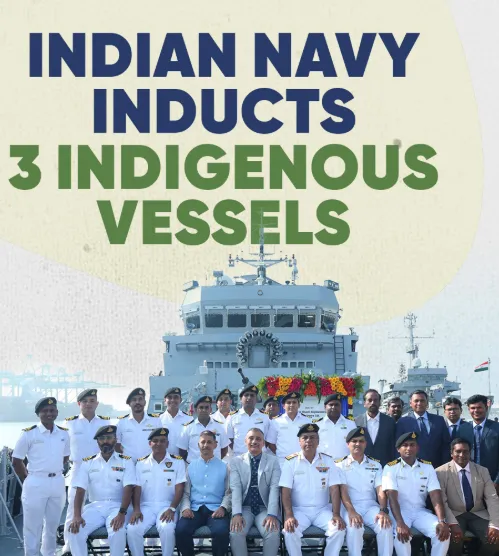
The Indian Navy is poised to induct three indigenous vessels in Kolkata during a ceremony scheduled for this week. This occasion is notable as it marks one of the rare instances where multiple frontline naval platforms are entering service concurrently. Sources indicate that the commissioning ceremony will take place shortly, potentially coinciding with Prime Minister Narendra Modi’s visit to the city on June 21.

Details of the Vessels Being Inducted

The three vessels set to join the Indian Navy’s fleet include the stealth frigate INS Dunagiri, the anti-submarine warfare shallow water craft INS Agray, and the survey ship INS Sanshodhak. Collectively, these vessels enhance the Navy’s capabilities in surface combat, underwater warfare, and maritime domain awareness.

INS Dunagiri is the fifth ship in the Project-17A stealth frigate series and the second to be constructed by Garden Reach Shipbuilders and Engineers (GRSE). Once commissioned, it will rank among the Navy’s most advanced warships, featuring BrahMos supersonic cruise missiles, cutting-edge air-defence systems, and anti-submarine weaponry. Its design allows it to undertake a comprehensive range of combat missions across blue-water environments.

Meanwhile, INS Agray, part of the Arnala-class Anti-Submarine Warfare Shallow Water Craft project, is aimed at enhancing the Navy’s capacity to detect and neutralise underwater threats in coastal areas and shallow waters. This vessel is equipped with state-of-the-art sonar systems, lightweight torpedoes, and locally manufactured anti-submarine rocket launchers, bolstering surveillance capabilities for India’s extensive coastline and essential maritime infrastructure.

Completing this trio is INS Sanshodhak, the last ship in the Survey Vessel (Large) programme. It comes fitted with advanced hydrographic survey tools, autonomous underwater vehicles, and remotely operated systems geared towards seabed mapping, navigational charting, and gathering oceanographic data. Such capabilities are increasingly recognised as vital for both military operations and civilian maritime initiatives.

Significance for Indigenous Shipbuilding

The simultaneous commissioning of these vessels highlights the Navy’s commitment to swiftly bringing indigenous shipbuilding projects into operational readiness. This event also underscores the expanding role of Indian shipyards in advancing defence modernisation, aligning with the government’s initiative to promote self-reliance in defence manufacturing.

This will mark the second significant occasion within recent years where three frontline naval platforms are inducted simultaneously; a similar event took place in January 2025, when a destroyer, a frigate, and a submarine were incorporated into the Mumbai fleet. The current inductions are anticipated to further bolster the Navy’s capabilities in securing crucial sea lanes and executing anti-submarine operations.

At a time when security dynamics in West Asia and the broader Indo-Pacific region are evolving, the enhancements brought by these vessels are expected to contribute significantly to India’s strategic posture. The Indian Navy’s growing operational presence in the Indian Ocean Region remains critical amid mounting security challenges, including increased submarine activity by external powers.

Long or Short, get news the way you like. No ads. No redirections. Download Newspin and Stay Alert, The CSR Journal Mobile app, for fast, crisp, clean updates!

App Store –  https://apps.apple.com/in/app/newspin/id6746449540 

Google Play Store – https://play.google.com/store/apps/details?id=com.inventifweb.newspin&pcampaignid=web_share

Latest News

Popular Videos
