


Women’s Representation in Indian Politics Before 33% Quota Implementation
The CSR Journal Magazine

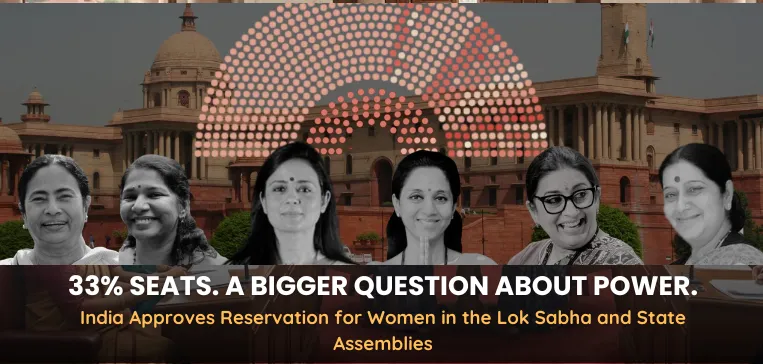
The impending implementation of the Nari Shakti Vandan Adhiniyam highlights the state of women in Indian politics. Although women’s involvement in education and the workforce has seen a positive trajectory, their representation in political spheres remains disproportionately low. The recently passed law, which proposes a 33 per cent reservation for women in the Lok Sabha and state assemblies, is poised for amendment during an upcoming three-day Parliamentary session.

As part of this legislative adjustment, the Lok Sabha is expected to expand to 816 seats, with 273 specifically reserved for female representatives. This move is aimed at addressing the gender disparity prevalent within the legislative framework of the country.

Grassroots Representation of Women

According to data from the Ministry of Statistics and Programme Implementation, women display significant participation in Panchayati Raj institutions, with several states recording over 50 per cent representation. Uttarakhand currently leads with 56 per cent, followed closely by Andhra Pradesh and Chhattisgarh. However, other states like Uttar Pradesh, Punjab, and Ladakh are observed to have considerably lower levels of female representation in local governance.

On average, women occupy approximately 46.6 per cent of seats in these local bodies, suggesting that grassroots representation is more favourable compared to higher legislative bodies. The contrast emphasises the layered nature of political representation across different levels of governance in India.

Despite these advances at the local level, the scarcity of women in wider political roles continues to be a pressing issue. Thus, while progress has been made within local government settings, a substantial gap persists in higher political institutions.

Disparity in Higher Political Representation

The representation of women at the Lok Sabha and state assembly levels reflects a notable gap in equality. A report by the Association for Democratic Reforms and National Election Watch indicates that out of approximately 51,000 candidates who contested elections for Lok Sabha and State Assembly seats, merely about 10 per cent, or 5,095, were women. Among the total number of 4,666 Members of Parliament (MPs) and Members of Legislative Assemblies (MLAs), only 464 are women, representing just 10 per cent of these roles.

In the forthcoming 2024 Lok Sabha elections, women constituted only 9.6 per cent of candidates, totalling 800 out of 8,360. Alarmingly, nearly 28 per cent of constituencies were devoid of any female candidates. Constituencies like Baramati, Secunderabad, and Warangal showed a more considerable presence of women candidates, though these instances remain exceptions.

Among the major political parties, the Bharatiya Janata Party (BJP) registered the highest percentage of female candidates at 16 per cent, followed by the Indian National Congress and the Communist Party of India (Marxist), each at 13 per cent. The Bahujan Samaj Party accounted for eight per cent of female candidates. This data indicates a persistent trend of low female representation across party lines, further complicating women’s journey in higher political positions.

When examining Assembly elections from 2021 to 2025, the scenario remains similarly discouraging. Of 43,348 candidates, only 4,295, or around 10 per cent, were women, with 41 per cent of constituencies not featuring any female candidates at all. No state or Union Territory reported more than 15 per cent representation of women candidates, illustrating the systemic barriers that continue to undermine women’s political engagement in India.

Analysis of Women’s MPs in Lok Sabha

Overall, women’s presence in the Lok Sabha has gradually increased but remains low compared to global standards. From a mere 5.46 per cent in 1957, women’s representation rose to 13.6 per cent by 2024. This growth trajectory, however, remains inconsistent.

Internationally, countries such as Rwanda have made significant strides in ensuring greater female representation in parliament, with women occupying around 64 per cent of seats. Other nations like Cuba and Nicaragua also demonstrate robust involvement of women in legislative roles, with women holding over half of the parliamentary positions. This global comparison serves to contextualise India’s ongoing struggle in achieving gender parity within its political system.

Long or Short, get news the way you like. No ads. No redirections. Download Newspin and Stay Alert, The CSR Journal Mobile app, for fast, crisp, clean updates!

App Store –  https://apps.apple.com/in/app/newspin/id6746449540 

Google Play Store – https://play.google.com/store/apps/details?id=com.inventifweb.newspin&pcampaignid=web_share

Latest News

Popular Videos
