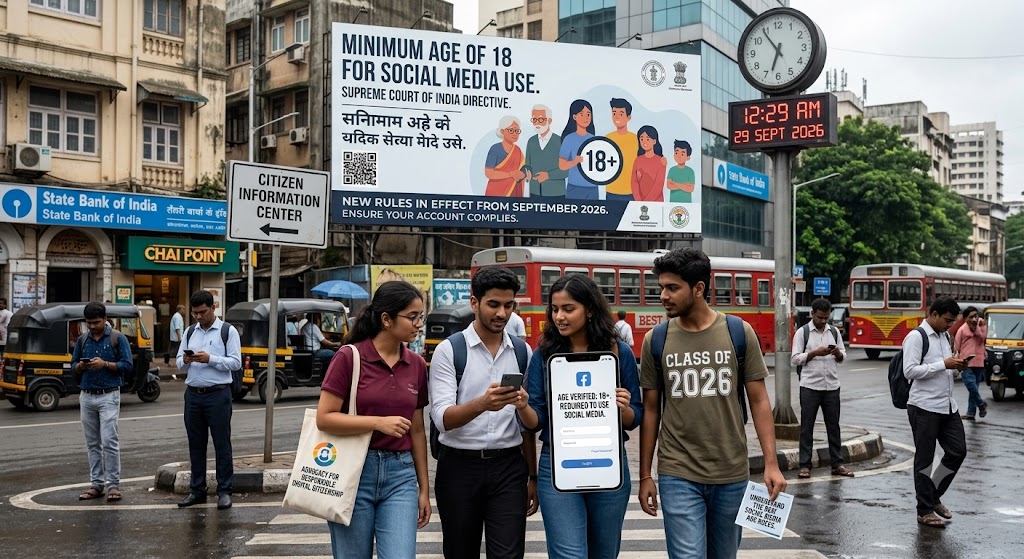
The Supreme Court has urged the Centre to evaluate the implementation of statutory rules that would enforce an age limit of 18 years for social media accounts. This call to action was made on September 25, during a hearing related to a petition filed by the Just Rights for Children Alliance (JRCA), which advocates for the protection of minors on digital platforms. The bench, led by Chief Justice Surya Kant, along with Justices Joymalya Bagchi and V Mohana, asserted that legal protections for minors should extend to social media platforms.
Concerns Raised Over Minors’ Access to Social Media
The JRCA’s petition raises significant concerns regarding the ability of minors to create and maintain social media accounts, a practice that contradicts their legal incapacity to enter into binding contracts. During the proceedings, Justice Bagchi emphasised that the standards should not remain as mere guidelines but must be formalised into statutory obligations. Solicitor General Tushar Mehta acknowledged the concerns raised and stated that the government would evaluate potential actions in line with existing laws.
Justice Bagchi highlighted the need for social media platforms to comply with Indian laws, suggesting that their software must be tailored to meet these legal requirements. The Solicitor General indicated that the issue would be reviewed further, referencing Section 79 of the Information Technology Act, which pertains to intermediary responsibilities concerning online content.
Moreover, senior advocate HS Phoolka, representing the JRCA, pointed out that the Digital Personal Data Protection Act, 2023, while addressing data privacy, will not take effect until 2027. He argued that the current framework already invalidates agreements made by minors, advocating for immediate action instead of waiting for future legislation.
Proposals for Regulatory Mechanisms
The Solicitor General proposed that a regulatory framework could be envisaged, requiring parental consent for minors to access social media. This would create a contractual relationship between parents and the platforms, thereby ensuring a level of oversight. The bench expressed concern regarding the obligation of digital platforms, many of which are incorporated abroad, to adhere to Indian regulations while operating within the country.
Phoolka indicated that the Centre could invoke Section 79 of the IT Act to compel foreign intermediaries to comply with Indian laws, specifically those protecting minors. He urged swift action to establish regulations that would safeguard children from various risks associated with online platforms, including grooming, sexual exploitation, and cyberbullying.
As discussions continue, the Supreme Court highlighted the importance of creating a safe digital environment for children. The risks associated with online engagement, such as sextortion, misuse of personal data, and behavioural profiling, underscore the urgency of implementing effective regulations. The government’s response to the court’s direction will be closely monitored by the JRCA and other advocacy groups concerned about child safety in the digital age.
Long or Short, get news the way you like. No ads. No redirections. Download Newspin and Stay Alert, The CSR Journal Mobile app, for fast, crisp, clean updates!