


Monsoon Thrives Primarily in Central India as El Nino Gains Momentum
The CSR Journal Magazine

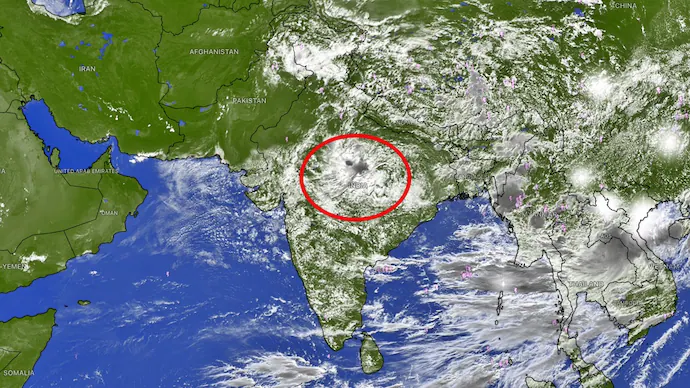
The monsoon in India is currently being sustained largely due to strong activity in its central heartland. East Madhya Pradesh is experiencing substantial rainfall, showcasing extensive cloud cover and active weather systems. In stark contrast, many other regions in the country are largely characterised by clear skies or scattered clouds.

Recent satellite imagery reveals a pronounced disparity in monsoon conditions. Dense clusters of clouds associated with active weather are predominantly located over central and eastern India, while large areas in the western, northern, and southern sections show limited cloud formation. This uneven distribution highlights the challenges faced by the monsoon in gaining uniform strength across the nation.

East Madhya Pradesh has become a crucial area in maintaining monsoon circulation. The region benefits from low-pressure systems and disturbances that continue to inject moisture, crucial for sustaining rainfall. Such activity alleviates the otherwise dry conditions seen in various parts of the country, where more consistent rainfall would typically be expected.

Scattered Rainfall in Other Regions

Despite significant activity in East Madhya Pradesh, other regions are experiencing far less robust conditions. Many areas are showing either patchy cloud cover or clear skies, indicative of limited monsoon engagement. The dryness is pronounced in several communities where the monsoon is usually expected to deliver consistent precipitation.

In addition, intense thunderstorms have been recorded in Jammu and Kashmir, as well as northern Punjab. While these storms brought localised spells of intense weather, they have not contributed meaningfully to the overall monsoon performance, which remains inconsistent.

The prevailing dry conditions and lack of widespread activity underscore the challenges the monsoon faces in achieving adequate rainfall distribution across India this season. These conditions are particularly concerning given that the monsoon is fundamental to agriculture and water resources in the country.

Influence of El Nino on Monsoon Patterns

The current status of the monsoon is closely linked to the influence of El Nino, which is recognised for its abnormal warming of the central and eastern Pacific Ocean. This phenomenon can significantly alter global atmospheric circulation patterns, affecting rainfall distribution. In India, its effects are commonly associated with a weakened southwest monsoon and a reduced overall rainfall output.

Despite the challenges posed by El Nino, the monsoon has managed to establish some resilience. Ongoing formations of depressions and low-pressure systems continue to travel across the region, temporarily bolstering rainfall. These systems act as moisture conduits, generating widespread rain as they move inland and providing some level of defence against the adverse effects of El Nino.

Nonetheless, the influence of El Nino seems to be moderating the effectiveness of these monsoon-supporting systems, leading to rainfall that remains slightly below normal levels. Although recent patterns indicate that active weather systems have not delivered the expected results, the overall rainfall deficit has been minimal. This resilience has prevented a more severe deterioration of the monsoon situation in India.

At this moment, while the Indian monsoon persists, its most vigorous activity is increasingly centralised in the heart of the country. How this situation evolves will be crucial for various sectors dependent on seasonal rains, particularly agriculture.

Long or Short, get news the way you like. No ads. No redirections. Download Newspin and Stay Alert, The CSR Journal Mobile app, for fast, crisp, clean updates!

App Store –  https://apps.apple.com/in/app/newspin/id6746449540 

Google Play Store – https://play.google.com/store/apps/details?id=com.inventifweb.newspin&pcampaignid=web_share

Latest News

Popular Videos
