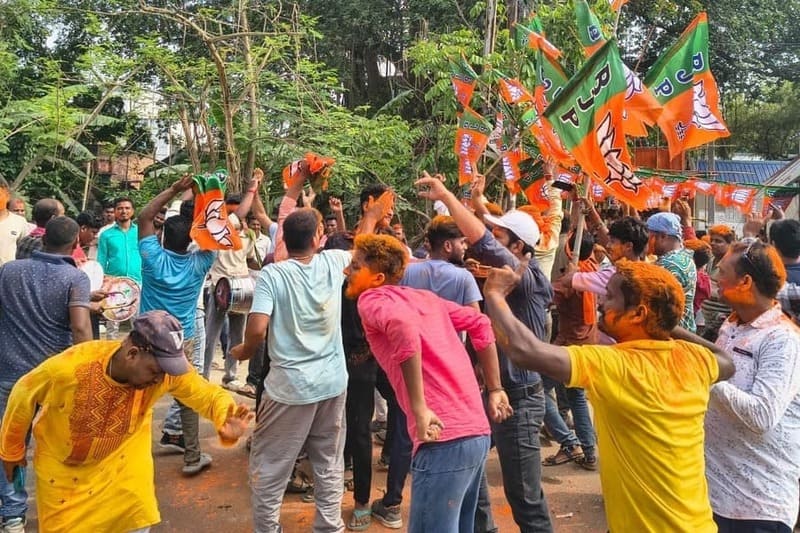
The latest Assembly election results in West Bengal point to a significant political realignment, with the Bharatiya Janata Party (BJP) registering a sweeping victory across nine districts, leaving the ruling Trinamool Congress (TMC) without a single seat in these regions.
Across large parts of the state, voter sentiment appeared shaped by a mix of anti-incumbency and religious polarisation. Observers note that in several constituencies, support for the BJP ranged from strong endorsement to a more reluctant acceptance, driven by frustration with the ruling establishment.
The electorate’s discontent, built up over time, translated decisively at the ballot box, resulting in a complete rout of the TMC in districts spanning from North Bengal to Junglemahal and parts of south Bengal.
The districts where the TMC failed to win any seat include Jalpaiguri, Darjeeling, Kalimpong, Alipurduar in North Bengal; Bankura, Purulia, and Jhargram in Junglemahal; along with East Medinipur and West Bardhaman.
Political analysts attribute this outcome to multiple factors, including allegations of corruption, dissatisfaction with local leadership, and perceptions of arrogance among party workers at various levels.
North Bengal: Tea belt factor
In the Hills and Terai regions, the “Tea Belt” played a decisive role in shaping electoral outcomes. Long-term grassroots engagement by organisations like the Rashtriya Swayamsevak Sangh (RSS) is believed to have contributed to the BJP’s consolidation in these areas.
Through initiatives such as single-teacher schools and community outreach among tea garden workers, these networks built sustained local connections. Additionally, shifts in traditional Left votes toward the BJP, along with alliances with regional players, strengthened the party’s position.
The BJP secured all 22 Assembly seats across these four northern districts. In the Matigara-Naxalbari constituency, candidate Anandamay Barman recorded a victory margin exceeding one lakh votes, highlighting the scale of the party’s dominance.
Junglemahal: Anti-incumbency drives shift
In the Junglemahal region—comprising Bankura, Purulia, and Jhargram—the BJP emerged victorious across all 25 seats.
Voters in the region appeared to view the BJP as the principal alternative to the TMC, with the Left Front and Congress failing to regain relevance. Analysts suggest that many voters supported the BJP less out of ideological alignment and more as an expression of dissatisfaction with the incumbent government.
Interestingly, results from several minority-dominated polling booths indicate a possible shift in voting patterns, despite minorities constituting only 8–9 percent of the region’s electorate.
West Bardhaman: local factors at play
In the industrial district of West Bardhaman, the BJP won all nine Assembly seats, with different factors influencing outcomes in urban and rural areas.
In Asansol North, the defeat of TMC leader Moloy Ghatak has been linked by some observers to the exclusion of a significant number of voters from electoral rolls. Meanwhile, in Barabani, dissatisfaction among rural voters and local-level grievances, including allegations of misconduct by close aides of the incumbent, contributed to the party’s loss.
Observers also point to the consolidation of non-Bengali and majority community votes as a key factor behind the BJP’s success in the district.
East Midnapore: Adhikari factor dominates
In East Midnapore, the BJP’s clean sweep of all 16 seats is widely attributed to the influence of the Adhikari family, particularly Suvendu Adhikari.
Their strong grassroots presence and extensive local outreach reportedly played a crucial role in mobilising support across communities. Analysts also highlight internal factionalism within the TMC as a major contributing factor to its defeat in the district.
Reports suggest that the Adhikari network maintained consistent engagement with residents, offering assistance during times of need and building long-term trust. This outreach is believed to have resonated across both majority and minority communities.
Factionalism weakens TMC
Across several districts, internal divisions within the TMC appear to have further weakened its electoral prospects. Political observers note instances of intra-party competition, where leaders allegedly undermined each other’s support bases, contributing to the party’s overall decline in key constituencies.
The BJP’s sweeping performance across these nine districts underscores a combination of anti-incumbency sentiment, organisational strength, and region-specific political dynamics. While the results mark a significant moment in Bengal’s political landscape, analysts suggest that future electoral outcomes will depend on how these shifts translate into sustained voter support.
Long or Short, get news the way you like. No ads. No redirections. Download Newspin and Stay Alert, The CSR Journal Mobile app, for fast, crisp, clean updates!