


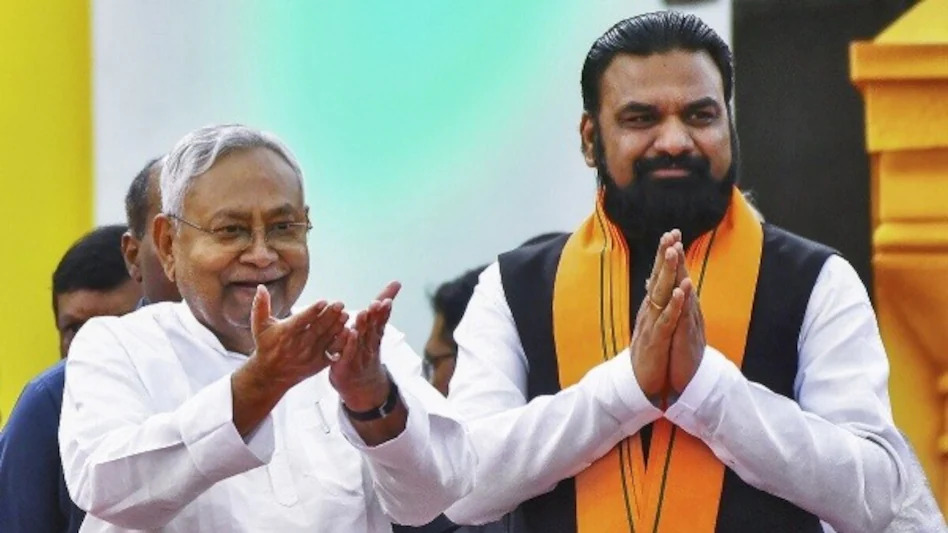

Following Nitish Kumar’s resignation, Samrat Choudhary was appointed Chief Minister of Bihar, marking one of the most significant political changes in the state’s recent history. Power structures, caste alignments, coalition politics, and electoral tactics are all changing throughout Bihar as a result of the transformation, which goes beyond a simple change in leadership.
The “Nitish Era” Comes to an End
Nitish Kumar served as the center of Bihar politics for almost twenty years, frequently dictating the formation of governments despite changing coalitions. A centrist, personality-driven political model has collapsed with his departure.
Kumar’s strength was his ability to move between ideological extremes, occasionally siding with the Rashtriya Janata Dal and the Bharatiya Janata Party. With his departure:
-
In Bihar politics, the “kingmaker” position has diminished
-
There will probably be less coalition fluidity
-
Major blocs may become more ideologically divided
As a result, there is less room for middle-ground leadership, which Nitish Kumar once held, and the political battle becomes more binary.
The BJP’s Ascent to Dominance
Samrat Choudhary’s ascent marks the BJP’s transition from a supportive ally to the main hub of power in Bihar.
Under Nitish Kumar’s direction, the BJP functioned under the NDA framework for many years. Now, for the first time in the state, the party is in charge of the Chief Minister’s office.
The BJP now has a significant amount of decision-making power
The party’s regional leaders become more visible and independent
This change reflects the BJP’s larger national policy of substituting domestic leadership structures for regional partners in order to strengthen long-term influence.
Caste Equation Reconfiguration
Bihar’s electoral politics still revolve around caste, and this shift is closely related to social engineering.
OBC leader Samrat Choudhary is an example of a conscious effort to unite OBC support. This has a number of ramifications:
-
The RJD’s traditional caste roots are being aggressively challenged, particularly among the lower classes
-
The Extremely Backward Classes (EBCs) coalition led by Nitish Kumar may disintegrate
-
Consolidation of OBCs and upper castes may become the new dominant electoral formula
Voting blocs may be redefined in advance of upcoming elections as a result of this recalibration, especially if the BJP is successful in growing outside of its conventional support.
Impact on Opposition Politics
The opposition, especially the RJD, faces both chances and hazards as a result of the leadership change:
-
The RJD might try to resurrect its story about caste identity and social justice
-
In addition to eliminating a significant opponent, Nitish Kumar’s absence also removes a possible ally in anti-BJP coalitions
-
Without an impartial, seasoned leader like Kumar, opposition unity becomes extremely challenging
However, opposition groups may become more unified as a result of the BJP’s dominance, particularly in the run-up to state and national elections.
Outward Calm, Internal Tensions
The National Democratic Alliance (NDA) is still in place, although the internal balance has changed dramatically.
In the past, Nitish Kumar’s party functioned as an equal, or occasionally dominant, partner. In the revised arrangement:
-
The obvious senior partner is the BJP
-
Smaller allies could experience political exclusion
-
Power-sharing agreements may cause conflict
Careful management will be needed to keep the coalition stable, especially if electoral pressure increases.
Governance Story: Assertion vs Continuity
Samrat Choudhary must overcome two obstacles:
Continuity: Maintaining well-liked programs and Nitish Kumar-related governance styles
Assertion: Under BJP leadership, creating a unique administrative identity
This delicate balancing effort will affect:
-
The operation of bureaucracy
-
Policy priorities
-
Public perception toward the incoming administration
Voters may get disenchanted if consistency is not maintained, and the BJP’s political discourse may be weakened if assertiveness is lacking.
The “Double Engine” Factor
It is anticipated that Bihar and the Indian government will work together more closely because the same party controls both the state and the central government.
Possible effects include:
-
Quicker approval and implementation of infrastructure projects
-
Enhanced central financing and policy coherence
-
Increased political messaging regarding development
However, this also raises expectations, as the ruling party may be held more directly responsible for any governance deficiencies.
Electoral Consequences: A New Political Arena
Future elections will probably be different as a result of the shift:
-
The BJP intends to transform control over governance into electoral supremacy
-
Caste-based mobilization may be intensified by opposition parties
-
Leadership-focused campaigns could replace coalition-driven narratives
Campaigns could become more divisive and aggressive in the absence of Nitish Kumar as a counterbalance.
Risks and Uncertainties
Despite the seeming concentration of power, there are still a number of risks:
-
Factionalism within the BJP’s state unit
-
Opposition from powerful political networks established under Nitish Kumar’s leadership
-
Voters’ mistrust of a novel leadership approach
-
The challenge of handling ongoing socioeconomic issues in Bihar