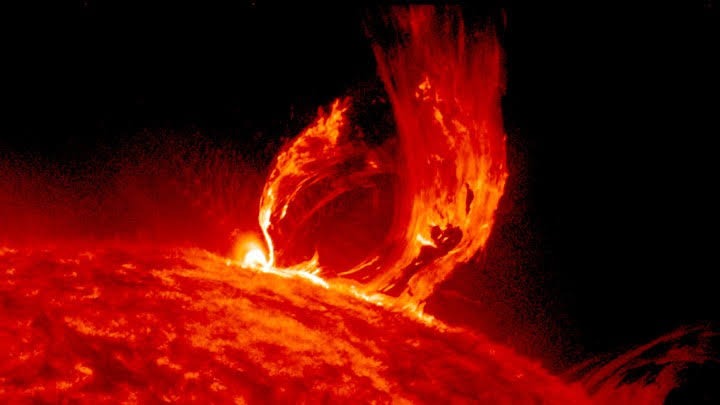
Two significant eruptions occurred almost concurrently on opposite sides of the Sun, showcasing the star’s immense power. Scientists noted that these eruptions offer a rare opportunity to study the intricate magnetic forces responsible for solar activity. A remarkable animation from NOAA’s GOES-19 weather satellite revealed large plumes of superheated plasma ejecting from the Sun’s opposing hemispheres within a brief two-hour period.
The near-simultaneous phenomena have captured the attention of solar physicists, who are now investigating potential connections between the eruptions. Initially, it may seem that the events were merely coincidental; however, experts suggest that the Sun’s magnetic field functions like an extensive interconnected web. This web allows disturbances in one area of the Sun to have rapid effects on another region of its surface.
Nasa has previously documented similar occurrences. In 2010, researchers observed magnetic instabilities that propagated across the Sun, causing eruptions throughout an entire hemisphere. The latest double eruption appears to follow this established pattern, indicating that magnetic forces may interlink disparate regions of our star.
Current Activity of the Sun
These recent eruptions are taking place during a notably active period for the Sun. Scientists have also been monitoring intense solar flares emanating from sunspot 4482, signalling an increase in solar activity as the Sun approaches the peak of Solar Cycle 25. Solar eruptions release vast quantities of plasma and magnetic energy into space, and their implications can extend well beyond the solar surface.
If such eruptions are accompanied by Earth-directed coronal mass ejections (CMEs), they can lead to geomagnetic storms. These storms may create stunning auroras while also posing risks to satellite operations, disrupting radio communications, GPS navigation, and electrical power systems on Earth.
At present, it is unclear whether either eruption from July 7 launched any plasma directly towards Earth, leading scientists to conduct further analysis of satellite observations. They aim to determine any potential impacts that could emerge due to space weather over the following days.
Implications of Solar Eruptions on Earth
This recent episode serves as a crucial reminder that the Sun is far from a serene celestial body. Rather, it is a dynamic and magnetically active star, capable of producing extraordinary explosions with the potential to affect the entire solar system. The eruptions from July 7 reflect the complexity and energy of solar phenomena and underline the importance of continuous observation and research on solar activity.
As scientists delve deeper into their investigations, the findings from this event may provide valuable insights into the behaviour of solar activity and its implications for space weather. Understanding such interactions on the Sun’s surface is essential, not only for protecting Earth’s technological infrastructures but also for advancing our knowledge of stellar dynamics.
In conclusion, the simultaneous eruptions on the Sun highlight its vigorous and volatile nature, underscoring the importance of monitoring solar activity, especially during periods of heightened activity. The ongoing analysis by scientists will potentially reveal more about these phenomena and their consequences for both space and Earth-based systems.
Long or Short, get news the way you like. No ads. No redirections. Download Newspin and Stay Alert, The CSR Journal Mobile app, for fast, crisp, clean updates!