


Top Congress Leaders Honour Former PM Rajiv Gandhi on His 82nd Birth Anniversary at Samvidhan Sadan

The CSR Journal Magazine

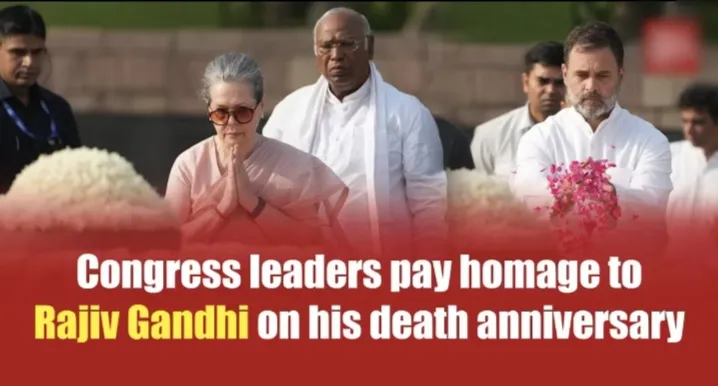
Key Congress figures, including Congress President Mallikarjun Kharge, Rahul Gandhi, the Leader of the Opposition in the Lok Sabha, and Priyanka Gandhi Vadra, gathered at the Central Hall of Samvidhan Sadan to commemorate the 82nd birth anniversary of former Prime Minister Rajiv Gandhi. The event included floral tributes and a focus on Rajiv Gandhi’s lasting impact on Indian politics.

Rahul Gandhi Critiques Economic Centralisation

During the event titled ‘Hara Bhara Swaraj: A Tribute to Rajiv Gandhi’s Vision,’ Rahul Gandhi addressed issues related to corporate monopolies and economic centralisation. He highlighted the disconnect between true democratic self-governance, referred to as Swaraj, and the current concentration of wealth and power. Rahul Gandhi stated that genuine Swaraj cannot exist if individual control dominates every industry in the nation.

He elaborated that the presence of monopolistic systems stifles the potential for grassroots economic participation, asserting that individuals in the audience should not feel compelled to act based solely on the influence of powerful business entities. The Leader of the Opposition’s remarks pointed to the need for broader economic participation and the importance of a diverse economic landscape in India.

Emphasising Mahatma Gandhi’s philosophies, he stated that structural reforms are critical for establishing true grassroots democracy. He argued that economic and institutional equality should be fundamental tenets of the nation, essential for any progress that aligns with Gandhiji’s vision.

Rajiv Gandhi’s Legacy and Contributions

Rajiv Gandhi, born on August 20, 1944, became the youngest Prime Minister of India when he took office in October 1984 at the age of 40, following the tragic assassination of his mother, then Prime Minister Indira Gandhi. His tenure lasted until December 2, 1989. Gandhi’s leadership and vision were instrumental in shaping several key policies during a transformative period in India.

Under his administration, the Computer and IT Policy introduced measures that reduced import duties on computers and software, setting the stage for significant growth in India’s information technology sector. His government was pivotal in establishing the National Association of Software and Service Companies (NASSCOM) in 1988, which became a cornerstone for advancing the country’s software industry.

Rajiv Gandhi’s vision extended beyond technology, advocating for modernisation and development across various sectors. His efforts contributed to positioning India as a competitive player on the global stage, particularly in the realms of technology and communications. Despite his tragic death due to an assassination by an LTTE suicide bomber during an election rally in Tamil Nadu’s Sriperumbudur on May 21, 1991, Rajiv Gandhi’s legacy continues to resonate in contemporary discussions on governance and reform in India.

Long or Short, get news the way you like. No ads. No redirections. Download Newspin and Stay Alert, The CSR Journal Mobile app, for fast, crisp, clean updates!

App Store –  https://apps.apple.com/in/app/newspin/id6746449540 

Google Play Store – https://play.google.com/store/apps/details?id=com.inventifweb.newspin&pcampaignid=web_share

Latest News

Popular Videos