


Nasa Orbiter Captures Detailed Images Of New Moon Crater
The CSR Journal Magazine

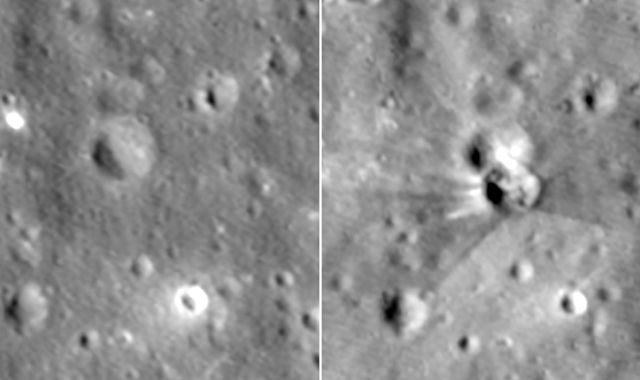
Nasa’s Lunar Reconnaissance Orbiter (LRO) has released highly detailed images of a newly formed crater on the Moon, created by the impact of a SpaceX Falcon 9 upper stage earlier this month. The collision occurred on August 5, resulting from a spent rocket that was initially launched in January 2025 as part of the Firefly Blue Ghost 1 mission.

The impact site was photographed by the LRO between August 11 and 12, providing scientists with a significant opportunity to analyse a newly formed lunar crater. This unprecedented view is crucial for understanding the processes involved in lunar impacts.

Complex Imaging Process

Capturing images of the new crater presented several challenges. Engineers had to adjust the spacecraft’s angle during each pass to ensure that its cameras were focused on the precise location of the impact while orbiting about 60 miles (100 kilometres) above the Moon at approximately one mile per second. Given that the orbiter completes its orbit every two hours while the lunar surface rotates beneath it, the team had to wait six days for the area of interest to become visible.

The timing for the photographs was critical. Nasa indicated that if the LRO’s camera had captured images just ten seconds earlier or later, the target would have shifted by nearly ten miles, possibly missing the crater entirely.

Using its advanced Narrow-Angle Camera, which can detect objects as small as three feet in size, the LRO obtained images of the crater under various lighting conditions. The observations indicate that the crater measures around 60 feet (18 metres) in width and is less than 10 feet (3 metres) deep.

Crater Characteristics and Surroundings

The images also revealed distinct bright and dark rays extending from the impact zone. Researchers explained that the darker streaks consist of older lunar soil, which has been altered over billions of years by solar wind, cosmic rays, and the impacts of micrometeorites. In contrast, the brighter rays represent fresh material that was excavated from deeper layers of the lunar surface during the collision.

Locating the impact site was a collaborative effort that involved international astronomers. They first tracked the trajectory of the Falcon 9 rocket using publicly available data. Subsequently, Nasa’s Centre for Near Earth Object Studies refined their predictions regarding the rocket’s impact.

These coordinates were then provided to South Korea’s Korea Pathfinder Lunar Orbiter, known as Danuri, which successfully imaged the crater shortly after it formed, confirming the predicted location with an accuracy of approximately 0.6 miles.

By combining the observations from both Danuri and LRO, scientists have been able to analyse the crater in detail, offering unique insights into how human-made objects continue to alter the lunar landscape. This phenomenon underscores the ongoing relationship between human activities in space and the Moon’s geological history.

Long or Short, get news the way you like. No ads. No redirections. Download Newspin and Stay Alert, The CSR Journal Mobile app, for fast, crisp, clean updates!

App Store –  https://apps.apple.com/in/app/newspin/id6746449540 

Google Play Store – https://play.google.com/store/apps/details?id=com.inventifweb.newspin&pcampaignid=web_share

Latest News

Popular Videos
