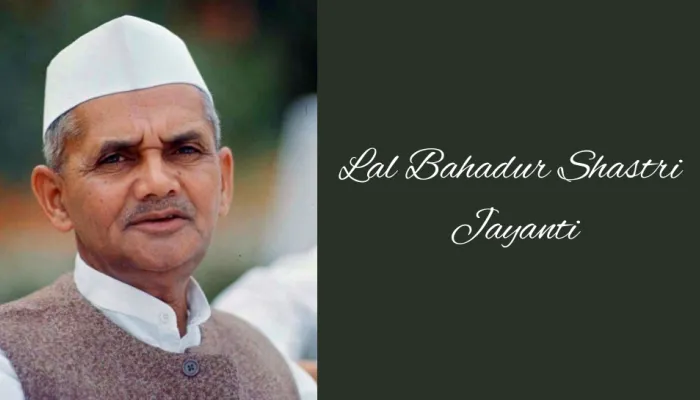
India observes the birth anniversary of Lal Bahadur Shastri on October 2 every year, remembering one of the country’s most respected leaders. Born on October 2, 1904, in Mughalsarai, Uttar Pradesh, Shastri played an important role in India’s freedom movement and later served the nation as its second Prime Minister.
His life remains an example of simplicity, integrity, humility and dedication to public service. At a time when India was navigating significant political and economic challenges, Shastri’s leadership reflected a strong sense of responsibility toward the nation and its people.
Early Life and Freedom Struggle
Lal Bahadur Shastri grew up in modest circumstances and developed a strong sense of patriotism at an early age. Inspired by Mahatma Gandhi and the national movement, he became actively involved in India’s struggle for independence.
He participated in the freedom movement and was imprisoned several times by the British authorities. His commitment to India’s independence and his disciplined approach to public life helped establish his reputation as a dedicated nationalist.
Following independence in 1947, Shastri took on several important responsibilities in the government and the Indian National Congress. His administrative experience and reputation for honesty eventually brought him to the country’s highest political office.
Leadership as Prime Minister
Shastri became India’s Prime Minister in 1964 following the death of Jawaharlal Nehru. Although his tenure was relatively short, it came during a period of considerable challenges, including food shortages, economic pressures and security concerns.
His leadership during the 1965 India-Pakistan war demonstrated his resolve and commitment to national security. At the same time, he emphasized the importance of strengthening India’s agricultural sector and improving food production.
The Message of “Jai Jawan, Jai Kisan”
One of Shastri’s most enduring contributions to India’s national consciousness was the slogan “Jai Jawan, Jai Kisan”, meaning “Hail the Soldier, Hail the Farmer.”
The slogan highlighted the vital role played by both soldiers defending the country and farmers contributing to its food security. It continues to be associated with the values of national service, self-reliance and respect for India’s agricultural and defence communities.
A Legacy of Simplicity and Integrity
Lal Bahadur Shastri was widely known for his modest lifestyle and personal integrity. Despite holding one of the most powerful positions in the country, he maintained a reputation for humility and discipline.
His approach to public service continues to be remembered as an example of leadership centred on duty rather than personal privilege. His life story has also remained an important part of India’s political and historical narrative.
Remembering His Contribution
On his birth anniversary, citizens across India pay tribute to Lal Bahadur Shastri and reflect on his contribution to the nation. Alongside commemorating his role in India’s freedom struggle and governance, the occasion provides an opportunity to remember the values he represented.
More than six decades after his death, Shastri’s legacy continues to occupy an important place in India’s history. His emphasis on simplicity, patriotism, agriculture, national security and public responsibility remains central to the way generations of Indians remember him.