


India Proposes Bheem: A Made-in-India Habitat for Mars Missions
The CSR Journal Magazine

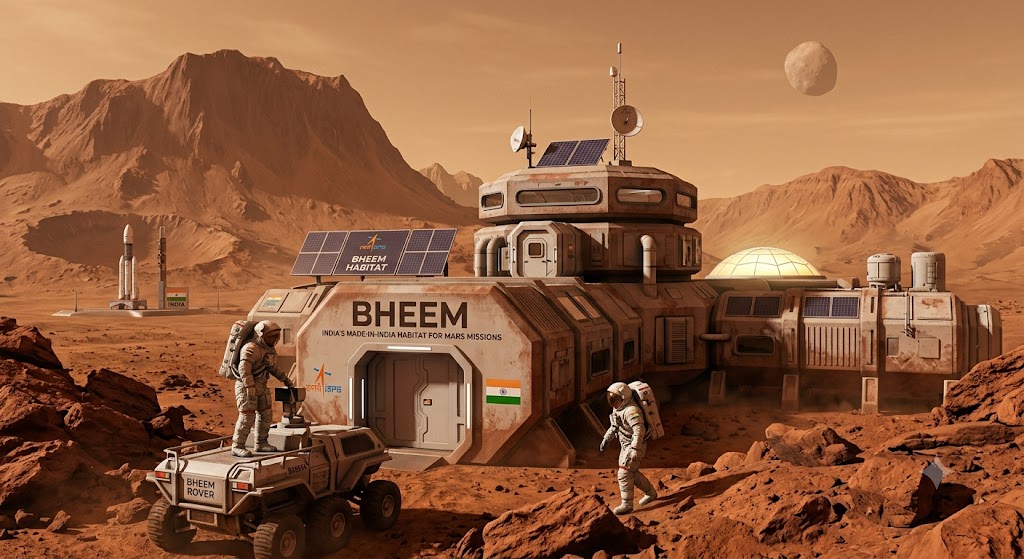
The Bheem project represents India’s initiative towards establishing habitats for future lunar and Martian missions. Researchers from the Indian Institute of Science (IISc) in Bengaluru have developed a concept named the Bhartiya Extraterrestrial Expandable Modular Habitat. This innovative design envisions a modular habitat that can be launched compactly and assembled on the Moon or Mars.

Authored by Mritunjay Baruah, Amogh Jadhav, Bimalendu Mahapatra, and Indian astronaut Shubhanshu Shukla, the research outlines the significance of Bheem in addressing the challenges of human existence beyond Earth. Unlike traditional space habitats which are deployed as large modules, Bheem utilises smaller, panel-based structures for easier transport and assembly.

The researchers specifically focused on optimising the design for transport aboard SpaceX’s Starship. The modular panels, transported within the rocket’s payload section, can be assembled into pressurised living spaces once they reach their designated destination.

Design Features and Functionality

The central feature of Bheem’s design is its human-centric approach, meticulously considering the daily activities astronauts will undertake on long missions. Researchers assessed the necessary volume for these tasks to ensure astronauts can perform them comfortably within the habitat.

The design incorporates various geometric shapes, including triangles, squares, and pentagons, which were analysed for volume efficiency and structural integrity. This meticulous selection process aimed to yield a robust and effective habitat solution suitable for harsh extraterrestrial environments.

Additionally, Bheem’s panel-based structure not only aids in construction but also facilitates future repairs and maintenance. In scenarios where a panel requires attention, it can be replaced individually, ensuring that the overall habitat remains functional without comprehensive overhauls.

Advantages and Future Implications

One notable advantage of the Bheem concept is its inherent flexibility. The modular design allows for habitats of varying sizes and configurations to be created, adapting to the unique demands of each mission. This flexibility could also accommodate the expansion of human settlements as more astronauts arrive on the lunar or Martian surface.

The ambitious layout of Bheem posits that a single Starship payload could deliver double the habitable volume compared to the International Space Station. This potential for creating large living environments aligns with India’s long-term aspirations for space exploration and habitation.

While Bheem currently exists as a conceptual design, it exemplifies India’s innovative approach to human spaceflight. Substantial engineering and development work, encompassing materials, life-support systems, and radiation protection, will be necessary before this concept can evolve into a functional habitat for astronauts on another celestial body.

Long or Short, get news the way you like. No ads. No redirections. Download Newspin and Stay Alert, The CSR Journal Mobile app, for fast, crisp, clean updates!

App Store –  https://apps.apple.com/in/app/newspin/id6746449540 

Google Play Store – https://play.google.com/store/apps/details?id=com.inventifweb.newspin&pcampaignid=web_share

Latest News

Popular Videos
