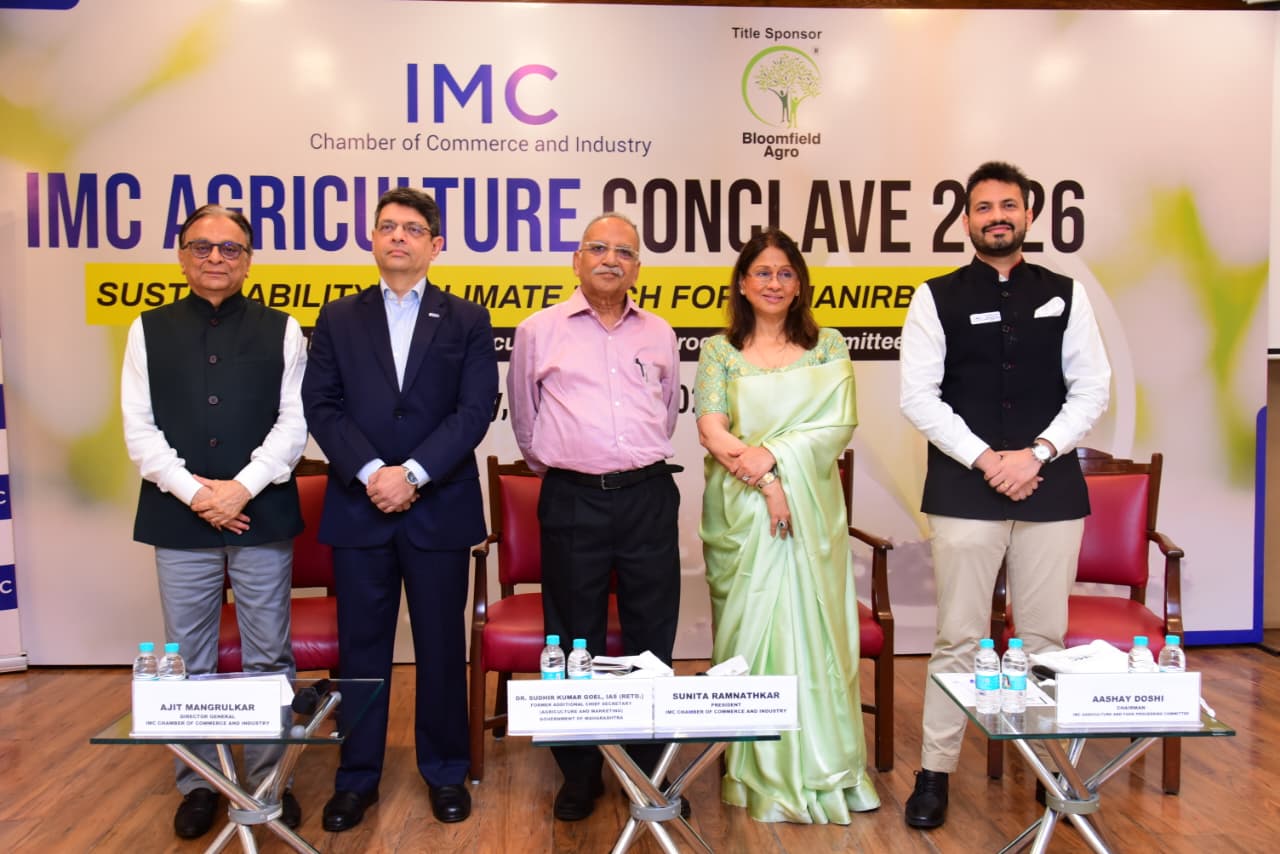
At the IMC Agriculture Conclave 2026 organised by the IMC Agriculture & Food Processing Committee under the theme “Sustainability & Climate Tech for Atmanirbharta,” Dr. Sudhir Kumar Goel, IAS (Retd.) and former Additional Chief Secretary (Agriculture and Marketing), Government of Maharashtra, said, “India’s agriculture sector employs nearly 46% of the people and yet contributes only 18% to the GDP. Moreover, a majority of them are marginal farmers, surviving at less than half of the country’s average per capita income. They do not have the resources or capital to adopt modern farming methods or new technology.”
Stressing the urgent need for reforms in India, he said, “Collectivisation of farmers, rather than land consolidation, is key to accelerating agricultural reforms. This would enable small farmers to pool resources and adopt technologies such as IoT and AI to boost productivity and incomes.”
Ms. Sunita Ramnathkar, President, IMC Chamber of Commerce and Industry, said, “Agriculture remains the backbone of India’s economy and the primary source of livelihood for millions. However, rising dependence on imports of key food commodities, coupled with challenges such as climate change, resource depletion and shifting market dynamics, has made the need for sustainable and climate-smart agricultural solutions more urgent than ever.”
Mr. Aashay Doshi, Chairman, IMC Agriculture and Food Processing Committee, observed, “The West Asia conflict can precipitate a serious shortage of fertilisers, which could threaten India’s food security. It also threatens to reverse years of progress, pulling India down from the goal of nutrition security and forcing a renewed focus on mere food availability.”
Advocating the promotion of bio-fertilisers in India, Dr. Goel said, “Even as India is striving hard to achieve self-sufficiency in food production, the West Asia crisis and the closure of the Hormuz Strait have intensified the country’s challenges. India consumes more than 60 million tonnes of chemical fertilisers annually, with nearly half of them dependent on imports, while uninterrupted LNG supplies remain critical for domestic fertiliser production.”
Despite having the world’s largest arable land base and one of the biggest agricultural workforces, India continues to rely heavily on imports for edible oils, purchasing nearly $18 billion worth annually to meet more than 60% of domestic demand. Every year, India imports around 16 million tonnes of edible oil.
Similarly, in the case of pulses, India is dependent on imports to meet around 20% of its domestic consumption of 25–28 million tonnes. Annually, the country imports five to seven million tonnes from countries such as Canada and Mozambique, amid recurring concerns over rising prices and supply pressures.
“The vision of ‘Atmanirbharta’ in agriculture is not only about higher productivity but also about creating environmentally sustainable, technologically advanced and economically viable systems for farmers and stakeholders across the value chain,” Ms. Ramnathkar added.
Disclaimer: This media release is auto-generated. The CSR Journal is not responsible for the content.