


Fire Breaks Out at Rajasthan Refinery Ahead of PM Modi’s Launch
The CSR Journal Magazine

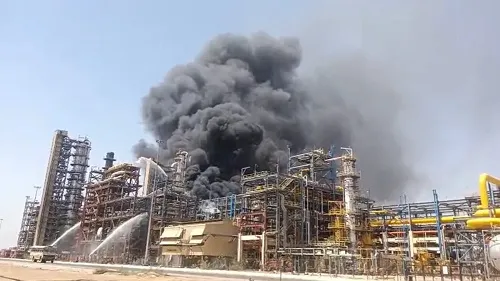
A day before PM Narendra Modi was scheduled to inaugurate India’s ambitious energy project, a massive fire broke out at the refinery in Pachpadra, Balotra, Rajasthan. This has raised serious concerns about safety preparedness. The fire reportedly started at the Crude Distillation Unit (CDU), one of the crucial parts of the refinery.

After dark smoke rose from the refinery, the emergency response team was deployed immediately. For several hours the operation to control the fire continued for several hours. No casualties have been reported yet; however, a safety audit is underway to determine the extent of the damage and investigate the fire’s origin.

Incident highlights risks in large-scale industrial operations

The official statement confirmed there were no casualties, but a thorough safety audit is being conducted to determine the extent of the damage and identify the cause of the fire. The preliminary investigation suggests a technical fault may have caused the fire; however, the investigation is ongoing. This refinery is India’s first greenfield integrated Refinery-cum-Petrochemical Complex located in Barmer district of Rajasthan. It was developed through a collaboration between Hindustan Petroleum Corporation Limited (HPCL) and the Government of Rajasthan. This project was seen as a strategic initiative that could have reduced the dependency on imported petroleum products.

Rajasthan refinery project sees revival and rising costs

Sonia Gandhi laid the foundation stone in September 2013, when Ashok Gehlot was the Chief Minister. Then the estimated cost was Rs 37,230 crore. However, due to delays and a change in government, PM Modi relaunched the ambitious project on January 16, 2018, with an estimated cost of over Rs 79,000 crore. Due to inflation, the total investment cost was much higher.

It was more than just fuel production

The refinery was a visionary project, not limited to just fuel production, it was designed in such a manner that it could have generated a great range of downstream products, such as polypropylene, polyethylene (HDPE and LLDPE), benzene, toluene, and butadiene—these are key raw materials for different industries. Availability of these raw products could have attracted numerous ancillary industries to the region, including those producing plastic goods, automotive components, packaging materials, textiles, and even medical equipment.

This ambitious project could have brought massive employment opportunities, boosting the economy of western Rajasthan, which is considered industrially backward. The project could have also spurred infrastructure development, including roads and industrial clusters.

Long or Short, get news the way you like. No ads. No redirections. Download Newspin and Stay Alert, The CSR Journal Mobile app, for fast, crisp, clean updates!

App Store –  https://apps.apple.com/in/app/newspin/id6746449540 

Google Play Store – https://play.google.com/store/apps/details?id=com.inventifweb.newspin&pcampaignid=web_share

Latest News

Popular Videos
