


7.5-Magnitude Earthquake Strikes Japan Off Its Northeastern Coast
The CSR Journal Magazine

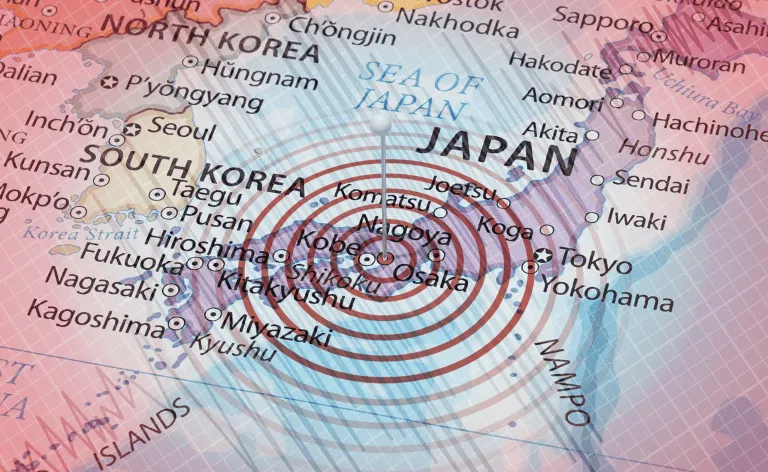
The region of Japan experienced significant upheaval on Monday, April 20, as a powerful earthquake, measuring 7.5 on the Richter scale, struck off its northeastern coast. The tremor occurred at 1:23 pm IST, originating from a depth of merely 10 kilometres, as officially reported by the Japan Meteorological Agency. The epicentre was located approximately 100 kilometres east of Miyako in Iwate Prefecture, an area known for its vulnerability to tsunamis.

Following the earthquake, the Japan Meteorological Agency issued a tsunami warning for several prefectures, including Iwate, Aomori, and Hokkaido, cautioning residents about potential waves reaching heights of up to three metres. This warning led to immediate evacuation efforts, underscoring the urgency of the situation.

Local authorities prompted residents to seek higher ground, away from low-lying areas and coastlines, due to the immediate threat posed by tsunami waves. Reports indicate that at least 30 individuals were injured as a result of the earthquake, and around 90,000 residents were advised to evacuate their homes to ensure their safety.

Geological Context of Earthquakes in Japan

Japan is situated at the convergence of four major tectonic plates: the Pacific, Philippine Sea, Eurasian, and North American plates. This geological positioning makes the nation one of the most earthquake-prone locations globally, responsible for approximately 10 per cent of all recorded earthquakes despite accounting for only 0.3 per cent of the Earth’s land mass. The constant movement and grinding of these tectonic plates lead to the accumulation of pressure, which, when released, results in seismic activity.

The Pacific Plate, for instance, continuously shifts beneath the Okhotsk Plate along the Japan Trench, while the Philippine Sea Plate subducts beneath Japan in areas such as the Nankai Trough. These dynamics create a hazardous environment, as the geological forces can generate both earthquakes and tsunamis when occurring underwater.

The Sanriku coast experienced today’s quake, a location historically known for seismic events. Notably, the catastrophic 2011 Tohoku earthquake and tsunami originated from this seismic zone, leading to nearly 20,000 fatalities and the Fukushima Daiichi nuclear disaster, thus showing the longstanding relationship between this region and seismic activity.

Potential for Future Megaquakes

The recent earthquake has reignited public concern regarding the prospect of a megaquake. In Japanese parlance, a megaquake is defined as an earthquake measuring 8.0 or higher on the Richter scale, typically resulting from one tectonic plate sliding beneath another within subduction zones. Although the recent tremor measured 7.5, it did not reach the threshold for classification as a megaquake.

According to the Headquarters for Earthquake Research Promotion in Japan, the likelihood of a large earthquake occurring within a week following one that registers at 7.0 is minimal, estimated to occur “once per a few hundred instances.” This leads to a sense of cautious vigilance among both officials and residents, as the unpredictability of seismic activity contributes to ongoing anxiety.

In 2022, the Japanese government presented predictions that a significant earthquake could potentially occur within the next 30 years, with a rough probability of 70 per cent. This forecast adds to the unease felt by Japanese citizens, who remain watchful of seismic developments in their region and the possible implications for their safety and well-being.

Long or Short, get news the way you like. No ads. No redirections. Download Newspin and Stay Alert, The CSR Journal Mobile app, for fast, crisp, clean updates!

App Store –  https://apps.apple.com/in/app/newspin/id6746449540 

Google Play Store – https://play.google.com/store/apps/details?id=com.inventifweb.newspin&pcampaignid=web_share

Latest News

Popular Videos
