


Maharashtra Faces Worsening Water Crisis As Reservoir Levels Drop Amid Scorching Heatwave
The CSR Journal Magazine

The water crisis in Maharashtra is highlighted by a significant reduction in supply in Mumbai, where a decrease of ten per cent has been implemented since May 15. This measure comes as reservoirs, consisting of seven key lakes that fulfil the city’s water needs, are now at merely 19.22 per cent of their full capacity. The total capacity of these lakes is approximately 14.47 lakh million litres, but with the current depletion, the Brihanmumbai Municipal Corporation (BMC) is taking proactive steps, anticipating challenges should the impending monsoon not deliver adequate rainfall.

The BMC is urging the state government for assistance to manage the ongoing crisis effectively. With the expected onset of the monsoon around June 10, the focus remains on ensuring water availability until at least August. Should the monsoon fail to adequately replenish these lakes, the situation could become increasingly dire.

Other regions in Maharashtra, particularly beyond Mumbai, are already grappling with severe water shortages, further exacerbated by the extreme heat.

Impact on Villages and Rural Areas

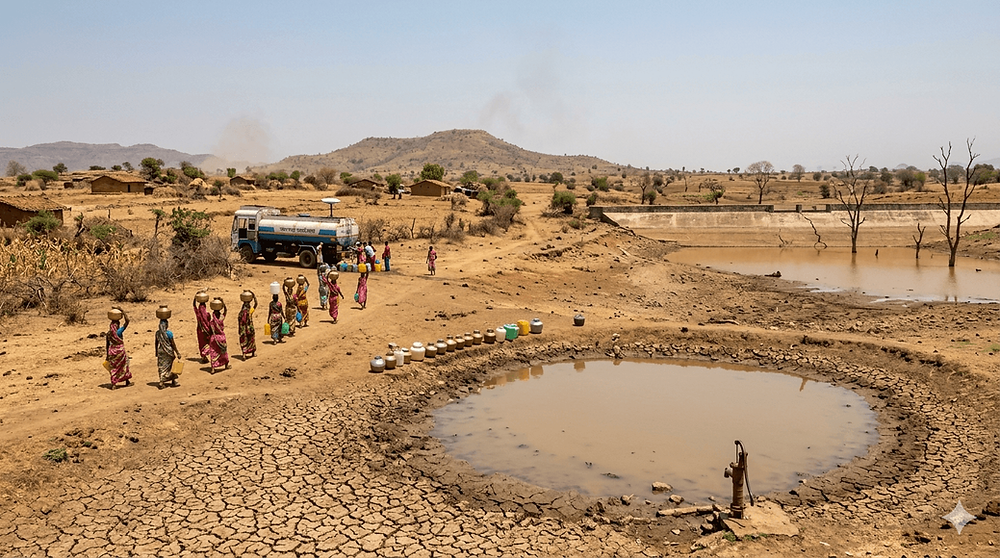
Areas within Maharashtra, such as Melghat, are experiencing intense heat reaching up to 47 degrees Celsius, with villages reliant on water deliveries via tankers or from deep saline sources. The Amravati and Akola districts, situated in the Vidarbha region, are notably affected, where villagers stand in long queues for precious water, often having to wait for hours to retrieve even a small pot.

In particular, the Chikhaldara taluka sees water distribution through 21 tankers across nine villages, with an additional reliance on private wells in 17 other locales. However, despite these efforts, the thirst for water continues, prompting villagers to embark on journeys lasting several kilometres, carrying pots on their heads in search of relief. The empty wells and inoperative hand pumps vividly depict the breadth of this crisis.

The local administration has been proactive in promising additional tanker deployments. According to Sneha Dhawale, an officer with the Zila Parishad Water Board in Amravati, they are adopting various measures to mitigate the water shortage as the problem is projected to escalate.

Social and Health Ramifications of Water Scarcity

In the Akola district’s saline belt, the situation is dire. The groundwater in this area is unsuitable for drinking, forcing residents to collect seepage from riverbanks, further complicating the water crisis. This has persisted for nearly five decades, with adverse effects on both daily life and community interactions. Marriage prospects are reportedly declining, as families in this water-scarce region face challenges in securing suitable matches for their children.

Despite significant investments in infrastructure meant to alleviate the water crisis, such as the Kavatha Barrage, technical difficulties have rendered these efforts ineffective. Consequently, water scarcity in Akola city is escalating, with only 27 per cent of storage available in the Katepurna Dam at present. Water supply frequency has decreased from every three to four days to just once every six days.

The increasing pressure from the summer heat and the resultant water shortage is affecting health, with over 500 reported heatstroke cases and two fatalities. As towns like Chandrapur record temperatures nearing 47 degrees Celsius, the search for potable water remains a strenuous reality for many residents.

Rural Struggles with Water Access

In places such as the Gondpipri tehsil of Chandrapur district, residents experience taps that deliver no water, forcing women to search for alternatives at dawn. Although there is a well in the vicinity, its saline water is deemed unfit for consumption. As a last resort, villagers dig holes in drains, hoping for seepage that can be collected and cleaned for use.

This arduous process can take up to fifteen minutes per pot, necessitating waits for water to accumulate. In May, desperate situations require villagers to dig trenches as deep as eight feet to find water. This ongoing struggle has persisted across generations, with governmental efforts resulting in little to no improvement in conditions.

Tarabai Yelamule, a centenarian from Heti Nandgaon, recalls the continuous challenges her community has faced. Although infrastructure projects have been initiated, the promised water supply remains absent for many households. Even those with running connections often find the water unsuitable for drinking, resorting instead to salvaging pit water for basic needs.

Long or Short, get news the way you like. No ads. No redirections. Download Newspin and Stay Alert, The CSR Journal Mobile app, for fast, crisp, clean updates!

App Store –  https://apps.apple.com/in/app/newspin/id6746449540 

Google Play Store – https://play.google.com/store/apps/details?id=com.inventifweb.newspin&pcampaignid=web_share

Latest News

Popular Videos
