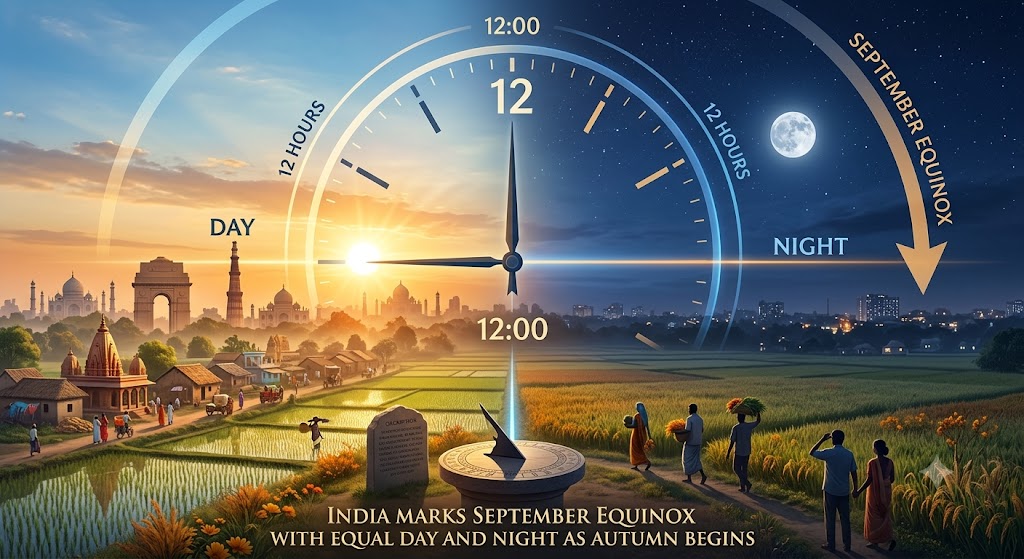
India will witness an astronomical event today, September 23, when the Sun crosses a significant boundary known as the September equinox. According to calculations from NASA, this phenomenon occurred at 5:35 am IST. During this moment, the Sun’s centre aligned with the Earth’s equatorial plane, transitioning from the northern hemisphere to the southern hemisphere. This event is a marker of the seasonal transition across the Northern Hemisphere.
The term “equinox” originates from Latin, meaning “equal night.” This description reflects nearly equal durations of daylight and darkness experienced during the event, which occurs twice annually—once in March and once in September. The phenomenon occurs due to the tilt of the Earth’s axis, which is approximately 23.5 degrees, as it moves around the Sun.
During the equinox, sunlight is distributed more evenly between the two hemispheres as neither hemisphere is tilted towards the Sun. This leads to the onset of specific astronomical seasons; notably, the September equinox signals the start of autumn in the Northern Hemisphere.
Daylight and Darkness Around the Equinox
Although the equinox is commonly associated with equal lengths of day and night, this is not entirely accurate. Most locations will not experience precisely 12 hours of daylight and 12 hours of darkness, due to factors such as the atmospheric refraction of light and the conventions defining sunrise and sunset. Consequently, daylight typically lasts slightly longer than 12 hours as the equinox approaches.
Following the September equinox, the Northern Hemisphere will notice gradually diminishing sunlight. As Earth’s position changes, the length of the daylight hours will decrease incrementally, resulting in longer nights. This trend will continue until the December winter solstice, which is characterised by the shortest day of the year in the Northern Hemisphere.
In stark contrast, while the equinox is an important event, it does not mean an immediate shift into autumn-like conditions across India. Various factors including geographical influences, regional climates, and the monsoon season play a crucial role in determining the country’s weather patterns.
Impact of the Equinox on India’s Weather
The September equinox serves as an essential reference point in Earth’s yearly cycle. However, it does not lead to an immediate or dramatic change in weather across India. The monsoon season, which significantly influences the climate, is not abruptly altered by this astronomical event.
The transition in daylight hours observed in upcoming months will be gradual. As the equinox occurs, citizens will experience a slow reduction in daylight, continuing up until the winter solstice in December. During this time, temperatures may fluctuate as the days become shorter and cooler.
Therefore, while the equinox represents an important transition, its impact on Indian weather conditions will unfold over time. Residents can expect progressively shorter days and longer nights, but these changes will be influenced more by the prevailing monsoon conditions and regional climates than by the equinox itself.
Long or Short, get news the way you like. No ads. No redirections. Download Newspin and Stay Alert, The CSR Journal Mobile app, for fast, crisp, clean updates!