


India’s Aditya-L1 Unveils New Insights into Solar Eruptions
The CSR Journal Magazine

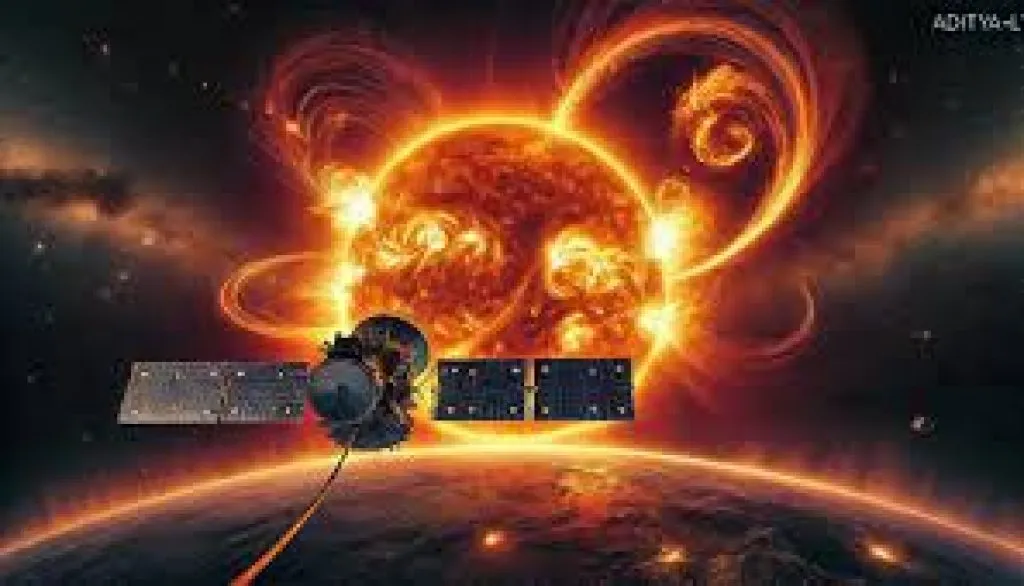
India’s inaugural space-based solar observatory, Aditya-L1, has revealed groundbreaking information regarding the behaviour of solar eruptions. The observations challenge the long-held belief that these massive eruptions expand uniformly like symmetrical bubbles. Scientists from the Indian Institute of Astrophysics (IIA) in Bengaluru reported that a solar eruption observed an uneven expansion and developed an asymmetric shape.

The findings, which have been published in The Astrophysical Journal Letters, were derived from data collected by the Visible Emission Line Coronagraph (VELC) on board Aditya-L1, alongside images from NASA’s Solar Dynamics Observatory (SDO) and advanced three-dimensional modelling techniques. This research marks a significant advancement in the understanding of coronal mass ejections (CMEs), which are powerful eruptions of hot, magnetised plasma from the Sun’s outer atmosphere.

When directed towards Earth, CMEs can lead to geomagnetic disturbances that may impact satellites, communication networks, and other space-based infrastructure. The insights gained from this study could enhance the predictive capabilities regarding the effects of these eruptions on our planet.

Challenges in Understanding Solar Eruptions

Accurately predicting the timing and intensity of a CME’s impact on Earth relies heavily on understanding its speed, direction, and evolution as it moves away from the Sun. However, studying these eruptions during their early stages has proven to be a complex task. Traditional coronagraphs can track the movement of CMEs across the sky but lack the ability to directly measure the velocity of the plasma as it approaches or recedes from an observer.

Aditya-L1’s VELC instrument offers a significant advantage in this area. By employing a technique known as Doppler spectroscopy, VELC can detect shifts in the wavelength of light emitted by moving plasma. A blue shift indicates material moving towards the observer, while a red shift signifies material moving away. During the eruption on August 5, 2024, VELC identified two distinct Doppler-shifted emission features simultaneously, located on opposite sides of the regular coronal emission line.

This detection revealed the presence of plasma moving both towards and away from the observer as the CME traversed the corona, providing valuable data for understanding the dynamics of solar eruptions.

Implications of the Research

To interpret these unexpected observations, researchers constructed a three-dimensional model of the expanding CME. Their analysis indicated that a symmetrical expansion could not accurately replicate the spectral patterns recorded by VELC. However, incorporating uneven lateral expansion and a tilt into the model yielded results that closely aligned with the observations.

This discovery challenges the conventional view that CMEs expand uniformly, suggesting that an asymmetric shape could significantly influence how an eruption interacts with the solar wind as it travels through space. Variations in drag could alter the eruption’s speed, complicating predictions regarding its arrival time at Earth.

The study also highlights the potential of Aditya-L1 in aiding scientists to reconstruct the three-dimensional evolution of solar eruptions by merging spectroscopy with imaging observations. Continued observations from VELC are expected to enhance CME tracking and improve space-weather forecasting, providing deeper insights into solar eruptions that pose threats to modern technological systems.

Long or Short, get news the way you like. No ads. No redirections. Download Newspin and Stay Alert, The CSR Journal Mobile app, for fast, crisp, clean updates!

App Store – https://apps.apple.com/in/app/newspin/id6746449540

Google Play Store – https://play.google.com/store/apps/details?id=com.inventifweb.newspin&pcampaignid=web_share

Latest News

Popular Videos
