


app-store-logo
play-store-logo
March 10, 2026

India Ranks as Second-Largest Global Arms Importer Amid Rising Domestic Production
The CSR Journal Magazine

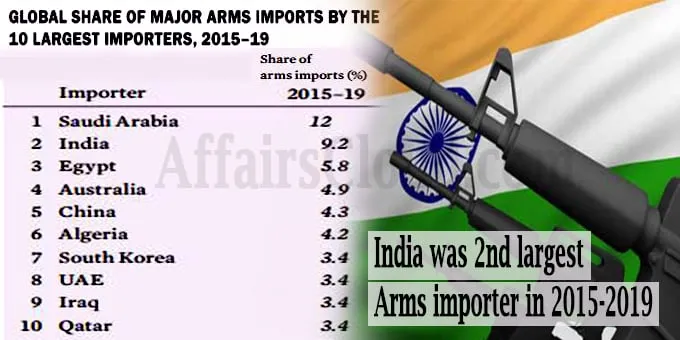
India has been identified as the second-largest importer of major weapons globally, holding an 8.2 percent share of total arms imports, according to data from the Stockholm International Peace Research Institute (SIPRI). War-torn Ukraine is the only nation with a higher share, at 9.7 percent, during the latest assessment period. Despite ongoing modernization efforts of its military in response to shifting regional and global security dynamics, India is showing a gradual decline in defense imports while experiencing a rise in domestic production capabilities.

Trends in Defense Procurement

Between 2019 and 2023, India’s share of global arms imports was approximately 9.8 percent, a figure that has recently decreased to about 8.3 percent. This decline showcases India’s ongoing efforts to diversify its military procurement strategy. The latest data highlights a notable shift in sourcing patterns, where Russia continues to be the largest supplier, contributing around 40 percent of India’s arms imports. France has emerged as the second-largest supplier, accounting for around 29 percent of the import share, largely bolstered by significant contracts such as the procurement of Rafale fighter jets.

Emerging Suppliers in India’s Defense Landscape

With the anticipated acquisition of 114 additional Rafale jets for the Indian Air Force, France’s percentage of defense procurement from India is expected to increase further. Following France, Israel occupies the third position, accounting for roughly 15 percent of India’s military import profile. The cooperation between India and Israel has intensified, focusing on advanced defense systems, including missiles and drones.

Impact on Global Arms Import Dynamics

The rise of France and Israel in India’s defense import landscape has contributed to a decreased reliance on Russia, which has seen its share of arms imports into India drop from over 70 percent in the early 2010s. This trend reflects India’s strategic shift towards diversifying its military suppliers and enhancing partnerships on a global scale. SIPRI’s previous analyses indicate that New Delhi’s focus on self-reliance and indigenous manufacturing has shaped this diversification strategy.

Geopolitical Influences on Arms Trade

The global arms trade environment has been notably altered by various geopolitical tensions. Ukraine’s surge to the top of the arms import rankings is largely attributed to extensive military aid received from Western allies amidst its ongoing conflict with Russia. The evolving dynamics in arms procurement highlight the complexities involved in national defense strategies and international relations.

Long or Short, get news the way you like. No ads. No redirections. Download Newspin and Stay Alert, The CSR Journal Mobile app, for fast, crisp, clean updates!

App Store –  https://apps.apple.com/in/app/newspin/id6746449540 

Google Play Store – https://play.google.com/store/apps/details?id=com.inventifweb.newspin&pcampaignid=web_share

Latest News

Popular Videos
