


India Advocates Strong Response to Cross-Border Terrorism at UN General Assembly
The CSR Journal Magazine

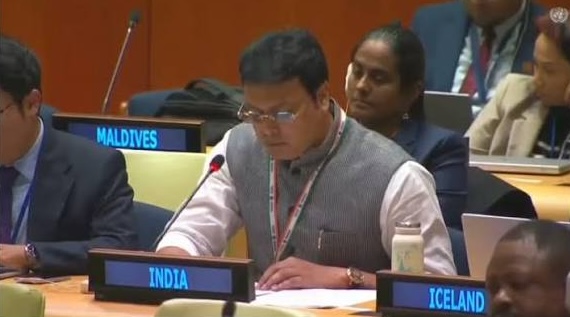
India has reaffirmed its unwavering stance against cross-border terrorism at the United Nations General Assembly. During a session of the Sixth Committee, Biplab Kumar Deb, a Member of Parliament and national general secretary of the Bharatiya Janata Party (BJP), accused Pakistan of actively perpetuating terrorist activities in Jammu and Kashmir. Deb underscored India’s entitlement to defend its citizens and borders against such threats.

Speaking to delegates about international legal matters, Deb emphasised the necessity for enhanced global action against terrorism. He called attention to the role of those who organise and finance terror attacks and underscored the importance of accountability in countering these threats. In his address, he asserted that Pakistan has established camps for terrorist organisations along its border, supporting acts of terror in the region.

Deb’s statements came in the wake of persistent calls for a robust international legal framework to hold accountable individuals involved in terrorist activities, which encompasses both the attackers and those who support them financially or logistically. This approach aims to enhance cooperation among nations to combat terrorism effectively.

Focus on Accountability for Terror Attacks

The BJP leader referenced the Pahalgam terror attack, which claimed the lives of 26 civilians in 2022, stressing the imperative to ensure accountability for all individuals behind cross-border terrorism. The attack was reportedly claimed by The Resistance Front, a group believed to operate as a proxy for Pakistan-based Lashkar-e-Taiba.

India has consistently articulated its position that Pakistan serves as a state sponsor of terrorism. Following the Pahalgam incident, India allegedly conducted retaliatory measures against terrorist bases located in Pakistan and Pakistan-occupied Jammu and Kashmir. Within the UN forum, Deb reiterated that India’s right to safeguard its population from terrorism remains indisputable.

In his address, he dismissed any distinctions between different categories of terrorism by stating that all forms of terrorism are equally condemnable. He stressed that targeting civilians cannot be justified under any circumstance, reinforcing India’s commitment to a unified stance against violence.

Push for Comprehensive Convention on International Terrorism

A significant portion of Deb’s discourse concentrated on advocating for the swift adoption of the Comprehensive Convention on International Terrorism (CCIT). This proposal, initially put forward by India in 1996, has faced delays for nearly three decades owing to disagreements among countries regarding its provisions.

Deb articulated that the establishment of a more vigorous international legal framework is essential to ensure that all individuals involved in terrorist acts, including those providing support, face legal repercussions. His comments are particularly pertinent in relation to India’s call for justice for victims of attacks like the one in Pahalgam.

Highlighting the evolving landscape of terrorism, Deb addressed concerns regarding the utilisation of emerging technologies by terrorist organisations. He pointed out that such technologies are increasingly being used for recruitment, radicalisation, propaganda, operational planning, and financing, necessitating a focused counter-strategy from nations worldwide.

India’s broader approach to tackling terrorism encompasses several priorities, including curtailing terrorist financing, prioritising the needs of victims, enhancing national capacity-building, challenging terrorist ideologies, and disrupting the infrastructure of terrorism. Deb’s intervention placed significant emphasis on Jammu and Kashmir, illustrating the region’s central role in the discourse on international cooperation against terrorism.

After his involvement at the UNGA, Deb provided an update on social media regarding his participation, noting the significance of India’s national statement at the ongoing session. He reiterated that under Prime Minister Narendra Modi, India maintains a steadfast ‘zero tolerance’ approach to terrorism, advocating for global solidarity against terror networks and their financial backers, thus reinforcing India’s commitment to international peace and security.

Long or Short, get news the way you like. No ads. No redirections. Download Newspin and Stay Alert, The CSR Journal Mobile app, for fast, crisp, clean updates!

App Store –  https://apps.apple.com/in/app/newspin/id6746449540 

Google Play Store – https://play.google.com/store/apps/details?id=com.inventifweb.newspin&pcampaignid=web_share

Latest News

Popular Videos
