


Google Launches WeatherNext 3, an AI-Powered Forecasting System
The CSR Journal Magazine

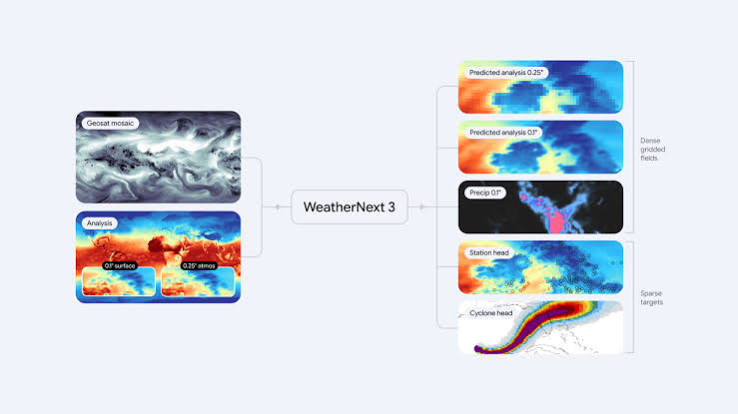
Google has announced the launch of WeatherNext 3, its latest artificial intelligence model designed for weather forecasting. The system leverages data from geostationary satellites to generate high-resolution weather forecasts every hour. According to Google DeepMind and Google Research, this model has been characterised as “the most advanced and accurate global weather model to date” following independent evaluations by Brightband.

One of the significant enhancements of WeatherNext 3 is its ability to provide detailed forecasts at a 5-kilometre resolution for essential surface variables like temperature and moisture. Other atmospheric variables, including wind speed, are forecast at a 25-kilometre resolution. The company states this model offers a global weather overview approximately five times sharper than its predecessor, WeatherNext 2, which only provided forecasts on a 25-kilometre grid every six hours.

WeatherNext 3’s hourly refresh rate enables it to track rapidly changing weather conditions, such as storms and precipitation systems, more accurately than previous models. This improvement is largely attributed to the model’s data sourcing, which now incorporates real-time global satellite observations instead of relying on traditional numerical weather prediction methods that can experience a data lag of up to six hours.

Utilisation of Real-Time Data

The model’s reliance on a continuous stream of live geostationary satellite data allows it to maintain an updated view of atmospheric conditions. Additionally, WeatherNext 3 integrates data from weather stations, allowing it to factor in local geographical influences, such as mountains and coastlines. This is especially beneficial for regions in Latin America, Africa, and the Asia-Pacific, which have limited access to high-resolution weather forecasts due to the prohibitive costs associated with traditional supercomputing models.

Furthermore, the model has been trained using precipitation data sourced from NASA’s Integrated Multi-satellite Retrievals for GPM (IMERG) alongside Google’s own global precipitation reanalysis. These enhancements reportedly resulted in a Continuous Ranked Probability Score improvement of up to 60 per cent compared to IMERG and 10 per cent against traditional rain gauge measurements for short-term forecasts.

Applications for Renewable Energy and Integration with Google Products

WeatherNext 3 has also been adapted for the renewable energy sector. The model can provide 100-metre wind speed forecasts, roughly corresponding to the height of wind turbines, along with precise estimations of cloud cover and solar radiation. This capability is designed to aid wind and solar energy operators in predicting their electricity generation potential more accurately.

The integration of WeatherNext 3 into various Google products is already underway. Users planning activities a day or more in advance are expected to benefit from precipitation forecasts that are up to 50 per cent more accurate. The most pronounced improvements in accuracy will likely be observed in regions where forecasts have historically lacked reliability.

In summary, Google’s WeatherNext 3 presents a significant step forward in the field of weather forecasting technology, offering enhanced accuracy and reliability through its innovative use of real-time data. The company’s commitment to improving forecasting capabilities represents a major advancement that could have far-reaching implications across multiple sectors.

Long or Short, get news the way you like. No ads. No redirections. Download Newspin and Stay Alert, The CSR Journal Mobile app, for fast, crisp, clean updates!

App Store –  https://apps.apple.com/in/app/newspin/id6746449540 

Google Play Store – https://play.google.com/store/apps/details?id=com.inventifweb.newspin&pcampaignid=web_share

Latest News

Popular Videos
