


Ancient Tree Reveals Hidden Ecosystem Beneath Its Roots
The CSR Journal Magazine

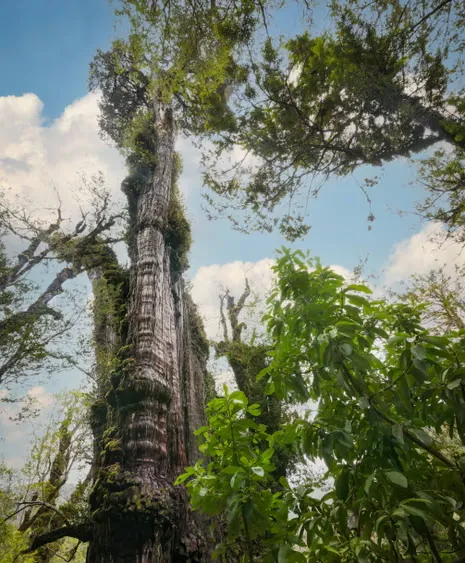
Deep within the temperate rainforests of Chile’s Alerce Costero National Park lies the Gran Abuelo, an ancient conifer that has held onto a significant secret for thousands of years. A new study published in the journal Biodiversity and Conservation has unveiled that the tree’s most remarkable value lies beneath its surface. Researchers analyzed soil samples from Gran Abuelo and discovered a previously unknown thriving community of life. This examination led to the identification of over 300 species of fungi, many unique to this ancient soil, which form a mycorrhizal network with the tree.

The Importance of Mycorrhizal Networks

This mycorrhizal network is crucial for the Gran Abuelo as it provides essential nutrients and water, while also serving as the foundation for the entire microbial ecosystem of the forest. Experts emphasize that the loss of such ancient trees could trigger a chain reaction within the forest’s carbon cycle, impacting the delicate ecological balance.

Gran Abuelo: A Historical Giant

Gran Abuelo, or ‘Great-Grandfather,’ is an enormous Alerce tree (Fitzroya cupressoides) conformed in Chile’s Alerce Costero National Park. With a height surpassing 60 feet and a trunk diameter exceeding 13 feet, Alerces are native to the temperate rainforests of Patagonia and have thrived for millennia. While there is ongoing debate regarding its exact age, environmental scientist Jonathan Barichivich has estimated through advanced modeling and partial core sampling that Gran Abuelo may be nearly 5,500 years old. This age would surpass that of ‘Methuselah,’ a Bristlecone pine in California, possibly making Gran Abuelo the oldest living individual tree on the planet.

A Rich Biodiversity Unearthed

While the age of Gran Abuelo is astonishing, researchers are more intrigued by the richness of life sustained within its underground network. By employing DNA sequencing, scientists mapped the mycorrhizal networks surrounding the tree. The findings indicated that the soil under Gran Abuelo is 2.25 times more biodiverse compared to the soil beneath more recently established trees in the same forest. Specifically, over 300 species of fungi were discovered within this subterranean ecosystem, many of which are not found anywhere else globally.

The Role of Fungi in Tree Survival

This discovery indicates that Gran Abuelo acts not merely as a tree, but as a central hub for a complex biological support system. Experts from the Royal Botanic Gardens in Kew highlight that these fungi form a mutualistic relationship with the tree. While the tree provides sugars through photosynthesis, the fungi extend into the ground, supplying phosphorus, nitrogen, and water, especially during dry periods. Hence, this ancient network may be the key factor in Gran Abuelo’s resilience against environmental stressors like climate change and fires.

The Historical Context of Soil Biomes

Though Gran Abuelo is estimated to have existed for about 5,000 years, the World Wildlife Fund (WWF) notes that the region functioned as an ‘ice age refuge,’ enabling soil biomes to develop undisturbed for more than 30,000 years prior to the tree itself taking root. Consequently, this created extensive underground networks that sequester carbon dioxide deep within the earth. Scientists warn that should these ancient trees succumb to climate change or human actions, the resulting degradation of this 30,000-year-old carbon storage system could lead to substantial greenhouse gas emissions into the atmosphere.

Long or Short, get news the way you like. No ads. No redirections. Download Newspin and Stay Alert, The CSR Journal Mobile app, for fast, crisp, clean updates!

App Store –  https://apps.apple.com/in/app/newspin/id6746449540 

Google Play Store – https://play.google.com/store/apps/details?id=com.inventifweb.newspin&pcampaignid=web_share

Latest News

Popular Videos
