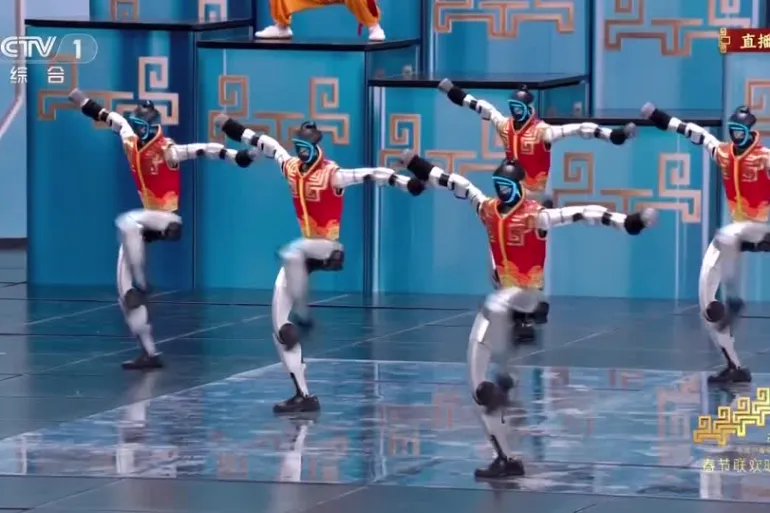
In a remarkable exhibition of technological progress, China’s annual Spring Festival Gala featured humanoid robots performing intricate martial arts routines. This year’s event, broadcast on state television, underscored significant advancements in robotics, contrasting sharply with the previous year’s more simplistic robotic performances.
Innovative Robotic Performances Captivate Audience
The gala, which took place on Lunar New Year’s Eve, garnered attention globally, with nearly 500,000 views on YouTube shortly after its airing. The highlight of the show was the performance by two dozen humanoid robots, which accomplished numerous groundbreaking feats. These included the world’s first continuous freestyle table-vaulting parkour, an aerial flip, continuous single-leg flips, a two-step wall-assisted backflip, and a 7.5-rotation Airflare grand spin, as reported by state broadcaster CGTN.
Collaborative Efforts Behind the Performance
This ambitious robotic display resulted from a collaboration among four companies: Unitree, Magiclab, Galbot, and Noetix, with partnerships reportedly valued at approximately 100 million yuan (around $14 million). The initial performance featured Noetix’s Bumi robots in a comedic sketch, followed by demonstrations of martial arts by Unitree’s robots, which included impressive backflips and trampoline stunts. The performance culminated in a musical section led by Magiclab’s humanoid robots.
Implications for Global Robotics Landscape
Ramesh Srinivasan, an expert in artificial intelligence policy at the University of California, outlined that this event signals a significant message from Beijing about its technological capabilities, particularly directed at international observers, including the United States. This showcase of robotics illustrates China’s ambition in humanoid technology, which it sees as vital for various sectors, especially as its population begins to decline.
Comparative Insights from Global Tech Leaders
The gala’s robotic innovations have emerged during a period of heightened interest in humanoid robots globally. Recently, Elon Musk discussed their potential at the World Economic Forum in Davos, expressing confidence that such robots would be available to the public by the end of next year. This anticipation of expanding robotic integration raises questions about societal and economic implications, particularly for the workforce.
Concerns and Future Considerations
Srinivasan emphasized the need for a dialogue surrounding the societal impacts of humanoid robots, specifically their roles in the workplace and personal life. He posed crucial questions about the appropriateness of humanoid robots in specific contexts, asserting the importance of focusing on enhancing the human experience with technology. He highlighted the necessity for security and support in the human condition amidst these rapid technological changes, referencing existing studies that indicate increasing disconnection among people due to AI integration.