


Pilots’ Body Urges DGCA to Introduce Oral-Fluid Testing in Safety Upgrade
The CSR Journal Magazine

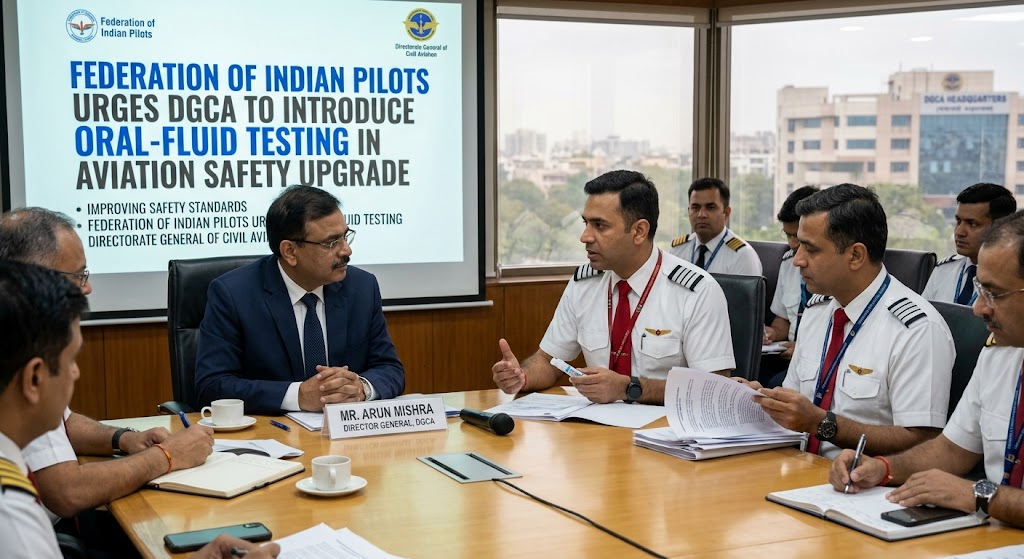
The Federation of Indian Pilots (FIP) has officially proposed to the Director General of Civil Aviation (DGCA) the incorporation of oral-fluid testing into the existing psychoactive-substance testing protocols for pilots. The FIP presented this representation in a letter dated August 18, noting that the recent growth in Indian aviation necessitates additional testing methodologies to bolster safety and efficiency.

Proposed Methodology and Benefits

The FIP’s letter outlines the current Civil Aviation Requirement (CAR) Section 5 framework, which mandates random urine testing for at least 10 per cent of applicable personnel annually. The federation argues that while the existing urine-test system is well-established, incorporating oral fluid testing could present several benefits. These include a more straightforward process, immediate observability, and potential execution at or near the workplace.

Notably, the FIP highlighted that the time required for oral-fluid collection is significantly less, taking approximately 15 minutes, compared to about 45 minutes for urine collection. This efficiency could theoretically decrease collection workload by 66.7 per cent, allowing for enhanced testing capacity without causing operational disruptions.

The federation proposed a “risk-based hybrid model” where oral fluid testing would be applied for high-volume random screenings at airports, while urine testing would be retained for cases that necessitate longer detection intervals or meet specific medical criteria.

Testing Coverage and Safeguards

A key recommendation in the FIP’s correspondence is to raise the annual random testing coverage for pilots from the current rate of 10 per cent to at least 25 per cent. This adjustment is suggested to increase the deterrent effect of the testing process. The federation firmly stated that oral-fluid testing should serve as a complementary method rather than a direct replacement for the existing urine-testing system.

The FIP made it clear that detecting a substance alone does not equate to proof of impairment. Thus, they stressed the importance of maintaining a thorough procedural sequence that includes initial screening, confirmatory laboratory testing, medical review, and final regulatory assessment.

To assess the effectiveness of oral-fluid testing, the FIP has requested the DGCA to initiate a controlled pilot programme lasting 12 months. They also suggested implementing a compulsory “Pilot Psychoactive-Substance and Medication Awareness Programme,” which encompasses the “Check Before You Take” principle, aimed at educating pilots on the impacts of various medications on flight safety and testing outcomes.

International Precedents and Recent Incidents

The federation’s recommendations draw on successful frameworks from international aviation safety authorities, specifically highlighting examples from Australia’s Civil Aviation Safety Authority (CASA), the United States Department of Transportation (DOT), and the United Arab Emirates’ General Civil Aviation Authority (GCAA). The FIP asserts that these improvements would enhance the overall efficiency and scalability of the safety regime without undermining existing safety protocols.

This proposal arrives in light of a recent incident involving an Air India flight, AI2379, which experienced an unexpected altitude drop of 300 feet while over Odisha, resulting in injuries to twenty passengers and four cabin crew members. Subsequently, Air India has mandated comprehensive screening for unauthorised substances and medications for all crew members on the aircraft involved.

Additionally, a technical issue concerning a triple hydraulic failure on the aircraft is currently undergoing investigation by the Directorate General of Civil Aviation (DGCA) and the Aircraft Accident Investigation Bureau (AAIB). The outcomes of these inquiries may further inform the context of the FIP’s recommendations and the responses from the DGCA.

Long or Short, get news the way you like. No ads. No redirections. Download Newspin and Stay Alert, The CSR Journal Mobile app, for fast, crisp, clean updates!

App Store –  https://apps.apple.com/in/app/newspin/id6746449540 

Google Play Store – https://play.google.com/store/apps/details?id=com.inventifweb.newspin&pcampaignid=web_share

Latest News

Popular Videos
