


Delhi Police Urges Immediate Redesign of Barapullah Phase-III Junction Due to Increased Traffic Congestion

The CSR Journal Magazine

The Delhi Traffic Police has called for an urgent redesign of a merger point on the recently opened Barapullah Phase-III flyover, citing that its current layout is exacerbating traffic congestion on a crucial corridor. Officials have identified particular areas of concern near Sundial Park, where the new flyover segment connects with the existing Barapullah corridor. This request follows closely on the heels of the flyover’s inauguration, which was anticipated to enhance connectivity between southern Delhi and regions such as Mayur Vihar and Sarai Kale Khan, while also alleviating pressure on current arterial routes.

Joint Inspection Reveals Geometry and Traffic Flow Issues

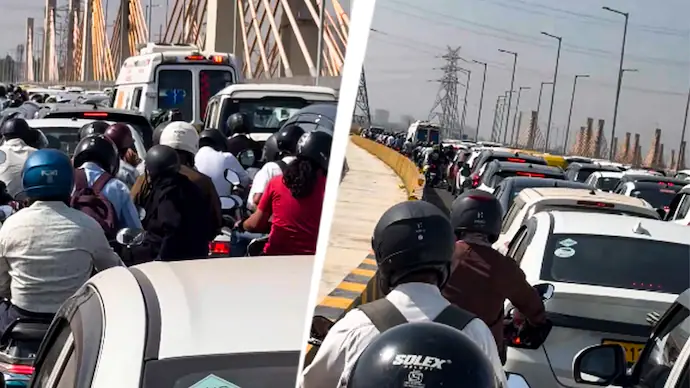
Since the flyover’s opening, traffic conditions have reportedly worsened. Commuters travelling along the nearly eight-kilometre stretch from Safdarjung Hospital to Sarai Kale Khan have been experiencing delays, taking over an hour to complete their journeys as of Thursday evening. A joint inspection conducted by high-ranking officials from the traffic police and the Public Works Department (PWD) on October 1 uncovered various geometric and traffic flow issues at the merger point located near Sundial Park.

In a formal communication to the PWD, the traffic police indicated that the existing configuration is contributing to “significant traffic congestion.” This situation is further aggravated by the exceptionally high volume of vehicles now using the newly constructed corridor. A drone survey conducted by the traffic police provided further insights into the challenges at the junction, where multiple streams of traffic intersect within limited road space.

The Phase-III flyover features three lanes, which converge with an additional three lanes of traffic coming from Sundial towards Sarai Kale Khan and Ring Road. Furthermore, three lanes from the Ashram and DND side also merge into the existing Barapullah corridor. However, at this junction, the structure narrows to two lanes, resulting in a mismatch between the number of inbound lanes and the available capacity ahead, creating potential choke points.

Design Flaws Contributing to Traffic Bottlenecks

Additionally, the traffic police have noted that the physical design of the merger area worsens the situation. The new flyover intersects with the older structure near Sundial at a relatively sharp angle rather than following a gradual curve. This design flaw leads to abrupt merging of traffic, creating a bottleneck at the junction and hampering fluid movement.

Officials have expressed concern that the current arrangement is particularly problematic given the significant traffic produced by the new corridor. Vehicles from various directions must merge within a constrained section, resulting in delayed movement and persistent congestion. The traffic police emphasized the need for structural redesign rather than relying solely on enforcement and traffic regulation, advocating for engineering modifications at the Sundial merger.

By focusing on these corrective measures, officials believe that the additional capacity provided by the new flyover can lead to smoother traffic flow instead of merely relocating congestion to the junction where the new and existing corridors converge. Such a redesign aims to enhance overall traffic management and efficiency in the area.

Long or Short, get news the way you like. No ads. No redirections. Download Newspin and Stay Alert, The CSR Journal Mobile app, for fast, crisp, clean updates!

App Store –  https://apps.apple.com/in/app/newspin/id6746449540 

Google Play Store – https://play.google.com/store/apps/details?id=com.inventifweb.newspin&pcampaignid=web_share

Latest News

Popular Videos