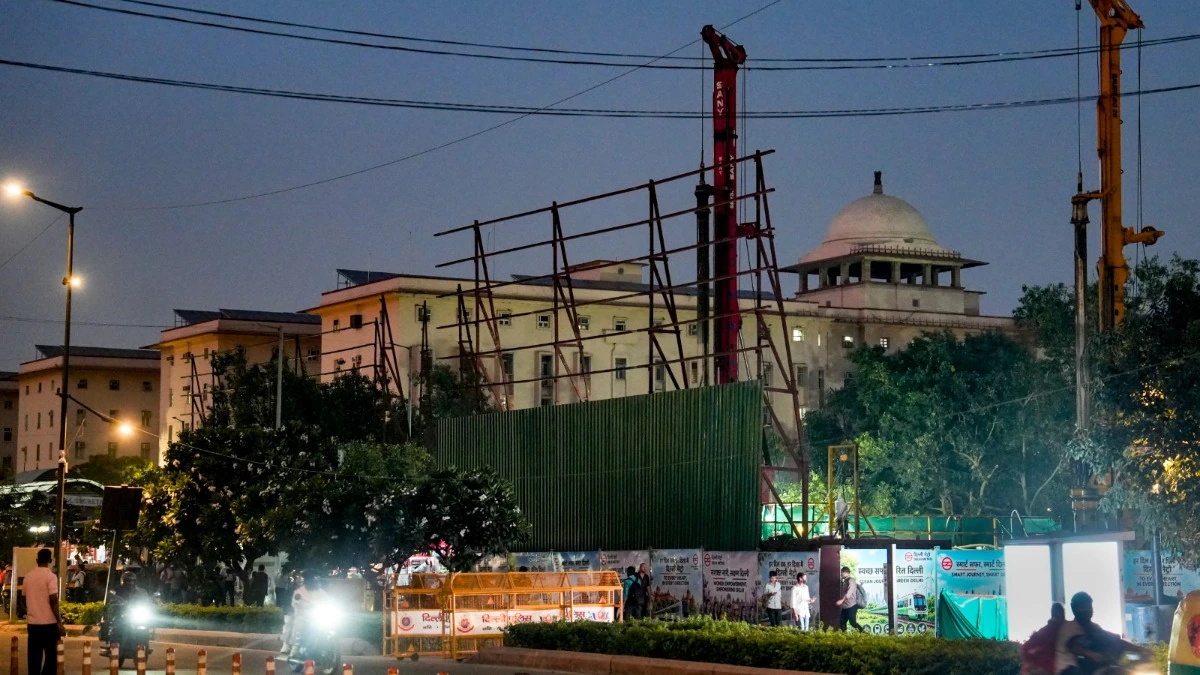
The Centre has informed the Delhi High Court that it intends to remove a mosque situated within the Krishi Bhawan complex in New Delhi to facilitate the construction of new government buildings as part of the Central Vista redevelopment initiative. The government argues that maintaining the mosque is incompatible with the secular nature of government property. Krishi Bhawan, a significant structure from the Nehruvian era, is located on Doctor Rajendra Prasad Road and houses several ministries, including the Ministry of Agriculture and Farmers’ Welfare.
The mosque, known as Qadeemi Masjid, has reportedly existed for over a century, predating the establishment of the current government complex. The Centre’s affidavit in court asserts that a permanent religious structure within a government office complex is not permissible. The mosque occupies the site designated for the construction of new buildings in the Central Secretariat area.
In a petition submitted to the Delhi High Court in September 2023, the mosque’s caretakers claimed that its existence is documented in historical records dating back to 1945, two years before India gained independence. The term “Qadeemi” translates to “ancient” in Urdu, reflecting its long-standing presence in the area.
Legal Proceedings and Arguments
The petitioners, represented by senior advocate Salman Khurshid, highlighted the mosque’s historical significance and its established role as a place of worship for employees of Krishi Bhawan and surrounding government offices. They argued that the mosque has served as a vital location for prayers during working hours, invoking Article 25 of the Indian Constitution, which guarantees the right to freely practice religion.
The Delhi Waqf Board officially recognised the mosque as Waqf property in 1970, further affirming its historical value. The caretaking committee expressed concerns over the potential removal of the mosque amid ongoing redevelopment efforts, stressing that its removal would violate the religious rights of those who utilise it.
The Centre, however, has pointed to a 1940 agreement that allowed the mosque’s managing committee to use the site but did not confer ownership. According to the government’s submissions, the agreement stipulated that any alterations or new constructions would require prior government approval, reinforcing the notion that the land remains under government control.
Historical Context of the Mosque’s Location
The 1940 agreement is pivotal in understanding the mosque’s historical context. It indicates that Qadeemi Masjid was established at least by November 1940, well before the completion of Krishi Bhawan in 1957. This suggests that the mosque was not an unauthorised structure but rather one that was permitted by the administration of the time.
New Delhi was developed following the British decision to shift the capital from Calcutta to Delhi in 1911, leading to the construction of significant landmarks. Post-independence, under Prime Minister Jawaharlal Nehru, the Central Secretariat expanded, with various government buildings emerging between the 1950s and 1960s. Notably, other mosques in the vicinity, such as Zabta Ganj Masjid and Sunehri Bagh Masjid, also predate these government structures.
As the Centre’s Central Vista redevelopment plans advance, the future of Qadeemi Masjid remains uncertain. The historical agreement and the mosque’s longstanding presence will be crucial factors in determining its fate amid the ongoing changes in the area.
Long or Short, get news the way you like. No ads. No redirections. Download Newspin and Stay Alert, The CSR Journal Mobile app, for fast, crisp, clean updates!