


app-store-logo
play-store-logo
March 5, 2026

Global Leaders Convene at Raisina Dialogue 2026 to Discuss AI, Security, and World Order
The CSR Journal Magazine

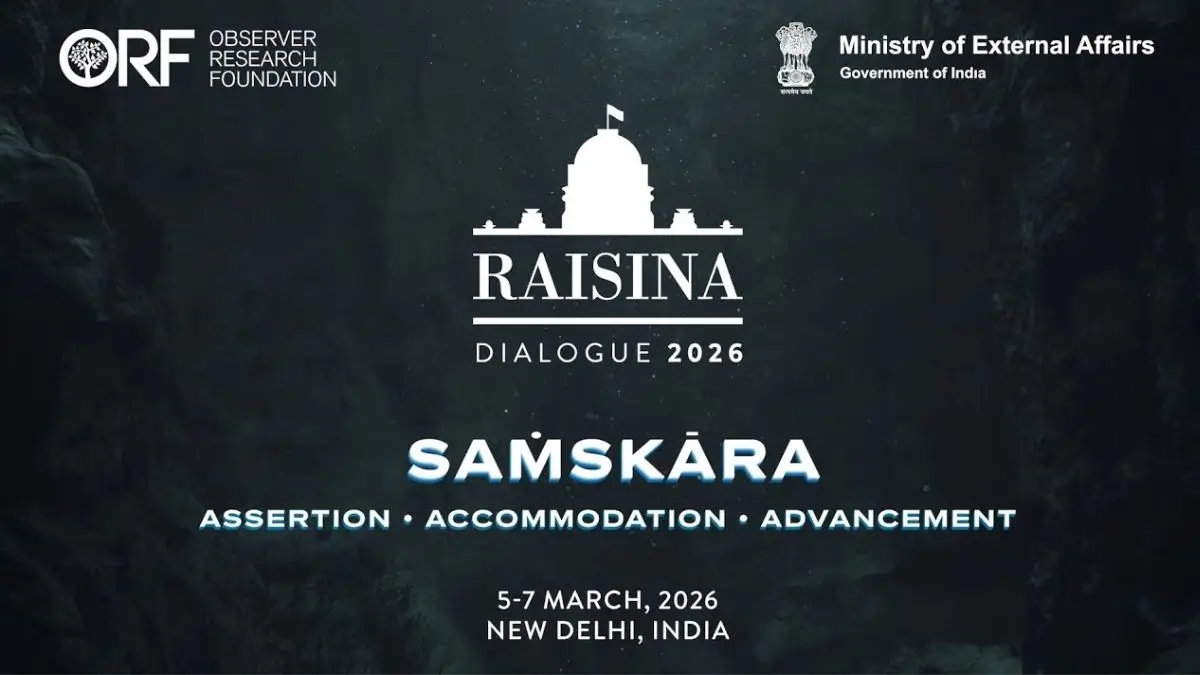
The annual Raisina Dialogue is set to commence in New Delhi on Thursday, gathering influential leaders, policymakers, and technology experts to engage in discussions on future geopolitical dynamics, geo-economics, and the impact of emerging technologies. This year’s theme, “Samskara: Assertion, Accommodation, Advancement,” encapsulates the complexities of current global challenges.

Organized by the Observer Research Foundation in collaboration with India’s Ministry of External Affairs, the three-day conference, running from March 5 to 7, aims to explore technological disruptions, strategic competition, and the implications for economic security on a global scale.

Dignitaries in Attendance

Several prominent dignitaries are participating in this year’s dialogue, including Ian Borg, Deputy Prime Minister and Minister for Foreign Affairs and Tourism of Malta; Lyonpo D N Dhungyel, Minister for Foreign Affairs and External Trade of Bhutan; and Dhananjay Ramful, Minister of Foreign Affairs, Regional Integration & International Trade of Mauritius. Also present will be Barry Faure, Minister for Foreign Affairs & Diaspora of Seychelles, and Vijitha Herath, Minister of Foreign Affairs, Foreign Employment & Tourism of Sri Lanka. Finnish President Alexander Stubb is the Chief Guest for the event, having arrived in the capital on Wednesday.

Focus on Geopolitical Tensions

This year’s discussions will center around the evolving landscape of international alliances amidst what analysts describe as a “technopolar” world, characterized by the significant influence of artificial intelligence, semiconductor supply chains, and digital governance. On the opening day, sessions will address the diminishing reliability of traditional security guarantees and the emergence of digital-first governance models. Panels will also assess the future of transatlantic security, particularly examining the “Paradox of NATO” and the heightened expectations on European members to bolster their defense capabilities in light of shifting U.S. commitments.

India’s Digital Initiative

A notable session will highlight India’s Digital Public Infrastructure (DPI) model, presenting it as a potential “Manhattan Project for AI for public good.” This initiative aims to enhance digital inclusion, particularly for rural communities and informal workers. Climate-related geopolitical discussions will address strategies for mitigating climate finance risks and ensuring green investments remain stable, even amid great-power rivalries, while also spotlighting renewable energy partnerships across the Gulf, Europe, and developing nations.

Security and Technology Challenges

The dialogue’s second day will pivot towards examining security challenges and technological competition. Significant discussions will focus on deterrence in the Taiwan Strait and the geopolitical stability shaped by reliance on semiconductors. Additional sessions will investigate the disparities in defense production capabilities between Western countries and Russia’s wartime mobilization efforts. The credibility of multilateral institutions, particularly the United Nations Security Council, will also be critically assessed amid the increasing unilateral actions of major powers.

Regional Focus and Emerging Issues

Parallel sessions will encompass a range of topics, from Africa’s demographic evolution to Latin America’s essential role in supplying critical minerals necessary for the AI sector. Experts will delve into the emerging risks posed by agentic artificial intelligence, particularly with respect to autonomy, cyber vulnerabilities, and digital sovereignty. The agenda will culminate with discussions on the future global order, concentrating on economic resilience and maritime security challenges affecting the Indian Ocean and Red Sea.

Conclusion of the Dialogue

The final day will explore themes such as economic coercion and supply chain security, reflecting the intersection of trade interdependence and strategic rivalry. Global connectivity initiatives, including the proposed India-Middle East-Europe Economic Corridor, will be reviewed for their potential to enhance logistics and trade links among Asia, the Middle East, and Europe. India aims to establish itself as a “bridge nation” between advanced economies and the Global South, reinforcing its role in digital governance and maritime security. The dialogue will also address India’s long-term vision, “Viksit Bharat 2047,” which seeks to transform the nation into a developed economy by the centenary of its independence, marking the eleventh edition of this esteemed strategic forum.

Long or Short, get news the way you like. No ads. No redirections. Download Newspin and Stay Alert, The CSR Journal Mobile app, for fast, crisp, clean updates!

App Store –  https://apps.apple.com/in/app/newspin/id6746449540 

Google Play Store – https://play.google.com/store/apps/details?id=com.inventifweb.newspin&pcampaignid=web_share

Latest News

Popular Videos
