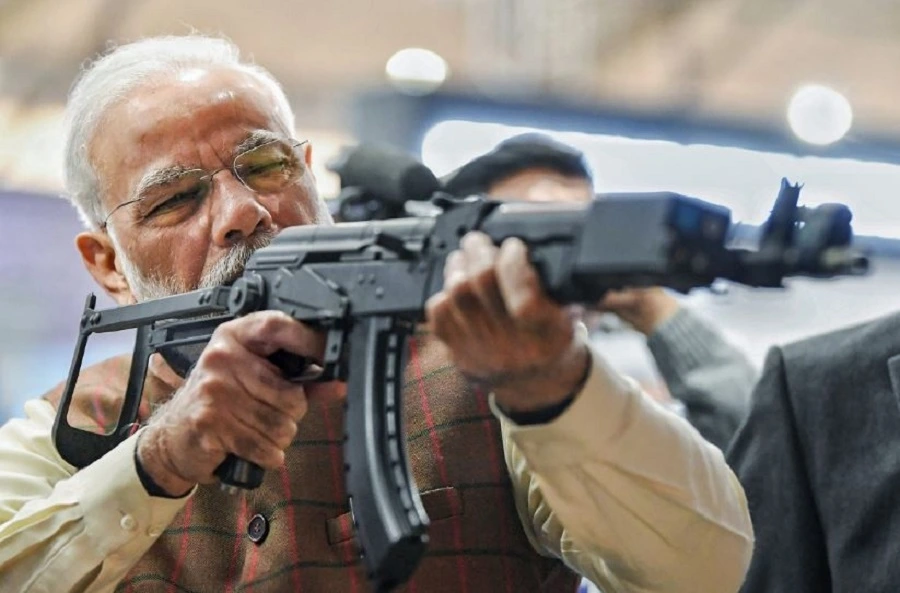
India is redefining its place in the global defence environment in a move that bears both strategic depth and emotional pride. Once largely reliant on imports, the nation is becoming a reliable supplier of military hardware for the first time in its history. Narendra Modi, whose vision of self-reliance has transformed ambition into quantifiable reality, is at the center of this shift.
Several countries are becoming increasingly concerned about India’s growing contribution to the world’s defence exports. Analysts point out that countries whose economy rely significantly on arms exports may face serious difficulties as a result of India’s capacity to provide military hardware at relatively reduced costs. The international defence market may become more competitive as a result of this change.
Some observers also suggest that the geopolitical landscape may become increasingly complex as India pursues its ambition of becoming a major defence manufacturing hub. At the same time, political debates and criticisms surrounding Prime Minister Narendra Modi have grown more prominent, with differing perspectives on whether these developments are linked to broader strategic and economic interests. Some also speculate that sections of the international community may be attempting to sabotage Modi’s endeavors through sustained negative publicity, in order to prevent him from realizing his ambition, although such claims remain contested and lack conclusive evidence.
The figures themselves convey a compelling narrative. India’s defence exports increased steadily from ₹21,083 crore the year before to a record ₹23,622 crore (about $2.76 billion) in the fiscal year 2024–2025. The long-term trend is even more remarkable—just ten years ago, in 2013–14, exports totaled a meager ₹686 crore.
That means India’s defence exports have grown over 30 times in ten years, a transformation rarely seen in such a complex sector.
There is no slowdown in this growth. According to recent data from 2025–2026, exports increased to over ₹38,424 crore, a staggering increase of more than 60% in a single year. This quick transition indicates that India is arriving not experimenting.
These figures are the result of a structural change brought about by policy Initiatives like Make in India and Atmanirbhar Bharat, spearheaded by prime minister Modi, that have increased domestic production, promoted private sector involvement, and decreased dependency on foreign suppliers. Currently, more than 100 Indian businesses export defence equipment to 80–100 nations across the globe.
India now exports highly complex equipment rather than simple machinery. Indian defence industry has advanced to a new level, producing everything from radars, artillery systems, and missiles to armored vehicles, patrol boats, and avionics parts. In 2024–2025, the private sector alone contributed more than ₹15,000 crore in exports, demonstrating the expansion of industry participation beyond government enterprises.
Beyond the figures lies a deeper transformation. For decades, India’s defence posture was defined by dependence on external suppliers. That narrative is now being decisively reshaped. The country’s growing ability to export defence equipment reflects not only economic progress but also a strengthened confidence in its indigenous capability to design, manufacture, and deliver high-quality military systems.
There are significant long-term ramifications. Defence exports are starting to play a significant role in the expansion of manufacturing and the creation of jobs. From a strategic standpoint, they are bolstering India’s diplomatic relations because countries that purchase defence equipment frequently form enduring alliances. Most significantly, this change improves national security because self-reliance makes India less susceptible to disruptions in external supplies.
This journey is just getting started, as the government has set an ambitious goal of ₹50,000 crore in defence exports by 2029.
Of course, there are still obstacles to overcome, such as execution difficulties, technological limitations, and international rivalry. However, the direction is clear.
India’s emergence as a defence exporter is more than a policy milestone—it is a story of transformation. It reflects a nation that has moved from dependence to determination, and from hesitation to growing strategic confidence.
And at its core lies a vision—one that dared to believe India could not only defend itself, but also equip the world.