


Akhilesh Yadav’s Game Plan for the Uttar Pradesh Elections
The CSR Journal Magazine

Coalition Building for Electoral Success

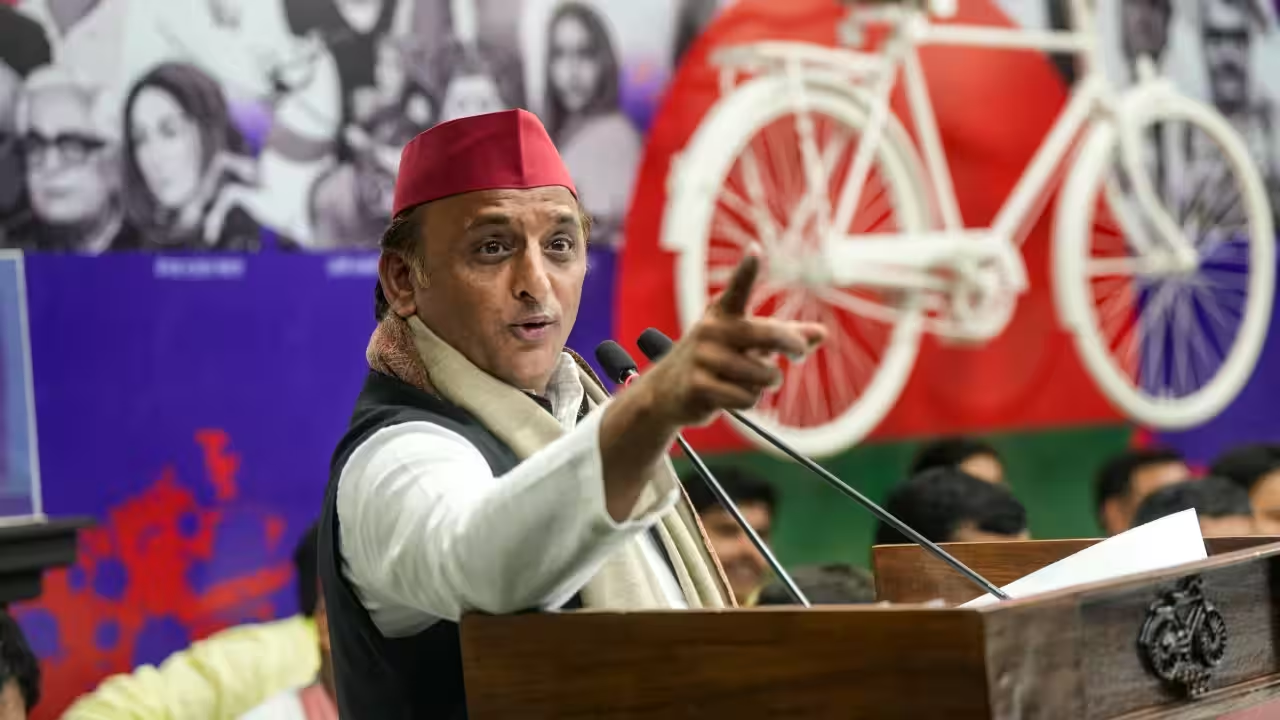
Akhilesh Yadav, the president of the Samajwadi Party, is devising a strategy aimed at expanding his party’s anti-BJP coalition ahead of the Uttar Pradesh assembly elections scheduled for 2027. His approach focuses on uniting various social groups, including backward classes, Dalits, minorities, and the traditional Muslim-Yadav vote base, along with engaging discontented young voters. Yadav expressed confidence that this combination would lead to the BJP’s defeat in the state.

On Friday, Yadav articulated his vision, stating that if the Muslim-Yadav (M-Y) votes remain intact and the coalition of “Picchda, Dalit, Alpasankhyak” (PDA) is effectively mobilised, coupled with the rising frustration among Generation Z, the BJP’s downfall is inevitable. The PDA acronym is intended to broaden the party’s social appeal and provide a more inclusive political alternative to the ruling party.

In recent years, Yadav has strategically downplayed the emphasis on the M-Y formula in his public discourse, instead prioritising the PDA coalition. This shift aims to attract a wider demographic, thereby enhancing the party’s electoral prospects.

BJP’s Counter Strategies and Political Dynamics

The BJP has consistently targeted the Samajwadi Party’s Muslim-Yadav support base, particularly during the 2022 assembly election campaign. BJP leaders reframed the M-Y acronym to represent “Modi-Yogi,” referring to Prime Minister Narendra Modi and Uttar Pradesh Chief Minister Yogi Adityanath. Additionally, the BJP reinterpreted the acronym to signify “Mahila” (women) and “Yuva” (youth), attempting to dilute the significance of the traditional Muslim-Yadav alliance.

Yadav’s recent remarks also extended to the ongoing protests against the Election Commission. He defended the right to peaceful demonstrations and questioned the lack of arrests of individuals in civilian clothing who allegedly attacked protesters during a demonstration in Delhi. He asserted that in a democratic society, citizens are entitled to express their opinions through peaceful means.

Yadav drew a parallel between the current political climate and historical instances of oppression, suggesting that the BJP employs tactics reminiscent of those used in Nazi Germany. He accused the ruling party of deploying political operatives against ordinary citizens, claiming that this strategy mirrors actions taken during Hitler’s regime.

Critique of Government Policies

In addition to his electoral strategy, Akhilesh Yadav has also voiced criticism regarding the BJP-led government’s foreign policy, particularly in light of the ongoing geopolitical tensions involving Iran, the United States, and Israel. He contended that the government has failed to safeguard Indian citizens working abroad, labelling it as one of the weakest administrations in terms of foreign policy.

Yadav challenged the BJP’s assertions of positioning India as a “Vishwaguru,” arguing that such claims are undermined if the government cannot ensure the safety of Indians overseas. He invoked the principle of “Vasudhaiva Kutumbakam,” emphasising the need for a more compassionate and protective foreign policy.

Through these statements, Yadav aims to galvanise support for his party while highlighting perceived failures of the current government. His focus on coalition-building and addressing pressing social issues reflects a strategic approach as the 2027 elections draw closer.

Long or Short, get news the way you like. No ads. No redirections. Download Newspin and Stay Alert, The CSR Journal Mobile app, for fast, crisp, clean updates!

App Store – https://apps.apple.com/in/app/newspin/id6746449540

Google Play Store – https://play.google.com/store/apps/details?id=com.inventifweb.newspin&pcampaignid=web_share

Latest News

Popular Videos
