Prepaid cards for online payments: convenience and security

The CSR Journal Magazine

Virtual prepaid cards solve a fundamental problem in digital finance: how to make online purchases without exposing your entire bank account to potential compromise. The architecture differs completely from traditional payment cards. Where a debit card connects directly to your checking account and a credit card links to a revolving credit line, a prepaid card operates as an isolated financial instrument. You load a specific amount, that amount becomes the absolute ceiling of what can be spent. No merchant, no hacker, no system glitch can extract more than what you deliberately placed there.

Scenarios where prepaid cards excel

International subscription services

Consider subscribing to a specialized software tool, streaming platform, or cloud service operated by a company in another country. These services typically require Visa or Mastercard and process recurring monthly charges. Giving them your primary bank card creates exposure that extends indefinitely into the future.

Here’s what actually happens when you use your main card: the merchant stores your card details in their payment system. Their security standards may or may not match your bank’s. Their employees may or may not have adequate access controls. A breach at their end six months from now compromises your current card, even if you’ve stopped using their service.

A prepaid card compartmentalizes this risk completely. Load exactly twelve months of subscription cost onto a dedicated virtual card. Link that card to the service. If their database gets breached, the attackers obtain card credentials that connect to a fixed, finite pool of money that you chose in advance. Your main bank account remains completely isolated from the incident.

Digital advertising spend management

Running paid ads on platforms like Facebook, Google, or TikTok creates specific financial risks that most businesses underestimate. These platforms require linking a payment method to your ad account. They automatically charge that payment method as your campaigns consume budget. The problem emerges when the platform’s automated systems flag your account.

Ad platforms use algorithmic detection systems that sometimes block accounts instantly, without human review, based on pattern matching that may or may not be accurate. When they block your account, they often freeze the associated payment method within their system simultaneously. Your card isn’t stolen, your credentials aren’t compromised, but you cannot use that card for other ad campaigns until the platform resolves their review, which can take days or weeks.

Creating separate prepaid cards for each ad account or major campaign transforms this operational headache into a minor inconvenience. Platform blocks one card? You’ve already got another ready, or you generate a new one in under two minutes. Your advertising operations continue without pause.

Several prepaid card providers specifically optimize for advertising spend by offering cashback on ad platform purchases. At scale, this matters considerably. If you’re spending $50,000 monthly on Facebook ads and receiving 2% cashback, that’s $1,000 returning to your account every month, or $12,000 annually. That number alone often exceeds the total cost of using the prepaid card service.

Purchases from low-trust merchants

You find a product available only through a small ecommerce site you’ve never heard of. Reviews exist but seem mixed. The site looks legitimate enough but doesn’t have the polish of major retailers. You need the product but can’t verify the merchant’s security practices or business reputation.

Using your primary card here means trusting this merchant’s entire technology stack. You’re trusting their website code doesn’t have vulnerabilities. You’re trusting their payment processing integration was implemented correctly. You’re trusting they store card data properly if they store it at all. You’re trusting their hosting provider secured their servers. That’s a lot of trust to extend to an unknown entity.

Load a prepaid card with the purchase amount plus estimated shipping. Complete the transaction. If the product arrives as expected, excellent. If something seems wrong, you block the card immediately through your phone. The merchant has already been paid for the legitimate transaction, but the card they have on file can no longer be charged. If their systems were compromised and your card data was exfiltrated, those credentials are now worthless.

Expense category separation

Freelancers and small business owners face tedious accounting work separating business expenses from personal spending, especially at tax time. Opening a dedicated business bank account solves this but adds monthly fees, minimum balance requirements, and administrative overhead that may not make sense for smaller operations.

Generate multiple prepaid cards, each designated for a specific business expense category. One card handles all software subscriptions. Another covers advertising. A third pays for contractor services or materials. Every transaction automatically sorts itself by which card you used. When you need to compile expenses for tax filing or client billing, you export the transaction history for the relevant card. No manual categorization, no sorting through mixed statements, no guessing whether a charge was business or personal.

Security architecture of prepaid cards

The security model centers on blast radius limitation. Security professionals use this concept when designing systems: if something goes wrong, how much damage can occur before containment? Prepaid cards answer this question definitively: damage cannot exceed the loaded balance.

Compare the failure modes. Someone compromises your debit card credentials. Before you notice and report it, they can attempt to drain your entire checking account. Your bank will likely reimburse you after investigation, but you’ve experienced days or weeks of locked funds, paperwork, and stress. Your checks might bounce, autopay bills might fail, and you’re managing financial chaos.

Someone compromises your prepaid card loaded with $200 for a specific purchase. Maximum loss: $200. You typically notice immediately because you’re actively using the card. You block it instantly through an app. Generate a new card number. Resume your activity. Total disruption time: under five minutes.

The 3D Secure protocol adds a secondary authentication layer that changes the threat model substantially. Card number, expiration, and CVV are no longer sufficient to complete a purchase. The payment triggers a push notification to your phone or a text message with a one-time code. An attacker with your card credentials but without access to your phone cannot complete fraudulent transactions.

Generating multiple cards for different purposes creates inherent segmentation. Each online merchant receives unique card credentials. A breach at Merchant A that exposes your card data doesn’t affect cards used at Merchants B, C, and D. Compromise of one card requires you to replace only that card, not every payment method you use online.

The virtual format eliminates physical attack surfaces entirely. Card skimmers at gas pumps or ATMs cannot capture what never physically exists. Criminals using handheld skimmers in restaurants have nothing to skim. RFID readers attempting to wirelessly capture card data from your wallet find nothing to read.

Prepaid card service providers

PSTNET

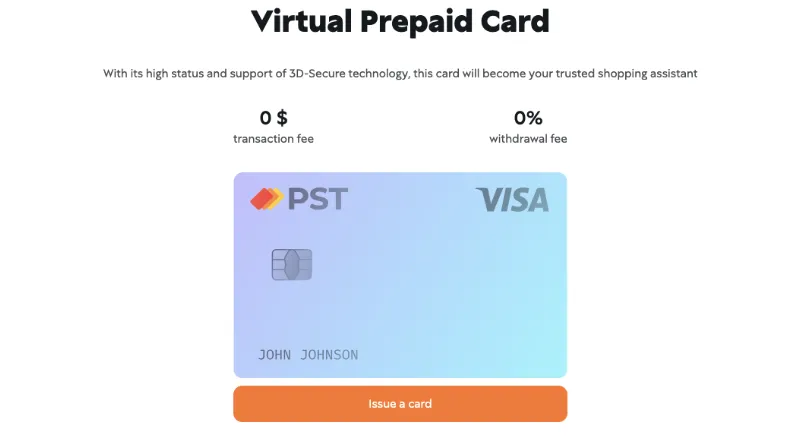
PSTNET differentiates itself through purpose-built card products matched to specific transaction types. Rather than offering a single generic prepaid card, they maintain distinct card programs optimized for different use cases. Their advertising-focused cards deliver enhanced cashback rates on ad platform spending. The general purpose PSTNET virtual prepaid card handles standard ecommerce transactions.

The funding architecture uses a two-tier design. You deposit funds into a master balance within your account dashboard using whichever method works for your situation. From that master balance, you allocate specific amounts to individual cards. This approach gives you precise control over how much exposure each card has while maintaining flexibility to redistribute funds as needs change.

PSTNET’s fee structure eliminates several charges that competitors typically impose. They collect zero fees on transactions themselves, charge nothing for withdrawing funds from a card back to your balance, and don’t penalize you for operations involving blocked cards. New users receive a specific bonus: their first USDT deposit posts to their account with zero processing fees.

The range of deposit methods accommodates users across different banking systems and preferences. Traditional banking customers can use SEPA transfers within Europe or SWIFT transfers internationally. Credit and debit card users can fund via standard Visa or Mastercard. Cryptocurrency users have access to 18 different digital assets including Bitcoin, Ethereum, and USDT on both TRC20 and ERC20 networks. This breadth ensures you can move money into the system regardless of which financial rails you typically use.

Security implementation includes mandatory 3D Secure protection on all card transactions and required two-factor authentication for account access. The verification process for new accounts requires only a passport for KYC compliance, avoiding the extensive documentation requests some financial services impose.

Account creation takes approximately two minutes through single sign-on with Google, Telegram, WhatsApp, or Apple ID, or through standard email registration. Card management happens through either a dedicated mobile application or a Telegram bot integration. Support staff maintain 24/7 availability through Telegram and other messaging platforms.

Spend.net

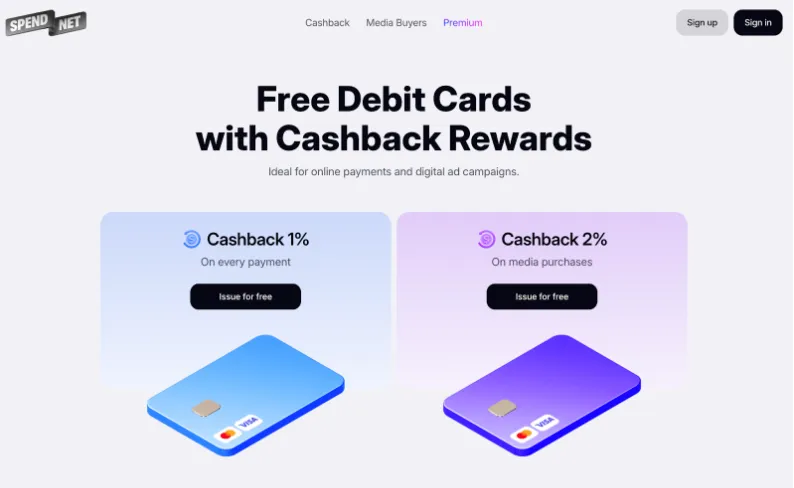
Spend.net positions itself specifically for advertising spend and general online commerce. The registration flow removes unnecessary friction: email address or Google authentication gets you started immediately.

Card issuance carries no fee, and activation occurs the moment your first Spend.net deposit clears. Funding options include cryptocurrency deposits in Bitcoin and USDT TRC20.

Their cashback program creates meaningful economics for higher-volume users. Advertising expenditures earn 2% cashback, while standard online purchases return 1%. For a media buyer spending $100,000 monthly on ads, that 2% cashback generates $2,000 in monthly returns, or $24,000 annually.

The platform includes built-in budget analytics tools and transaction export functionality supporting CSV and XSL formats for accounting software integration. All transactions run through 3D Secure authentication. Support operates continuously through the website’s chat interface.

Pyypl

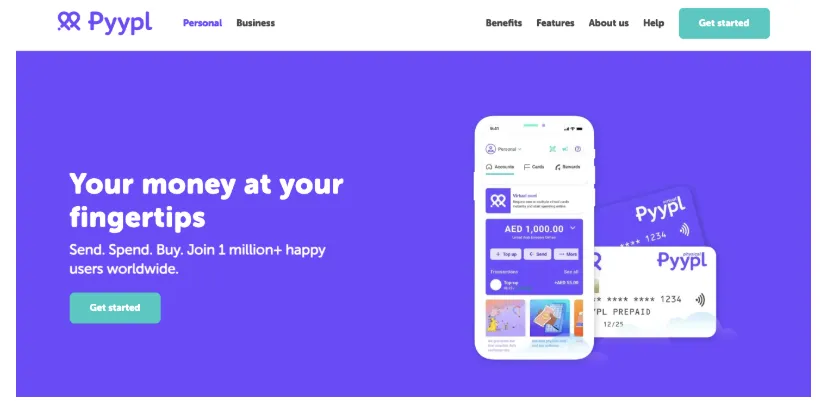
Pyypl issues Visa-based prepaid cards accepted anywhere Visa processes transactions. Their model includes specific constraints: individual transaction maximum of $1,000, and a per-transaction fee approaching 3%.

The service emphasizes mobile-first interaction. Their smartphone app provides card management, real-time spending visibility, and balance funding. You can add funds from existing Visa cards or through ten supported cryptocurrencies.

Card credentials appear in the app immediately upon account creation, but transaction capability requires completing identity verification first. 3D Secure protection applies to all purchases. Customer service operates through in-app support channels.

Omni Card (LinkPay)

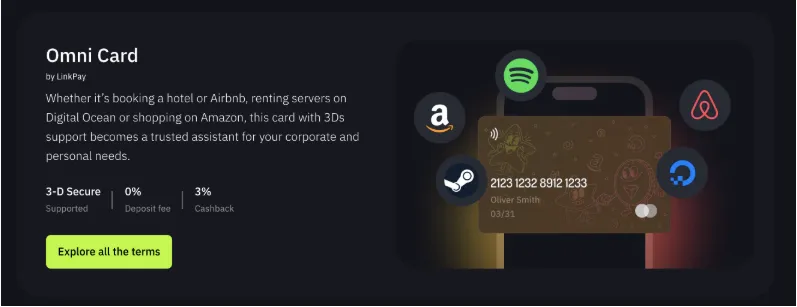
LinkPay operates cards on both Visa and Mastercard networks under various programs, with Omni Card as their primary prepaid offering. Their web interface prioritizes clarity and straightforward navigation.

Their distinctive feature: no transaction limits. The fee schedule sets 1% charges on balance deposits and 2% on internet purchases. Users maintaining $50,000 or higher monthly transaction volume qualify for zero fees on all transactions, though accessing this tier requires their Ultra subscription plan.

Funding works through bank cards or seven cryptocurrency options. Registration completes through a web form that grants immediate card access. Transactions use 3D Secure authentication. Support maintains 24/7 availability through Telegram and website chat.

Practical implementation

Prepaid virtual cards function as risk management instruments through deliberate compartmentalization. You define the maximum exposure for each online transaction in advance, separate spending streams by purpose, and protect primary financial accounts from compromise through isolation.

The tool delivers measurable value in specific contexts: paying international service providers, managing advertising platform relationships, transacting with merchants of uncertain trustworthiness, maintaining clean expense categorization.

Understanding where the model breaks down, particularly with authorization holds and variable recurring charges, prevents frustration and allows you to select the right payment instrument for each situation.

Long or Short, get news the way you like. No ads. No redirections. Download Newspin and Stay Alert, The CSR Journal Mobile app, for fast, crisp, clean updates!

App Store –  https://apps.apple.com/in/app/newspin/id6746449540 

Google Play Store – https://play.google.com/store/apps/details?id=com.inventifweb.newspin&pcampaignid=web_share

Latest News

Popular Videos