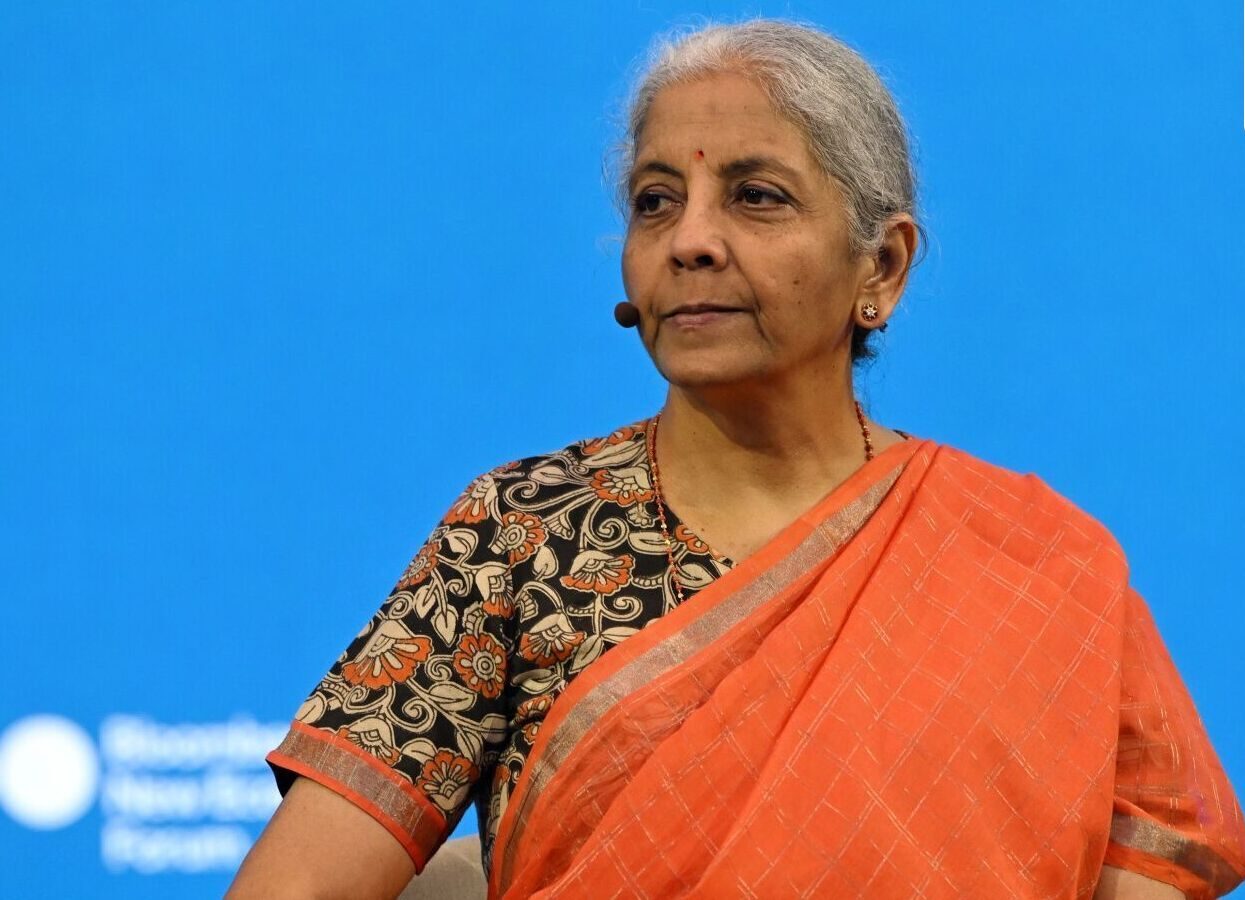
Nirmala Sitharaman, India's finance minister, during the Bloomberg New Economy Forum in New Delhi, India, on Tuesday, Oct. 13, 2026. The New Economy Forum is being organized by Bloomberg Media Group, a division of Bloomberg LP, the parent company of Bloomberg News. Photographer: Prakash Singh/Bloomberg
Union Finance Minister Nirmala Sitharaman has expressed her hope for the early finalisation of the proposed trade agreement between India and the United States. She made these remarks during a discussion with foreign policy expert Michael Kugelman at the Atlantic Council, an American think tank, while attending the annual meetings of the World Bank Group and the International Monetary Fund in Bangkok.
During the conversation, Sitharaman highlighted the significance of concluding the trade deal for both bilateral relations and global trade dynamics. Union Commerce and Industry Minister Piyush Goyal echoed her sentiments, stating that a mutually beneficial agreement should be signed promptly.
Goyal also mentioned that the first phase of the trade deal has been completed and is currently undergoing legal drafting. He expressed confidence that the agreement would be operational soon, contingent upon India securing a competitive edge in the US market.
Current Status of Trade Negotiations
On Thursday, US Ambassador to India, Sergio Gor, remarked that negotiations for the trade deal were progressing at an “incredible pace,” indicating that major issues had been resolved. In February, both nations had agreed on a framework that aims to reduce the punitive tariffs on most Indian goods from 50 per cent to 18 per cent by August 2025.
In the first half of the current fiscal year, the United States remained India’s largest destination for goods exports, with shipments rising by 11 per cent year-on-year to reach $50.8 billion. However, the ongoing trade discussions have been complicated by a new US law that allows President Donald Trump to impose tariffs of up to 100 per cent on countries purchasing Russian oil, adding to India’s concerns regarding energy security.
New Delhi has stated that it will take all necessary measures to ensure energy security for its population of 1.4 billion. The government remains focused on balancing trade interests while safeguarding its energy requirements.
India’s Economic Growth and Public Spending
Sitharaman emphasised that India has sustained its growth momentum, asserting that the country has remained the fastest-growing major economy since 2021-22. Both the World Bank and the IMF have recently adjusted their growth projections for India for FY27, increasing them by 50-60 basis points to 7.1 per cent and 7 per cent, respectively, following a stronger-than-expected growth rate of 7.8 per cent in the June quarter.
The minister attributed this growth to public spending on capital expenditure, which has significantly contributed to infrastructure development. She noted that such spending has a greater multiplier effect compared to direct cash transfers to individuals. The Central government has substantially increased its capital expenditure since 2020 to revive the economy affected by the pandemic.
While private investment is beginning to recover, public spending continues to be a crucial driver of growth, especially amid uncertainties stemming from geopolitical tensions in West Asia. The government has allocated ₹12.22 trillion for capital expenditure in FY27, a significant increase from ₹3.36 trillion in FY20.
Call for Multilateral Reforms
Sitharaman urged multilateral organisations, such as the World Bank and the IMF, to adapt more swiftly to contemporary challenges. She reiterated the need for these institutions to meet 21st-century expectations, stating that many middle-income countries are facing urgent balance-of-payments crises and require immediate assistance.
She expressed concern over the delayed responses from these institutions, noting that countries in distress often wait for years for solutions. The minister also highlighted emerging issues related to cross-border payments, stablecoins, and central bank digital currencies, which necessitate prompt action from multilateral bodies.
Countries like Sri Lanka, Argentina, Egypt, Ghana, and Zambia have experienced crises due to deteriorating external balances, underscoring the need for timely interventions in international financial systems.
Long or Short, get news the way you like. No ads. No redirections. Download Newspin and Stay Alert, The CSR Journal Mobile app, for fast, crisp, clean updates!
The Indian equity benchmark indices, BSE Sensex and Nifty50, experienced a significant rally on Tuesday, with both indices rising over 1 per cent during...
India and the United States have reached a difficult stage in negotiations for a proposed bilateral trade agreement, with Finance Minister Nirmala Sitharaman saying...