


Elon Musk Unveils Tesla Roadster with Flying Capabilities Using Compressed Air Thrusters
The CSR Journal Magazine

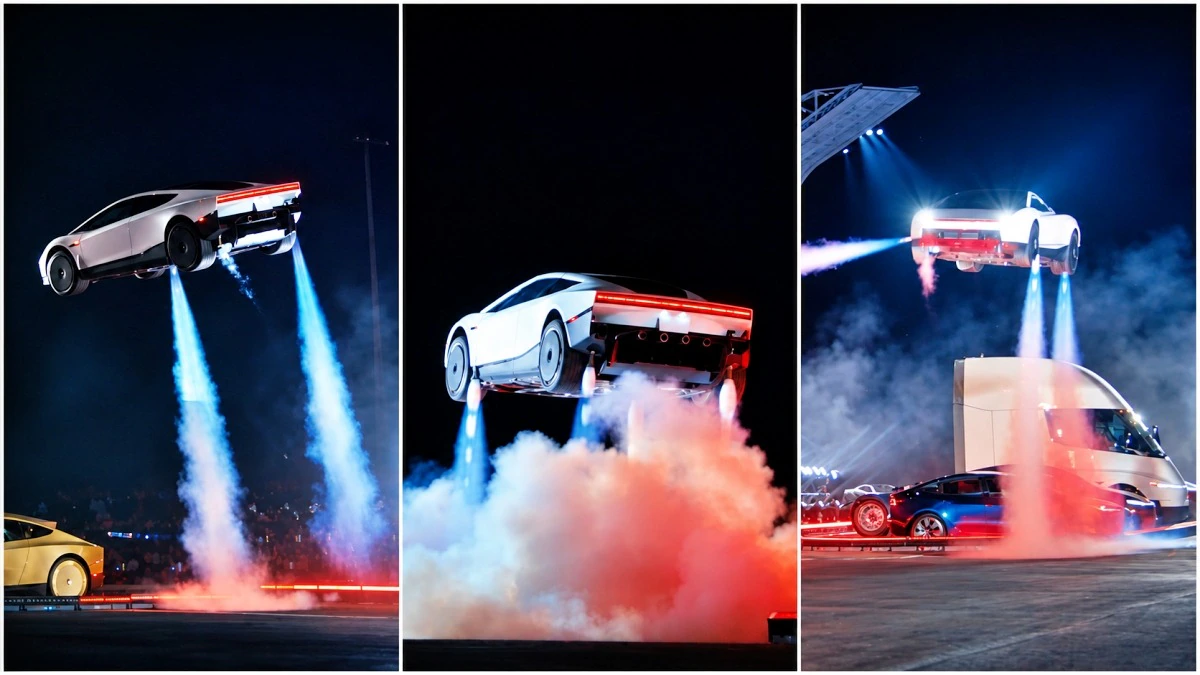
The new Tesla Roadster, presented by Elon Musk, has redefined the concept of a supercar by introducing remarkable flying capabilities. This electric sports car has showcased its ability to lift off the ground, perform aerial rotations, and land safely, utilising rocket-style thrusters developed in collaboration with SpaceX. However, the technology employed for these aerial manoeuvres diverges from traditional rocket propulsion, relying instead on compressed air and high-pressure gas, in accordance with Newton’s third law of motion.

During the unveiling event, Musk highlighted that the Roadster’s propulsion system does not involve the combustion of rocket fuel. Instead, it expels pressurised gas through nozzles to generate thrust, allowing the vehicle to achieve its unique aerial capabilities. This innovative approach marks a significant departure from conventional automotive engineering.

Mechanics Behind the Thruster System

The Roadster’s unique Rocket configuration incorporates a high-pressure gas storage system connected to multiple nozzles strategically placed around the vehicle. Reports indicate that the car can store approximately 250-260 kilograms of compressed air in composite pressure vessels, with ten nozzles aiding in the control of its movement. When a valve is activated, the compressed gas is released through a nozzle at high velocity, creating a force in the opposite direction that propels the vehicle either forward or upward, depending on the nozzle’s orientation.

This mechanism exemplifies Newton’s third law: for every action, there is an equal and opposite reaction. Unlike traditional rocket engines, the Roadster employs cold-gas thrusters, which generate thrust without combustion, thus eliminating the need for burning rocket fuel. The energy for propulsion is derived from gas that has already been compressed and stored under pressure.

To achieve lift, the Roadster must generate sufficient upward thrust to surpass its weight. Maintaining altitude requires balancing the thrust with the vehicle’s weight, while precise directional control is essential for manoeuvring. The thrusters can perform three primary functions: lifting the car, rotating it for attitude control, and stabilising during landing through timed bursts of thrust.

Challenges and Limitations of the Technology

While the Roadster’s technology is groundbreaking, it does not equate to a traditional flying car. The demonstrations have shown short, controlled airborne movements rather than sustained flight akin to that of an aircraft or helicopter. Significant engineering challenges persist, including stability, energy consumption, noise, safety, and the ramifications of a thruster malfunction. Tesla has yet to prove the system’s reliability and safety under typical real-world conditions.

The company has set a target for production in 2028, though the final capabilities of the production model remain unverified. The Roadster represents an experimental fusion of electric vehicle technology and aerospace propulsion, with the potential to adapt spacecraft manoeuvring techniques for terrestrial applications.

Despite its innovative design, the practicality of the Roadster as a flying vehicle remains uncertain. The concept raises questions about whether it will become a viable feature in the automotive market or remain an engineering curiosity. As Tesla continues to develop this technology, the future of the Roadster and its flying capabilities will be closely monitored by both enthusiasts and industry experts.

Long or Short, get news the way you like. No ads. No redirections. Download Newspin and Stay Alert, The CSR Journal Mobile app, for fast, crisp, clean updates!

App Store – https://apps.apple.com/in/app/newspin/id6746449540

Google Play Store – https://play.google.com/store/apps/details?id=com.inventifweb.newspin&pcampaignid=web_share

Latest News

Popular Videos
