


app-store-logo
play-store-logo
January 13, 2026

Why Shaksgam Valley is back in focus amid rising India-China tensions
The CSR Journal Magazine

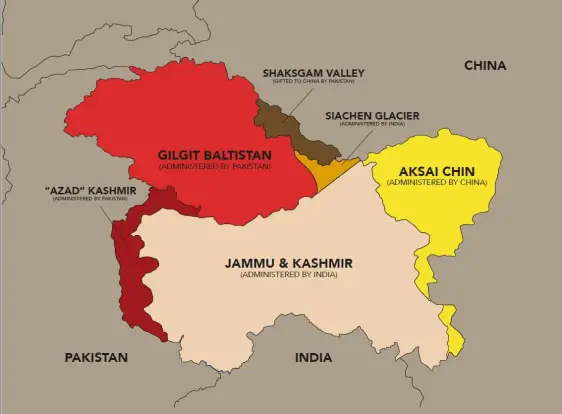
The sharp exchange between India and China over Kashmir’s Shaksgam Valley has once again drawn attention to a remote but critically important stretch of land in the high Karakoram. Largely absent from popular discourse for decades, the valley has re-emerged as a strategic fault line at a time when New Delhi and Beijing are still trying to stabilise ties after years of tension along the Line of Actual Control (LAC). At the heart of the dispute is India’s long-standing claim that the territory was illegally ceded by Pakistan to China in 1963, and Beijing’s growing infrastructure footprint in the region.

Spanning roughly 5,000 square kilometres, the Shaksgam Valley, also known as the Trans Karakoram Tract, lies north of Pakistan-occupied Kashmir and south of China’s Xinjiang region. Its forbidding terrain and extreme altitude once made it seem strategically inert. That assumption no longer holds. With reports of China completing significant stretches of an all-weather road as part of its broader regional connectivity push, the valley has become a fresh source of anxiety for Indian planners.

A Strategic Valley at the Crossroads of Three Rivals

The Shaksgam Valley’s importance flows primarily from geography. Nestled in the eastern Karakoram range, it sits close to the Siachen Glacier, the world’s highest battlefield. Control or influence in this region has a direct bearing on India’s ability to monitor movements along both the LAC with China and the Line of Control with Pakistan. The valley also offers access to the Karakoram Pass, historically one of the key gateways between the Indian subcontinent and Central Asia.

Recent satellite imagery and reports suggesting that nearly 75 kilometres of a 10-metre-wide road have already been completed have sharpened concerns in New Delhi. The Ministry of External Affairs has reiterated that Shaksgam Valley is part of Indian territory and underlined that India has never recognised the 1963 agreement under which Pakistan handed over the area to China. It has also made clear that India reserves the right to take necessary measures to safeguard its interests.

Beijing, for its part, has dismissed India’s objections and maintained that its activities in the region are legitimate. This stance has been seen in New Delhi as deeply contradictory. While China publicly describes Kashmir as a dispute to be resolved bilaterally between India and Pakistan, it continues to consolidate its presence in areas that India considers illegally occupied, thereby inserting itself more directly into the dispute.

How Pakistan’s 1963 deal Changed the Map

The roots of the Shaksgam Valley dispute lie in the early years after Independence. Historically, the valley was part of the Hunza-Gilgit region. In 1936, during British rule, the Mir of Hunza relinquished rights over some northern tracts, but the Shaksgam Valley and the Aghil range remained under his control. Following the accession of Jammu and Kashmir to India in October 1947, the area legally became part of Indian territory, even though New Delhi did not exercise physical control due to Pakistan’s occupation of large parts of the region.

In the 1950s, China began asserting claims in parts of eastern Hunza, contributing to a steady deterioration in India-China relations. Pakistan, then under President Ayub Khan, saw an opportunity to strengthen ties with Beijing. The result was the 1963 Sino-Pakistan boundary agreement, under which Islamabad ceded around 5,180 square kilometres of territory in the Shaksgam Valley to China. India immediately rejected the agreement as illegal, arguing that Pakistan had no right to transfer territory that did not belong to it.

Although India has consistently maintained its claim, it never attempted to physically occupy the valley. Over time, the issue faded from public view, even as it remained a sore point in diplomatic exchanges. That relative quiet has now been broken by China’s accelerating infrastructure activity.

Infrastructure, Security and the Risk of a Two-Front Squeeze

What has alarmed Indian strategists is not just the existence of Chinese infrastructure, but its pace and direction. Analysts point out that new access routes through the Aghil Pass could allow China to bring personnel and equipment uncomfortably close to Indian positions near Siachen. For decades, India’s defensive posture in the region was oriented primarily towards Pakistan, with threats expected from the south. Enhanced Chinese access from the north alters that calculus.

The prospect of coordinated pressure from China and Pakistan, often described as an “all-weather” partnership, raises the risk of a two-front contingency in one of the world’s most inhospitable military theatres. This is why developments in a sparsely populated, little-known valley resonate so strongly in New Delhi today.

Ironically, Shaksgam Valley’s renewed prominence underscores a broader strategic reality. A region that India considers legally its own, but has never physically controlled, has become a focal point of security concern because of actions by two neighbouring states. As India and China attempt to manage an uneasy relationship after years of confrontation, the future of this forgotten corner of the Karakoram may prove to be an important test of whether old disputes can truly be put to rest, or whether they are destined to resurface in ever more complex forms.

Long or Short, get news the way you like. No ads. No redirections. Download Newspin and Stay Alert, The CSR Journal Mobile app, for fast, crisp, clean updates!

App Store –  https://apps.apple.com/in/app/newspin/id6746449540 

Google Play Store – https://play.google.com/store/apps/details?id=com.inventifweb.newspin&pcampaignid=web_share

Latest News

Popular Videos
