


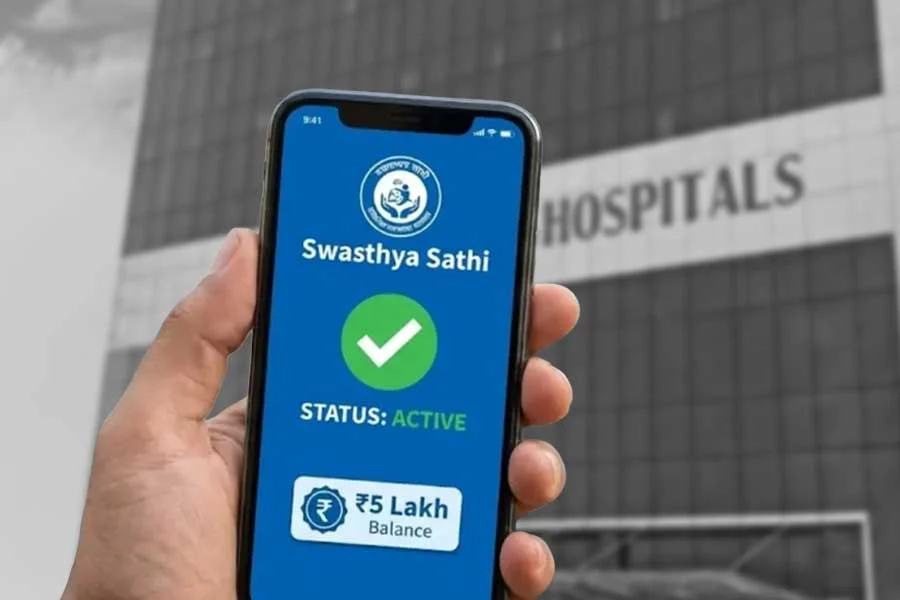

The West Bengal government’s Swasthya Sathi is a flagship health cover scheme providing cashless, paperless secondary and tertiary care for economically vulnerable families, offering up to Rs 5 Lakhs per family annually for treatments like cancer, heart, and kidney diseases. The scheme covers all family members with no cap on size, and including pre-existing conditions through a smart card-based system.
Swasthya Sathi scheme is very popular, especially among rural and economically weaker sections, as it provides cashless, paperless health cover up to Rs 5 lakh per family annually for secondary/tertiary care, covering everyone in the family, including pre-existing conditions, and has seen widespread adoption across the state, though it faces challenges in implementation.
How to check balance on your Swasthya Sathi card?
If you are a beneficiary of the scheme, you get a Swasthya Sathi card from the state, with which you can receive medical treatment worth up to Rs 5 Lakhs completely free of charge. However, most people don’t know how to check the remaining balance on their card after treatments. As a result, patients and their families often face difficulties at the hospital. Here is how to easily check your balance on your mobile phone.
1. You can check your Swasthya Sathi card balance in two ways. Firstly, you can visit the Swasthya Sathi website: https://swasthyasathi.gov.in/. Alternatively, download the Swasthya Sathi app from the Play Store on your phone.
2. On the website, you will find the ‘Check Your Online Status for Swastha Sathi Card’ option. Click on it. If you have downloaded the app, open it. You will see three dots in the left corner. Click on them. Several options will appear on your mobile screen. From there, select ‘URN Verification’.
3. If you are checking through the website, then select your district. You can also search using your Aadhaar card number. Similarly, you will need to select your district in the app. After that, in both cases, you will need to enter the URN number. You might be wondering where to find this number? The number written at the bottom of your Swasthya Sathi card is the URN.
4. If you are checking from the Swasthya Sathi website, you will then find the submit option. On the mobile app, you will find ‘Show Data’. Clicking on it will display all the Swasthya Sathi information on the screen. That is, the card balance, the number of family members linked to the card, and everything else. So, no more worries! Quickly check your Swasthya Sathi card balance this way.
Benefits of West Bengal government’s Swasthya Sathi scheme?
A major benefit of this scheme is that beneficiaries don’t pay at empanelled hospitals; costs are borne by the government. The scheme provides up to Rs 5 Lakhs per family per year for secondary and tertiary care. The scheme covers all family members, with no cap on family size, including parents of both spouses. It covers pre-existing diseases and conditions. The scheme provides specific coverage for major illnesses like cancer, neuro, and cardiothoracic surgeries up to Rs 5 Lakhs. A smart card is given to beneficiaries for identification and treatment.
Who is Eligible for Swasthya Sathi scheme?
The Swasthya Sathi scheme targets economically vulnerable families, including various groups like self-help groups (SHGs) and ASHA workers, extending beyond state government employees.
How to Apply?
Applications can be made online or offline by visiting the official website, filling forms, and submitting required documents like Aadhar, ration card, and domicile proof, with details of family members and employment status. Swasthya Sathi aims to provide universal health protection, ensuring access to critical medical treatments for families in West Bengal without financial hardship, functioning on a robust smart card system.
Challenges faced by the Swasthya Sathi scheme
Despite its popularity, West Bengal’s Swasthya Sathi scheme faces challenges. While it is praised for universal coverage, cashless benefits up to Rs 5 lakh, and empowering women with smart cards, significantly reducing catastrophic health spending for many, it faces challenges like persistent out-of-pocket (OOP) expenses for some, financial sustainability issues due to state funding, and conflicts with private hospitals over delayed payments, creating access barriers despite its cashless promise and digitalisation efforts.