


Slow Spin, Lost Moon: How Venus May Have Consumed Its Satellite
The CSR Journal Magazine

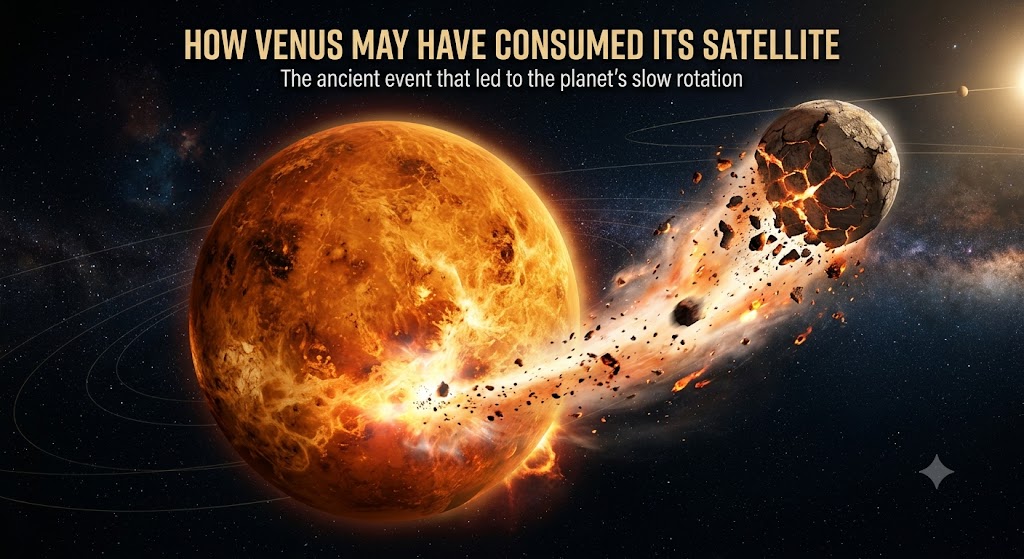
A study from the University of California, Riverside suggests that Venus may have once harboured a moon that it ultimately destroyed, not through catastrophic impacts, but rather through gravitational forces tied to the planet’s slow rotation. The research indicates that the nature of Venus’ rotational dynamics could have led to the moon spiralling inward and colliding with the planet.

Historically, scientists have been puzzled by the absence of a moon around Venus, especially given the similarities it shares with Earth, which boasts a substantial natural satellite. Existing hypotheses posited that either Venus never experienced the significant collisions that resulted in the formation of Earth’s Moon or that it lost any moon it may have had due to other large-scale impacts. This new study challenges those traditional views.

Details of the Computer Simulations Conducted

Stephen Kane, the lead researcher, utilised computer simulations to explore the gravitational interactions between Venus and theoretical moons. He initiated the research by recreating the Earth-Moon system, followed by adjustments to Venus’ rotation speed and the dimensions of potential moons. The simulations consistently indicated a similar outcome: any moon would inevitably collide with Venus due to insufficient orbital energy to maintain its trajectory.

Kane’s findings emphasized that larger moons would tend to meet a quicker demise, crashing into the planet sooner than their smaller counterparts. This leads to the conclusion that for a hypothetical moon to have remained in orbit, Venus’ rotation would have to be drastically different from its current pace of rotation, which takes approximately 243 Earth days to complete one full cycle.

This research does not categorically confirm that Venus once had a moon; however, it illustrates the dynamics involved, indicating that if such a celestial body existed, it could not have maintained its orbit over geological timescales under Venus’ current conditions.

Challenges in Finding Evidence of a Historical Impact

Identifying traces of any potential moon-colliding event presents significant challenges. The surface of Venus is thought to be predominantly uniform in age, approximately 80 per cent of it, which suggests a substantial resurfacing event took place around one billion years ago. Such an event could have obscured much of the planet’s earlier geological history.

Consequently, scientists may require alternative methods to uncover signs of an ancient impact, including seismic observations that might elucidate deeper geological structures potentially forged by such an event. Notably, if a former moon had collided with Venus, it could have substantially altered not only the rotation and geology of the planet but also its climate, raising questions about its capacity to support life.

This research opens pathways for further exploration and understanding of Venus’ history and its potential past habitability. Future studies may focus on both surface and subsurface investigations to provide clearer insights into the planet’s enigmatic past and the factors that may have influenced its evolution.

Long or Short, get news the way you like. No ads. No redirections. Download Newspin and Stay Alert, The CSR Journal Mobile app, for fast, crisp, clean updates!

App Store –  https://apps.apple.com/in/app/newspin/id6746449540 

Google Play Store – https://play.google.com/store/apps/details?id=com.inventifweb.newspin&pcampaignid=web_share

Latest News

Popular Videos
