


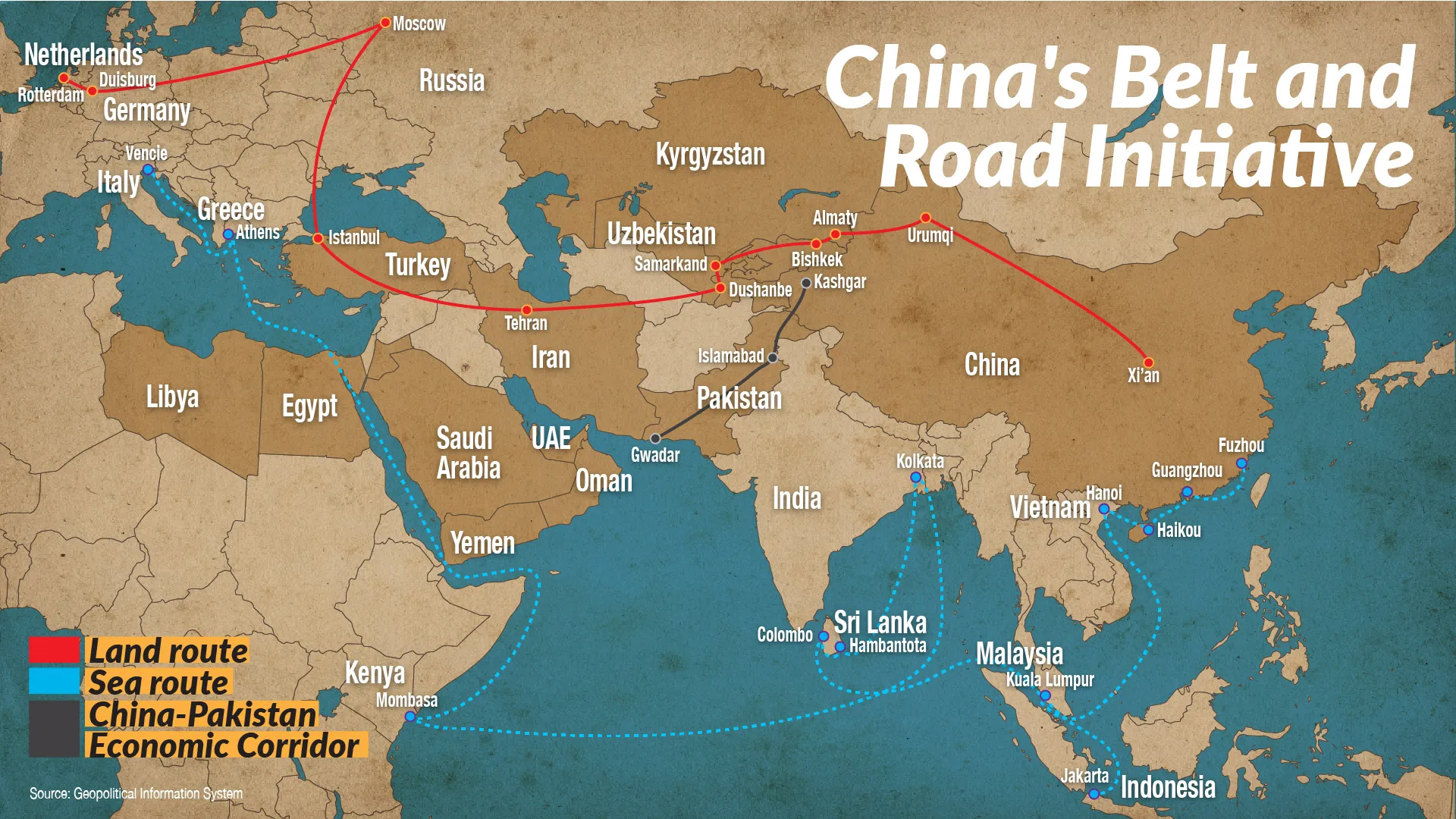


China’s “Belt And Road Initiative” Is Far From Finished

The CSR Journal Magazine

Every few months a headline tells me the China’s Belt and Road Initiative is finished, failing or a trap. I have read those headlines for years, and I have also read the data underneath them. The two do not always agree. I teach geopolitics to MBA students, and the one habit I try to build in them is simple. Before you decide what, you think of a project, find out what it built, who paid for it and what happened afterwards. When I apply that habit to the Belt and Road, I get a picture quite different from the one in most Western commentary.

I should say where I stand. I think the initiative is the largest attempt in living memory to connect economies that the older financial order left at its edges, and I think the evidence supports a more generous reading than it usually receives. I also think my own country has paid a price for letting its position be set by slogans. I will go through the evidence slowly, because slogans are exactly what I want to avoid.

The scale of it

Xi Jinping announced the idea in 2013, first in Kazakhstan and then in Indonesia. Thirteen years on, the most widely cited tracker of the programme comes from the Green Finance and Development Center at Fudan University in Shanghai, working with the Griffith Asia Institute in Australia. They count construction contracts and equity investments by Chinese companies together as engagement, and they put the total since 2013 above 1.3 trillion dollars.

The recent numbers are the ones I find hardest to square with the claim that the project is fading. In 2025, engagement reached 214 billion dollars across roughly 150 countries, the highest year on record. Construction contracts came to 128 billion dollars, up 81% from 2024. Investments came to 85 billion, up 62%. Africa was the largest destination, with 61.2 billion dollars, a rise of 283% in a single year. Energy took 43% of the total, and within it, wind, solar, waste to energy and hydropower reached about 21 billion dollars, up from 12 billion the year before.

For several years, analysts told us that Beijing had learned its lesson and would now build only “small and beautiful” projects. The data say otherwise. The average construction deal in 2025 was worth 964 million dollars, nearly double the 496 million of 2024. Whatever else one concludes, a failing programme does not behave this way.

The “debt trap” story

The phrase “debt trap diplomacy” has been repeated by presidents, vice presidents and attorneys general. Mike Pence used it in 2018 and described Sri Lanka’s Hambantota port as a possible forward base for the Chinese navy. The story goes that China lends more than a poor country can repay, then seizes the asset. It is a tidy story, and the facts do not fit it.

Take Hambantota, the case every speech uses.

Deborah Brautigam of Johns Hopkins, who directs the China Africa Research Initiative, traced its history in detail. A feasibility study for a port there was completed in 2003, paid for by Canada’s aid agency and carried out by the Canadian firm SNC-Lavalin. Years later, President Mahinda Rajapaksa pushed ahead with a second phase that turned the port into a container terminal. China Exim Bank lent 307 million dollars for the first phase and 757 million for the second. When the port underperformed, it was the Sri Lankan government that chose to lease it out, and China Merchants took a majority share in a 99-year lease that brought Colombo 1.2 billion dollars.

Now look at the debt itself.

When President Maithripala Sirisena took office in 2015, Sri Lanka owed more to Japan, the World Bank and the Asian Development Bank than it owed to China. Of the 4.5 billion dollars Sri Lanka had to pay in debt service in 2017, only 5% was because of Hambantota. Brautigam and Meg Rithmire of Harvard Business School found that Chinese banks have never actually seized an asset from any country, and that they are willing to restructure existing loans. In 2023 China did agree to restructure its loans to Sri Lanka, which cleared the way for an IMF programme. A Chatham House study of Sri Lanka and Malaysia, the two countries most often named as victims, concluded that their troubles came mainly from the conduct of local elites and from Western dominated financial markets, and not mainly from predatory Chinese lending.

There is an irony here that Indian readers should note. Brautigam traces the phrase to a 2017 paper from a think tank in New Delhi. It travelled from there into the speeches of American officials, and later research took it apart.

Who really holds Africa’s debt?

The Western version of the story needs a creditor to blame, and China has been the convenient one. The numbers from Debt Justice, a British campaign group that analyses World Bank and IMF data, tell it differently. Of Africa’s roughly 696 billion dollars in external government debt in 2020, 12% was owed to Chinese lenders. Private creditors outside China, meaning banks, bondholders, asset managers and oil traders, held 35%. Multilateral institutions held 39%. The average interest rate on the Chinese loans was 2.7%, against 5% on the private ones. Looking ahead, of the 444 billion dollars African governments must repay between 2022 and 2028, 156 billion goes to those private creditors and 83 billion to China.

When the pandemic arrived, China took part in the G20 debt suspension scheme. Private lenders did not, and so only 23% of the repayments due from applicant countries were suspended. I do not say this to pretend China is a charity. I say it because anyone who wants to explain Africa’s debt problem honestly must begin with who is owed the money.

What the steel and concrete have done

Debt statistics are abstractions. A railway is not. The Laos China Railway runs 1,035 kilometres from Kunming to Vientiane. It opened in December 2021, and by April 2026 it had carried 70.7 million passengers and 81.5 million tonnes of cargo, according to the railway operators. They report that freight costs from Kunming to Thailand through Laos have fallen by 30 to 50%, and transport costs inside Laos by 20 to 40%. Clearance at the Mohan border crossing dropped from over 40 hours to under five. In 2024 the first Lao coffee beans went by rail and then on a China Europe freight train, reaching Europe in 15 days. The Lao side owns 30% of the railway company. A country once described as landlocked now calls itself land linked, and its freight bills show why.

In Indonesia, the Jakarta Bandung high speed line is 142 kilometres long, built for 350 kilometres an hour, and it cut a journey of three and a half hours to 40 minutes. In its first three years it carried more than 18 million passengers. Daily ridership rose from about 9,000 to a peak above 26,000, and over a million passengers were foreign, 43% of them from Malaysia.

A sceptic will say that operators quote flattering figures. So, consider the World Bank, an institution hardly in Beijing’s pocket. In 2019 its researchers modelled the Belt and Road transport corridors and found that the economies along them trade 30% less than their potential and attract 70% less foreign direct investment. If the projects are completed, travel times along the corridors fall by up to 12%, trade rises by 2.8 to 9.7%, and low-income countries see foreign direct investment rise by 7.6%. Countries outside the initiative gain as well, with world trade up by 1.7 to 6.2%. The Bank estimated that 7.6 million people could leave extreme poverty and 32 million could leave moderate poverty. It attached conditions to those findings, and I turn to them now.

The honest ledger

The same World Bank study warned that the gains depend on transparency, open procurement and careful debt management, and that about a quarter of corridor economies already carried high debt. It estimated that carbon dioxide emissions would rise by 7% or more in Cambodia, the Kyrgyz Republic and Laos. Indonesia’s finance ministry has moved to take a 60% stake in the Whoosh operator, which tells me the financing needed repair. Christoph Nedopil Wang, the Griffith scholar behind the annual tracker, called 2025 both the greenest and the brownest year of the programme, since oil and gas grew faster than renewables.

The most serious finding I know came in 2023 from AidData, the World Bank, the Harvard Kennedy School and the Kiel Institute. China made 240 billion dollars of rescue loans to 22 countries between 2008 and 2021, and the share of its overseas lending going to borrowers in distress rose from under 5% in 2010 to 60% in 2022. The authors called the system opaque and uncoordinated, and Carmen Reinhart said Beijing was ultimately trying to rescue its own banks.

I read that finding differently from the way it is usually presented. A creditor that lends 240 billion dollars to keep borrowers solvent, with the People’s Bank of China charging about 5% on its swap lines against about 2% for IMF rescue loans, is behaving like a creditor that expects to be repaid and would rather restructure a loan than seize a port. That is the opposite of a trap. In 2021, Chinese rescue loans totalled 40.5 billion dollars against 68.6 billion from the IMF. Countries in distress now have a second door to knock on, which counts for something, even if the terms are open to argument.

Lessons for the world

The first lesson is that the demand existed before the supply arrived. The World Bank’s finding that corridor economies trade 30% below potential describes a gap that no speech closes. Governments in Africa, Central Asia and Southeast Asia accepted Chinese finance because the alternatives were slow, conditional or absent. Anyone who wants them to choose differently must put a competing offer on the table, with money and with a date for completion.

The second is that debt problems are shared problems, and every creditor has to be in the room. China joined the G20 suspension scheme while private lenders stayed out. A restructuring that excludes bondholders and banks will keep producing the same stalemate, whoever the other creditors are.

The third is for borrowers. Brautigam found that the sovereign immunity waiver clause that caused uproar in Nigeria is standard in international loan contracts. Nigerian technocrats explained it clearly, while politicians outside the executive used it to score points. Governments that publish their contracts, test projects against the World Bank’s questions on procurement and debt, and keep their own engineers involved get more from any lender. Laos holding 30% of its own railway shows a borrower keeping a share of the upside.

The fourth is about politics. Invoking China became a dependable campaign tactic in Sri Lanka, Malaysia, Kenya, Zambia, Tanzania and Nigeria. A port or a railway should be judged by its traffic, its costs and its repayment schedule, and not by the slogan attached to it.

Lessons for India

India stayed away from the first Belt and Road Forum in 2017 and has stayed away since. The reason is the China Pakistan Economic Corridor, announced in 2015 at a value of 46 billion dollars, parts of which pass through territory that India regards as its own and that Pakistan occupies. As an academic I respect that objection. Sovereignty is not a technicality, and Prime Minister Modi repeated at the Shanghai Cooperation Organisation summit in 2025 that connectivity must uphold sovereignty and territorial integrity. The first lesson I draw is that the objection is specific, to one corridor, and it should stay specific. A position on CPEC does not oblige India to have no position on a railway in Laos or a lease in Sri Lanka.

The second lesson is humbling. India’s own strategic community supplied the debt trap narrative that Western capitals adopted and that later scholarship dismantled. Sri Lanka, Nepal, Bangladesh and the Maldives took Chinese money for their own reasons, mostly because they needed roads, ports and power and could not get them quickly elsewhere. Policy that assumes those governments were fooled misreads them. They were negotiating, and they will keep negotiating with whoever shows up.

The third lesson is about delivery. India’s answer is the India Middle East Europe Economic Corridor, announced in 2023 with American and European backing. It is an attractive idea, and a report in The National this September said even Belt and Road officials expect no friction with it. But an announcement is not a railway. The Laos line went from agreement to 70 million passengers in under five years of operation. IMEC will be judged by what it carries and when.

The fourth lesson comes from my own work. My doctoral research, from 2015 to 2022, looked at informal trade between India and China through Northeast India, and it taught me to watch what traders do instead of what governments say. Traders respond to costs. A fall of 20 to 40% in transport costs inside a landlocked country, as the Laos figures suggest, is the kind of change that moves a regional economy. The Northeast, Nepal and Bhutan face a similar geography. Whatever route India chooses, it must bring those costs down, with its own finance and its own contractors, and it must do so quickly.

The fifth lesson is uncomfortable. India imports far more from China than it sells there, and its trade deficit with China was close to 100 billion dollars in 2024 to 2025. Staying out of the Belt and Road has not meant staying away from China. It has meant that India has less say in how the infrastructure around its borders is financed, priced and run. Engaging selectively, with open eyes about debt and contracts, would give India more influence than abstaining on principle everywhere.

Views of the author are personal and do not necessarily represent the website’s views.

Dr. Jaimine Vaishnav is a faculty of geopolitics and world economy and other liberal arts subjects, a researcher with publications in SCI and ABDC journals, and an author of 6 books specializing in informal economies, mass media, and street entrepreneurship. With over a decade of experience as an academic and options trader, he is keen on bridging the grassroots business practices with global economic thought. His work emphasizes resilience, innovation, and human action in everyday human life. He can be contacted on jaiminism@hotmail.co.in for further communication.

Long or Short, get news the way you like. No ads. No redirections. Download Newspin and Stay Alert, The CSR Journal Mobile app, for fast, crisp, clean updates!

App Store – https://apps.apple.com/in/app/newspin/id6746449540

Google Play Store – https://play.google.com/store/apps/details?id=com.inventifweb.newspin&pcampaignid=web_share

Latest News

Popular Videos