


ICJ Rules Myanmar Committed Genocide Against Rohingya
The CSR Journal Magazine

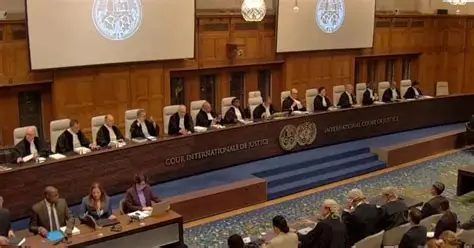
The International Court of Justice (ICJ) has determined that Myanmar is responsible for committing genocide against the Rohingya people. This landmark ruling, announced on Thursday, featured a split decision among the judges, with nine in favour and six against the interpretation of the 1948 Genocide Convention’s stipulations regarding intent to destroy a group. This marks the first instance where the United Nations’ principal judicial body has held a state accountable for genocide.

The court accepted the findings of a United Nations fact-finding mission, which estimated that Myanmar’s military operations in 2017 resulted in the deaths of at least 10,000 individuals. The court described this figure as “supported by the record.” The military campaign also led to the displacement of over 700,000 Rohingya, who sought refuge in Bangladesh. In response to the ruling, Khaing Khaing Soe, the spokesperson for Myanmar’s presidency, stated that the decision was “not fair.”

The ICJ’s ruling emphasised that the Rohingya constitute a distinct ethnic group, thereby qualifying them for protection under the Genocide Convention. The court found that Myanmar’s security forces intentionally killed members of this protected group on a large scale, contributing to the overall determination of genocide.

Understanding the Genocide Convention

The Genocide Convention, adopted by the UN General Assembly on December 9, 1948, defines genocide as any of five specific acts committed with the intent to destroy, in whole or in part, a national, ethnical, racial, or religious group. These acts include killing members of the group, causing serious bodily or mental harm, deliberately inflicting conditions of life calculated to bring about the group’s physical destruction, imposing measures to prevent births, and forcibly transferring children to another group.

The court clarified that the term “destroy” refers to the physical or biological annihilation of the group rather than the destruction of its culture. Furthermore, the convention also penalises conspiracy, direct and public incitement, attempts, and complicity in genocide.

The ICJ noted that the burden of proof lay with The Gambia, which brought the case in 2019. The court found that Myanmar’s military operations were not merely a response to insurgency but were characterised by actions that indicated genocidal intent, despite Myanmar’s claims of countering violent insurgency.

Historical Context of Genocide

The term “genocide” was first coined in 1944 by Raphael Lemkin, a Polish-Jewish lawyer, who combined the Greek word “genos,” meaning race or tribe, with the Latin “cide,” meaning killing. Lemkin’s work highlighted the systematic extermination of groups, particularly in the context of Nazi-occupied Europe. His advocacy led to the adoption of the Genocide Convention by the United Nations in 1948.

Prior to this ruling, the ICJ had been asked to determine state responsibility for genocide in earlier cases, including Bosnia’s case against Serbia in 2007 and Croatia’s case against Serbia in 2015. In both instances, while the court acknowledged acts of genocide, it did not find sufficient evidence to hold the states accountable under the convention.

The ICJ’s recent judgement is significant as it asserts the responsibility of a state for genocide, rather than focusing solely on individual culpability. The court mandated Myanmar to investigate and prosecute those implicated in genocidal acts during the 2017 military operations, as well as to facilitate the safe return of displaced Rohingya individuals.

Myanmar has been instructed to report back to the court within two years regarding its compliance with the ruling and any compensation measures it intends to implement. The court’s decision is binding, and its enforcement relies on the UN Security Council’s actions in cases of non-compliance.

Long or Short, get news the way you like. No ads. No redirections. Download Newspin and Stay Alert, The CSR Journal Mobile app, for fast, crisp, clean updates!

App Store – https://apps.apple.com/in/app/newspin/id6746449540

Google Play Store – https://play.google.com/store/apps/details?id=com.inventifweb.newspin&pcampaignid=web_share

Latest News

Popular Videos
