


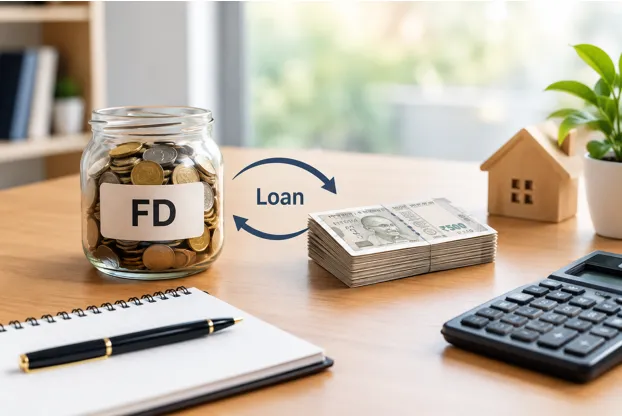

How a loan against FD helps you meet short-term cash needs

The CSR Journal Magazine

Furthermore, surprise expenses can affect even the best-prepared budget. Loans against fixed deposits give you the chance to get temporary cash while keeping your FD intact—essentially, the lender puts a lien on your deposit and allows you to borrow against it while it continues to earn interest normally.

This option is perfect if you need cash for a brief period of time and know that you’ll be able to make repayment. With a loan against FD, you can pay for medical treatment, schooling, urgent repairs, or a short cash flow crisis. However, don’t forget that even though you can avoid some costs compared to other types of loans, you still need to consider the borrowing costs and repayment conditions.

What is a loan against an FD?

Loans against a fixed deposit are secured loans as they are backed by existing deposits. Instead of taking out money from the deposit, a borrower allows the creditor to place a lien on the deposit and thus prevent its premature termination. This means that you cannot close the deposit and take your money until you repay the loan amount and related fees.

Because the lender holds financial security, the application may involve fewer checks. The deposit remains active, but deposit and loan interest are calculated separately.

Why can it work for temporary cash requirements?

Short-term needs often have a defined amount and repayment timeline. An expected bonus or customer payment may restore cash flow within several months. Borrowing can bridge that interval without dismantling savings reserved for a later objective.

Common uses may include:

  • Paying an urgent medical bill while awaiting reimbursement

  • Meeting education fees before planned income becomes available

  • Financing necessary home or vehicle repairs

  • Covering a temporary working-capital shortage

  • Managing essential family expenses after an income delay

The facility works most effectively for a specific requirement supported by a realistic repayment plan.

How much can you borrow against the deposit?

The available amount is calculated as a percentage of the fixed deposit rather than its entire value. Bajaj Finance allows eligible customers to borrow up to 75% of a cumulative Bajaj Finance Fixed Deposit and up to 60% of a non-cumulative deposit.

For instance, an eligible cumulative deposit worth Rs. 4,00,000 may support up to Rs. 3,00,000. The final sanction depends on deposit type, remaining tenure, applicant category, documentation, and lending policy. Borrowing only what is needed can reduce interest expenditure.

How does the application and lien process work?

The exact journey differs between lenders, but the underlying process is generally straightforward:

  1. Confirm that the fixed deposit qualifies for the borrowing facility.

  2. Choose the required amount after estimating the repayment timeline.

  3. Submit the application, fixed deposit receipt, and requested account documents.

  4. Review the sanctioned amount, interest rate, charges, and repayment conditions.

  5. Provide consent for the lender to mark a lien on the deposit.

  6. Receive the approved funds in the registered bank account.

  7. Repay all dues and request confirmation that the lien has been removed.

Joint deposits may require every holder’s consent. Confirm the process before relying on funds for a time-sensitive payment.

What happens to your fixed deposit during the loan?

The deposit ordinarily earns the agreed interest while under lien, preserving its original tenure. However, the borrower cannot access it until lien release.

Continued deposit interest does not make borrowing free. Compare the loan’s total cost with the financial impact of prematurely closing the deposit.

Which costs and terms should you check?

Examine the yearly interest rate, the manner of computation, any charges incurred in processing, the overdue amount and the terms of prepayment. Verify whether or not it is necessary to pay back using instalments, interest in periods or lump sum before the maturity date.

Make sure you get an example of expected costs. The contract must clarify how the proceeds from the deposit will be used if the debts are still pending at the maturity date.

What are the main risks?

The fixed deposit secures the lender but does not remove repayment obligations. Continued default may allow adjustment of deposit proceeds against outstanding dues.

A goal-linked deposit may be unavailable when required if the loan remains unsettled. Align repayment with income and the deposit’s planned use.

How can you use the facility responsibly?

Separate urgent needs from discretionary spending. Estimate the minimum required, calculate the total cost, and identify the income that will fund repayment.

Track the outstanding amount regularly and use surplus cash for permitted prepayment when economical. Keep payment receipts, account statements, and the final closure confirmation. After full repayment, verify that the lien has been removed and the fixed deposit is freely accessible again.

Who meets loan against fixed deposit eligibility requirements?

Understanding how to get loan against fixed funds eligibility begins with holding an active deposit accepted by the lender. Bajaj Finance lists resident Indians, sole proprietorships, partnership firms, companies, and Hindu Undivided Families holding eligible deposits among the applicant categories.

Applicants may need an application form, fixed deposit receipt, and a cancelled cheque for a non-cumulative deposit, although additional documents can be requested. Eligibility and the sanctioned limit also depend on deposit ownership, type, value, residual tenure, and lender policy. Joint holders should expect consent requirements, while restricted deposits may follow separate conditions.

Conclusion

A loan taken with a fixed deposit as collateral can help the borrower while still allowing the lender to earn interest on the deposit amount. However, for the loan to be effective, the borrower must borrow responsibly, evaluate the costs of borrowing accurately, and pay off the loan before they need the deposit. There are various factors, such as fixed deposit loan eligibility, loan amount limit, lien condition, total cost of borrowing, and penalties for default, which a borrower can check before obtaining the loan to ensure the borrower’s money needs are satisfied by using their deposit prudently yet efficiently.

Long or Short, get news the way you like. No ads. No redirections. Download Newspin and Stay Alert, The CSR Journal Mobile app, for fast, crisp, clean updates!

App Store – https://apps.apple.com/in/app/newspin/id6746449540

Google Play Store – https://play.google.com/store/apps/details?id=com.inventifweb.newspin&pcampaignid=web_share

Latest News

Popular Videos