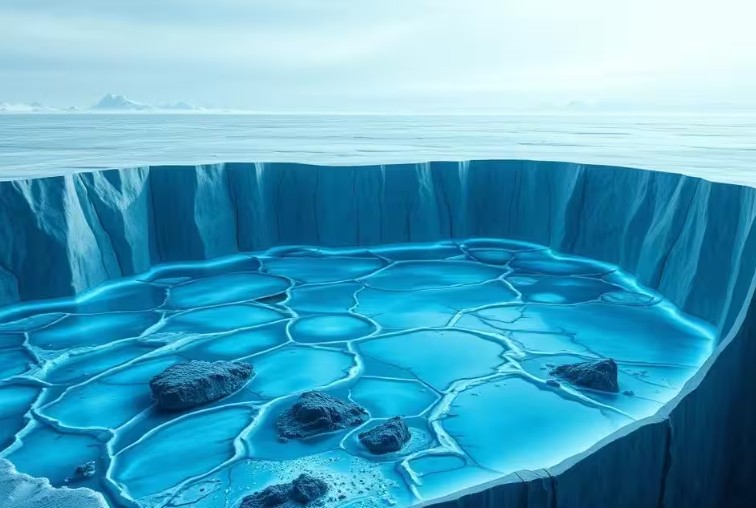
Vostok Station, situated in East Antarctica, is known for its extreme climatic conditions, consistently recording average temperatures around minus 55°C. This frigid environment poses significant challenges for scientific research and habitation. Established in 1957, Vostok serves as a key research site for understanding the Antarctic ice sheet and its implications for global climate change.
Significance of the Liquid Lake
Below the thick layer of ice at Vostok Station lies an intriguing geological feature, a subglacial lake that remains liquid despite the extreme cold above. This lake, known as Lake Vostok, is located approximately four kilometres beneath the ice. It has captured the attention of scientists, who are keen to explore its ecosystem, which is believed to have been isolated for millions of years.
Lake Vostok is one of the largest subglacial lakes in the world, covering an area of around 12,500 square kilometres. The unique conditions within the lake may provide insights into life forms that could exist in extraterrestrial environments, which has led to comparisons with icy moons such as Europa and Enceladus. The existence of liquid water beneath such thick ice raises questions about the potential for life in extreme conditions.
Research conducted at the site has revealed that the water in Lake Vostok is thought to be maintained in a liquid state due to the pressure from the overlying ice, combined with geothermal heat from the Earth’s interior. These factors inhibit the freezing of the water despite the sub-zero temperatures prevailing on the surface. The lake’s isolation for so long may mean that it contains microbial life that has evolved independently.
Scientific Exploration and Discoveries
Research activities in and around Lake Vostok are highly sensitive and meticulously planned to avoid contamination. Scientists employ advanced techniques to sample the water and sediment without bringing extraneous microorganisms into the lake. The first direct sampling of the lake’s waters occurred in 2012, leading to the discovery of new microbial life forms, expanding our understanding of biological adaptation.
As researchers continue to investigate the properties of Lake Vostok, they are also considering the effects of climate change on subglacial ecosystems. The potential for increased melting of ice sheets due to rising global temperatures may impact the delicate balance of these ancient water bodies. Consequently, ongoing studies are crucial to predict future changes and their implications for both local and global ecosystems.
Scientific findings from Lake Vostok have broader implications beyond Earth. Understanding how life survives in this extreme environment contributes to the search for extraterrestrial life. The knowledge gained can assist in formulating theories about life in similar icy conditions in other celestial bodies, marking an important intersection of Earth science and astrobiology.
Long or Short, get news the way you like. No ads. No redirections. Download Newspin and Stay Alert, The CSR Journal Mobile app, for fast, crisp, clean updates!