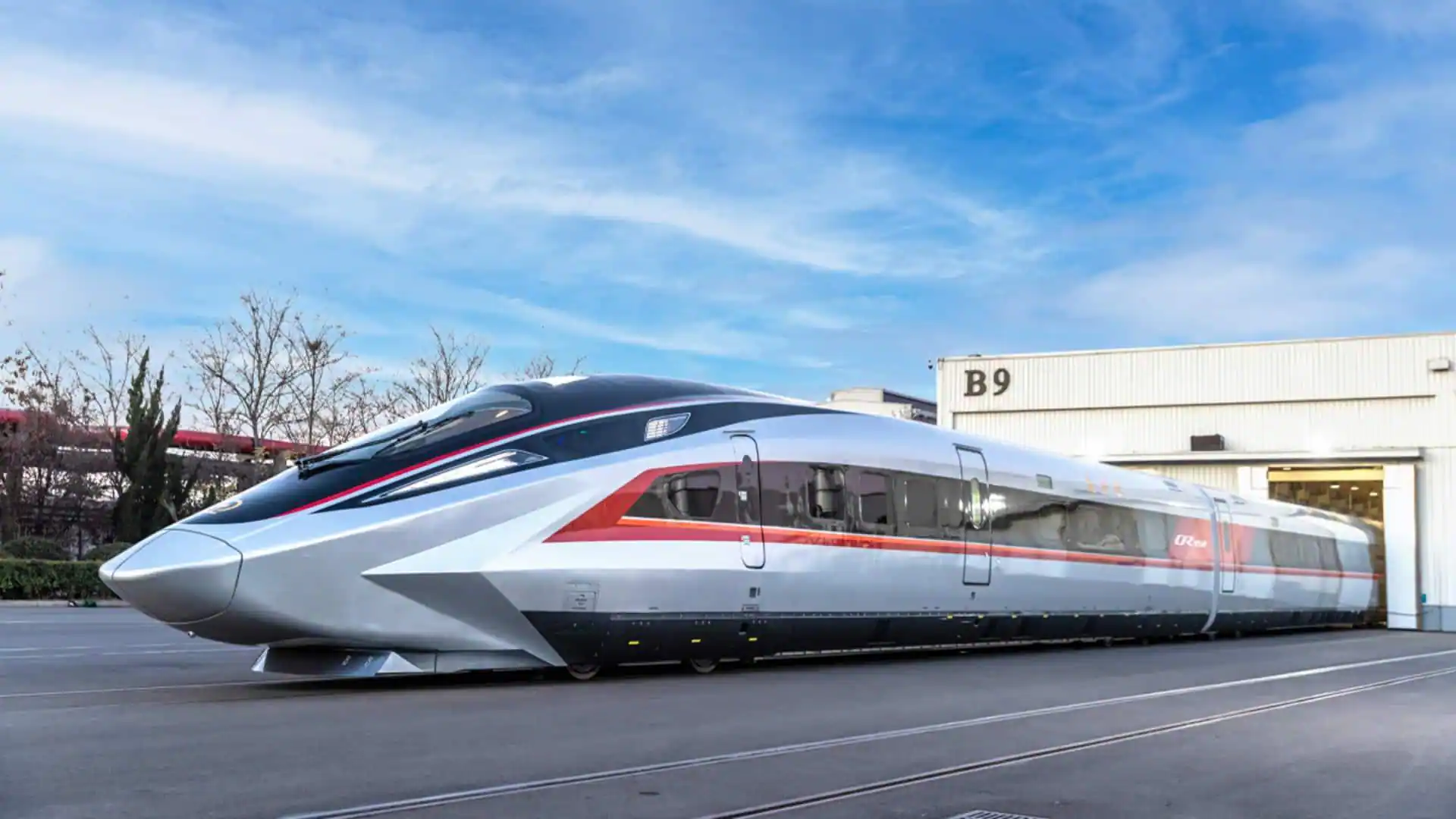
China has set a new benchmark in transportation technology. Researchers at the National University of Defence Technology (NUDT) successfully accelerated a one-ton maglev test vehicle to an astounding 700 km/h in just two seconds. The trial, conducted on a 400-meter magnetic levitation track, ended safely as the vehicle came to a controlled stop.
China Unveils World’s Fastest Superconducting Maglev Train
The breakthrough makes it the world’s fastest superconducting electric maglev train. Li Jie, a professor at NUDT, said, “The successful development of this ultra-high-speed superconducting electric maglev system will accelerate the research and development process of China’s ultra-high-speed maglev transport.”
Maglev trains float above tracks using powerful magnets, removing friction and enabling extreme acceleration. By using magnets on both the vehicle and track, these trains can move at speeds far beyond conventional rail systems. Li added, “Going forward, we will focus on frontier fields such as high-speed maglev transport in pipelines, aerospace equipment testing and electromagnetic launch technologies. By promoting deeper integration between industry, academia, research and application, we aim to support independent innovation in national defense science and technology.”
Maglev Train Reaches 700 km/h
The test demonstrates China’s growing expertise in ultra-high-speed rail. While commercial trains today usually operate at 300–350 km/h, this maglev test reached 700 km/h almost instantly, showcasing breakthroughs in power delivery, stability control, and track design. Experts say this technology could pave the way for vacuum-tube transport and even assist aerospace launches by reducing fuel consumption.
China has been developing maglev technology for decades. NUDT built the country’s first manned single-bogie maglev 30 years ago, making China the third nation in the world to master this technology. Recent projects, including collaborations with CRRC Qingdao Sifang and Southwest Jiaotong University, explored high-temperature superconducting maglev systems capable of operating in low-vacuum pipelines, with planned tracks targeting speeds up to 1,000 km/h.
Maglev Train Blurs Past 700 km/h in China Test
CCTV footage of the test showed the vehicle blurring across the track, leaving a mist trail as it accelerated and stopped within seconds. According to reports, the test resolved major technical challenges, including high-speed electromagnetic propulsion, electric suspension guidance, transient high-power energy storage, and superconducting magnets.
This milestone positions China at the forefront of global ultra-high-speed transportation research, opening doors for revolutionary projects such as hyperloop-style transport and advanced aerospace testing. While commercial applications are still years away, the test underscores China’s rapid progress in next-generation mobility technologies.