


Teachers Transforming Rural Classrooms with Innovative Technologies
The CSR Journal Magazine

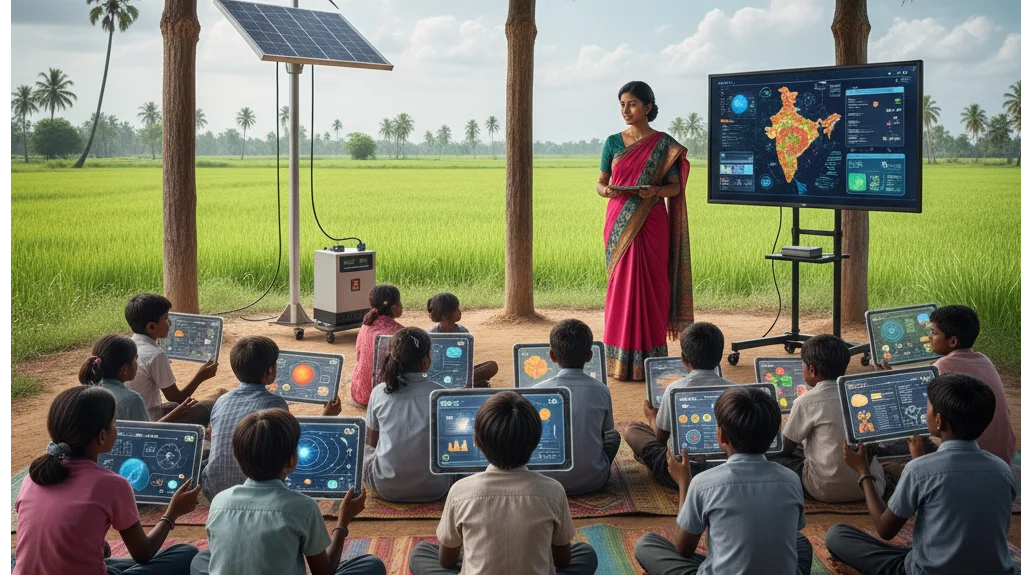
The integration of advanced technologies in rural education is reshaping how children learn across India. Initiatives such as 7D VR labs and AI-assisted learning applications are no longer exclusive to well-resourced private institutions or universities. Instead, they are being implemented by dedicated educators in government and rural schools. These educators are aiming to provide students with experiences that were previously inaccessible, ultimately enhancing their learning outcomes.

Successful Innovations by Indian Educators

One notable educator is Rajesh Kouluri from Andhra Pradesh, who has developed the Hello Dhruthi AI-based learning application. This interactive platform has facilitated advanced learning for over 15,700 students in more than 2,574 schools. Additionally, his WhatsApp Quiz Bot has benefited another 21,000 students. Kouluri’s digital ecosystem, branded as RAJCLASSROOM, has reached over 2.5 million teachers, while his digital pedagogy programmes have trained more than 2 lakh educators.

Similarly, Nitinkumar Mahendrakumar Pathak in Gujarat has transformed Rangpur Primary School in Vansda into a tech-savvy educational environment. The school now boasts a 45-computer IT lab, a 7D VRAR lab, an offline server intended for educational uses, and a journalism studio named R NEWS. Pathak’s initiative highlights the importance of exposing students at an early stage to technologies that can enrich their learning experience.

In Chandigarh, science educator Ravi Jaiswal has introduced a different approach by establishing a CV Raman Dome Theatre and a Mobile Science Lab on a cart, along with an outdoor Science and Knowledge Park created with recycled materials. These innovations prompt students to engage with scientific concepts in a tangible way, moving beyond traditional instructional methods. Meanwhile, Anil Kaushik from Haryana constructed a Mathematics Lab with over 40 teaching models and developed a Virtual Mathematics Lab comprising interactive puzzles to make learning more engaging for students struggling with abstract concepts.

Leveraging Digital Content for Expanded Access

The effective use of digital content has proven essential in ensuring that valuable lessons do not end when the school day concludes. Vartika Gulati, a Mathematics and Science teacher in Rajasthan, has produced over 200 e-content modules for various educational platforms, including DIKSHA and PM eVidya. Her innovative teaching strategies remain cost-effective, employing relatable materials like groundnuts and kites to teach concepts like algebra and geometry. This approach reinforces the idea that digital resources can complement rather than replace traditional teaching.

In West Bengal, Palash Chowdhury has further advanced the digital landscape within his primary school by incorporating biometric systems, app-based communication with parents, smart classrooms, and AR/VR technologies. His commitment to making educational software available in Bengali demonstrates a holistic approach to learning that addresses local needs.

What distinguishes these educators is not merely their use of technology but their strategic application within underprivileged contexts. They are championing the utilisation of advanced tools in settings where access to modern equipment and learning resources is scarce. The National Teacher Awards serve to honour these educators for recognising students’ unmet needs and striving to create solutions to bridge the educational gap.

Long or Short, get news the way you like. No ads. No redirections. Download Newspin and Stay Alert, The CSR Journal Mobile app, for fast, crisp, clean updates!

App Store –  https://apps.apple.com/in/app/newspin/id6746449540 

Google Play Store – https://play.google.com/store/apps/details?id=com.inventifweb.newspin&pcampaignid=web_share

Latest News

Popular Videos
