


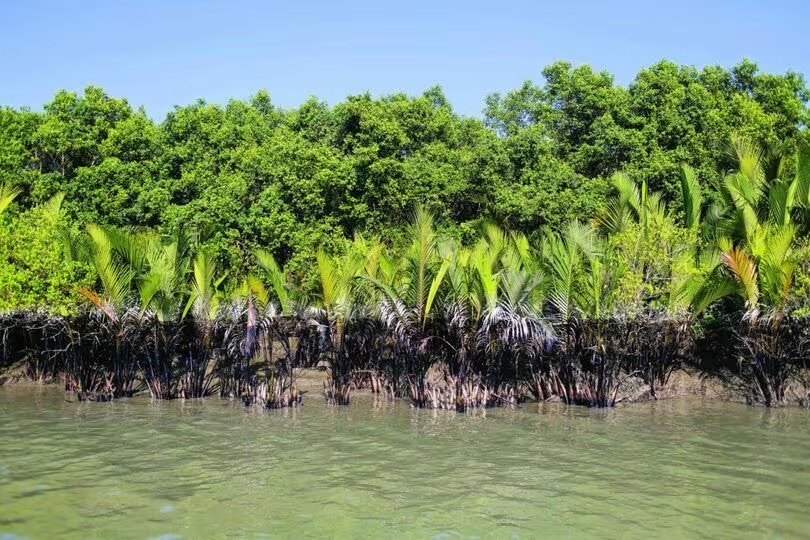

The National Green Tribunal (NGT) has expressed alarm regarding the alarming rate of land erosion in the Sundarbans, particularly highlighting the diminishing Ghoramara Island in West Bengal. In its directive, the Tribunal has called upon relevant authorities to devise an extensive and long-term strategy to address the ongoing issue. It emphasized that temporary or makeshift solutions would not suffice in resolving the critical problem of land loss. This matter was initiated by the Tribunal on its own accord, prompted by a news article indicating that nearly 40% of Ghoramara Island may disappear by the year 2042.
Tribunal Observations on Environmental Issues
A bench featuring Justice Prakash Shrivastava, Chairperson, alongside Dr. Afroz Ahmad, Expert Member, stated that the coastal erosion affecting this region demands immediate and systematic interventions. During the proceedings, representatives from the West Bengal government informed the Tribunal that the Gangetic delta is presently confronting severe erosion prompted by multiple factors, such as natural geological alterations, rising sea levels, frequent cyclones, and diminished sediment supply resulting from upstream dam constructions. The studies presented showcased the vulnerability of numerous islands within the Sundarbans, noting that several had already vanished over time.
Statistical Data on Land Loss
The Geological Survey of India (GSI) submitted findings revealing that the Indian segment of the Sundarbans has experienced a loss exceeding 250 square kilometers of land between the years 1969 and 2019. Specifically, Ghoramara Island has seen its land area decrease from 8.59 square kilometers in 1969 to just 3.83 square kilometers by 2019. The GSI attributes this significant reduction to a combination of rising sea levels, regional subsidence, strong tidal currents, and recurrent cyclonic storms.
Government Measures and Tribunal’s Findings
While the West Bengal Coastal Zone Management Authority briefed the Tribunal on various initiatives undertaken in recent years—including repairs to embankments, anti-erosion projects, and measures for reinforcement—the NGT concluded that no cohesive long-term strategy has been recorded for the safeguarding of mangroves or for curtailing coastal erosion. The Tribunal remarked that such ad-hoc approaches would not yield sustainable outcomes in the face of escalating environmental threats.
Formation of a Joint Committee for Long-term Strategy
In light of these findings, the NGT has established a Joint Committee that includes the Director General of Forests from the Regional Office of the Ministry of Environment, Forest and Climate Change based in Bhubaneswar, and the Principal Chief Conservator of Forests for West Bengal. The Committee’s mandate is to formulate a detailed plan aimed at preserving mangrove forests, implementing effective measures to control coastal erosion, augmenting mangrove cover, and identifying necessary funding, responsible agencies, and timelines for execution. A period of three months has been allocated for the Committee to submit its comprehensive report. The Tribunal plans to revisit the matter for further examination on May 28, 2026.
Long or Short, get news the way you like. No ads. No redirections. Download Newspin and Stay Alert, The CSR Journal Mobile app, for fast, crisp, clean updates!
App Store – https://apps.apple.com/in/app/newspin/id6746449540
Google Play Store – https://play.google.com/store/apps/details?id=com.inventifweb.newspin&pcampaignid=web_share