


Rajnath Singh Lays Foundation for Advanced Naval Testing Facility in Vizag
The CSR Journal Magazine

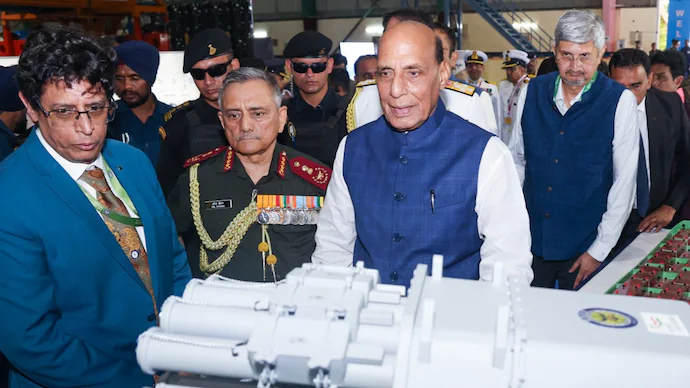
On February 1, 2025, Defence Minister Rajnath Singh inaugurated the foundation for a state-of-the-art Large Cavitation Tunnel (LCT) at the Naval Science and Technological Laboratory (NSTL) in Visakhapatnam. This initiative is a pivotal move aimed at enhancing India’s naval research and testing capabilities.

The facility is being developed under the auspices of the Defence Research and Development Organisation (DRDO) and seeks to bolster indigenous capabilities in hydrodynamic research. The goal is to mitigate reliance on foreign testing infrastructure, thereby fostering self-sufficiency in naval technology.

During the ceremony, Singh remarked that the project would empower India to design, develop, and test its own naval equipment, systems, and sub-systems using domestic resources. He indicated that this facility will play a crucial role in submarine and ship design, propulsion systems, noise reduction, and stealth capabilities.

Alignment with National Security Vision

Singh emphasised that the project embodies Prime Minister Narendra Modi’s vision of Aatmanirbhar Bharat, directly linking self-reliance with national security. He acknowledged the contributions of domestic industries, academic institutions, small and medium enterprises (MSMEs), and the scientific community in propelling India toward technological independence.

During his visit, Singh received insights on ongoing projects from DRDO Chairman Samir V Kamat, along with senior officials present at the event. He also toured the Seakeeping and Manoeuvring Basin, where advanced underwater technologies such as torpedoes, naval mines, decoys, and autonomous underwater vehicles (AUVs) were presented.

A live demonstration of a swarm of man-portable AUVs showcased India’s advancements in autonomous maritime operations and next-generation underwater warfare technologies. The Defence Minister evaluated the outcomes of the materials cluster labs associated with naval systems following Operation Sindoor.

Future Implications and Operational Readiness

In his address, Singh praised NSTL’s work in developing torpedo systems, underwater mines, decoys, and AUVs. He highlighted the significance of advancements in swarm technology and lithium-ion battery development for the future preparedness of India’s naval operations.

Singh noted that the development of reliable and robust technological systems is essential for enhancing the confidence and operational effectiveness of personnel stationed at sea. He was accompanied by Chief of Defence Staff Anil Chauhan, Chief of Naval Staff Dinesh K Tripathi, and Flag Officer Commander-in-Chief of the Eastern Naval Command Sanjay Bhalla, among other senior officials.

Conceived as a strategic national asset, the Large Cavitation Tunnel project is being executed on a turnkey basis with international collaboration, combining foreign expertise with local innovation. Once operational, this facility is anticipated to significantly strengthen India’s shipbuilding ecosystem, allowing for precise validation of hydrodynamic designs and propulsion systems for major naval platforms, including destroyers and aircraft carriers.

Long or Short, get news the way you like. No ads. No redirections. Download Newspin and Stay Alert, The CSR Journal Mobile app, for fast, crisp, clean updates!

App Store –  https://apps.apple.com/in/app/newspin/id6746449540 

Google Play Store – https://play.google.com/store/apps/details?id=com.inventifweb.newspin&pcampaignid=web_share

Latest News

Popular Videos
