



app-store-logo
play-store-logo
January 20, 2026

Personal Welcome, Strategic Gains: India–UAE Set $200 Billion Trade Target

The CSR Journal Magazine

India and the United Arab Emirates have agreed to work towards doubling bilateral trade from $100 billion to $200 billion by 2032, while significantly expanding cooperation in defence, energy, and advanced technologies. The understanding was reached during a brief but high-impact visit by UAE President Sheikh Mohamed bin Zayed Al Nahyan to New Delhi on Monday, reflecting the growing strategic weight of ties between the two countries.

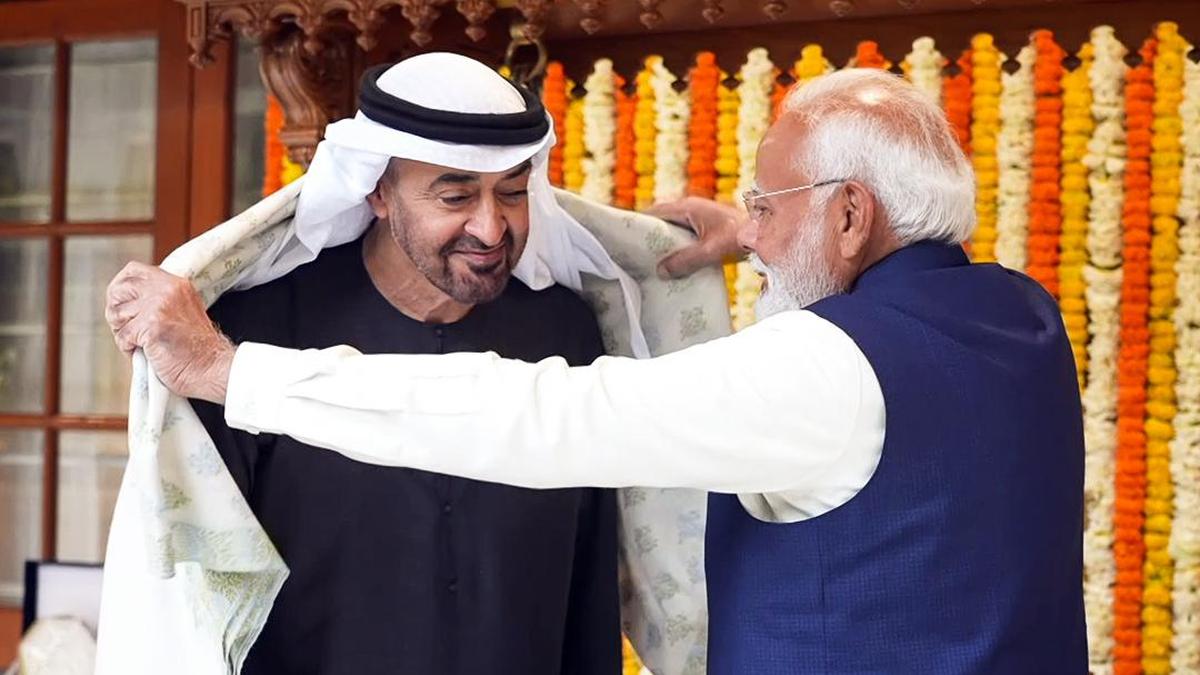
Prime Minister Narendra Modi personally welcomed the visiting leader at Palam Air Base, an unusual diplomatic gesture that underlined the importance India attaches to its partnership with Abu Dhabi. The two leaders travelled together to the Prime Minister’s residence, where they held talks lasting around two hours.

The visit resulted in a series of outcomes, including a long-term LNG supply arrangement, agreements to strengthen defence and space cooperation, and a reaffirmation of shared positions on regional and global issues. Officials described the discussions as forward-looking, with a focus on long-term strategic alignment rather than short-term transactional gains.

High-Level Diplomacy Amid Regional Tensions

Sheikh Mohamed’s visit came against the backdrop of heightened geopolitical volatility in West Asia, marked by strained Iran–US relations, continuing instability in Gaza, and lingering tensions in Yemen. Regional security and stability featured prominently in the talks, with both leaders exchanging assessments of developments in the Middle East and their potential global implications.

“Went to the airport to welcome my brother, His Highness Sheikh Mohamed bin Zayed Al Nahyan, President of the UAE. His visit illustrates the importance he attaches to a strong India–UAE friendship,” Modi said in a post on social media platform X following the meeting.

The UAE President also conveyed support for India’s upcoming chairmanship of BRICS in 2026 and for the AI Impact Summit that India is set to host. Officials said the exchanges reflected a convergence of views on the need for dialogue, stability, and economic cooperation in an increasingly fragmented global order.

Trade Expansion and Energy Security

A central outcome of the visit was the decision to set a $200 billion bilateral trade target by 2032, building on rapid growth since the signing of the Comprehensive Economic Partnership Agreement in 2022. According to India’s Ministry of External Affairs, two-way trade crossed the $100 billion mark in the 2024–25 financial year, making the UAE India’s third-largest trading partner. India, in turn, is the UAE’s second-largest trading partner.

The trade expansion is expected to be driven by non-oil sectors, including manufacturing, services, digital trade, logistics, and food security. Both sides also underscored the importance of investments in infrastructure and industrial corridors, with UAE sovereign wealth funds already playing a significant role in India’s ports, airports, and renewable energy projects.

Energy cooperation remains a cornerstone of the relationship. During the visit, the two sides agreed to a long-term LNG supply arrangement for 0.5 million tonnes annually. The UAE continues to be among India’s top suppliers of crude oil, LNG, and LPG, providing a measure of stability to India’s energy security amid global market uncertainty.

Defence and Space Cooperation

Defence and security cooperation emerged as a key pillar of the evolving partnership. A Letter of Intent was signed to work towards a framework agreement for a strategic defence partnership, covering areas such as joint exercises, training, and defence manufacturing. Officials indicated that the agreement could open the door for co-development and co-production of defence equipment, aligning with India’s push for greater self-reliance in defence.

The two countries also agreed to pursue joint initiatives in space infrastructure development, signalling intent to collaborate in high-technology domains beyond traditional areas of engagement. This builds on growing cooperation in emerging technologies, including artificial intelligence and advanced manufacturing.

The visit followed a series of recent high-level exchanges, including trips to India by Abu Dhabi Crown Prince Sheikh Khaled in September 2024 and UAE Deputy Prime Minister and Defence Minister Sheikh Hamdan in April 2025, highlighting sustained momentum in bilateral ties.

Symbolism and People-to-People Ties

This was Sheikh Mohamed’s third official visit to India since assuming the presidency and his fifth visit over the past decade. The emphasis on symbolism was evident, with Modi presenting the UAE President with traditional Indian gifts, including a carved wooden jhula from Gujarat and a Pashmina shawl in an ornate silver box crafted in Telangana.

Officials said people-to-people ties remain the bedrock of the relationship, with over 3.5 million Indians living and working in the UAE. As both countries seek to navigate economic transformation and regional uncertainty, the latest agreements point to a partnership that is broadening in scope and deepening in strategic intent, with trade, defence, energy, and technology at its core.

Long or Short, get news the way you like. No ads. No redirections. Download Newspin and Stay Alert, The CSR Journal Mobile app, for fast, crisp, clean updates!

App Store –  https://apps.apple.com/in/app/newspin/id6746449540 

Google Play Store – https://play.google.com/store/apps/details?id=com.inventifweb.newspin&pcampaignid=web_share

Latest News

Popular Videos